

 AR
AR
 NL
NL
 FR
FR
 DE
DE
 ES
ES
 IT
IT
 PL
PL
 SV
SV
 PT
PT

Choosing the right trading platform is a critical first step for any day trader, as laggy software or high fees can quickly turn a winning strategy into a losing one. This guide cuts through the marketing hype to compare the best trading platforms for day traders, focusing on the practical details that directly impact your performance. You’ll get a clear, honest breakdown of features, costs, and the specific use case for each platform.
1. MyFundedCapital
MyFundedCapital is not a traditional broker but a proprietary trading firm offering skilled traders a path to trade significant simulated capital. Its standout feature is an Instant Funding program, which allows traders to bypass a lengthy evaluation and get immediate access to up to $100,000 in a simulated trading account. This makes it a strong choice for day traders who have a proven strategy and are ready to scale without risking their own funds.

The platform supports a diverse range of trading styles through its integration with DXtrade, cTrader, and Match-Trader, providing robust tools for discretionary and algorithmic traders. With over 300 tradable instruments including Forex, indices, metals, and crypto, traders have ample opportunity to deploy their strategies across various market conditions.
Key Differentiators and Use Cases
MFC’s strength lies in its customizable accounts. Traders can purchase add-ons like weekend holding, news trading, and payout-on-demand, features often restricted by other prop firms. This flexibility is valuable for swing traders and those whose strategies rely on high-volatility events. For those new to this model, you can learn more about how funded trading accounts work on MyFundedCapital.com.
The firm’s risk rules (e.g., 5% daily drawdown, 6–10% max drawdown) create a structured trading environment. The profit-sharing model is highly competitive, allowing traders to keep up to 100% of their profits via paid upgrades.
- Best For: Traders with a proven strategy who want to access larger capital without risking their own money.
- Pricing: One-time fees for challenges and instant funding accounts, starting from around $225 for a $15k account. Add-ons cost extra.
- Pros: Instant funding option, high profit splits (up to 100%), and flexible rules with add-ons.
- Cons: All trading is done in a simulated environment for evaluation; strict drawdown rules are enforced.
- Website: https://myfundedcapital.com
2. Interactive Brokers
Interactive Brokers (IBKR) is a top-tier platform for professional and high-volume day traders who need institutional-grade tools. It is known for its direct market access, extremely low commissions for active traders, and advanced order types. Its SmartRouting technology automatically searches for the best price across multiple exchanges, which is critical for strategies where every fraction of a cent counts.
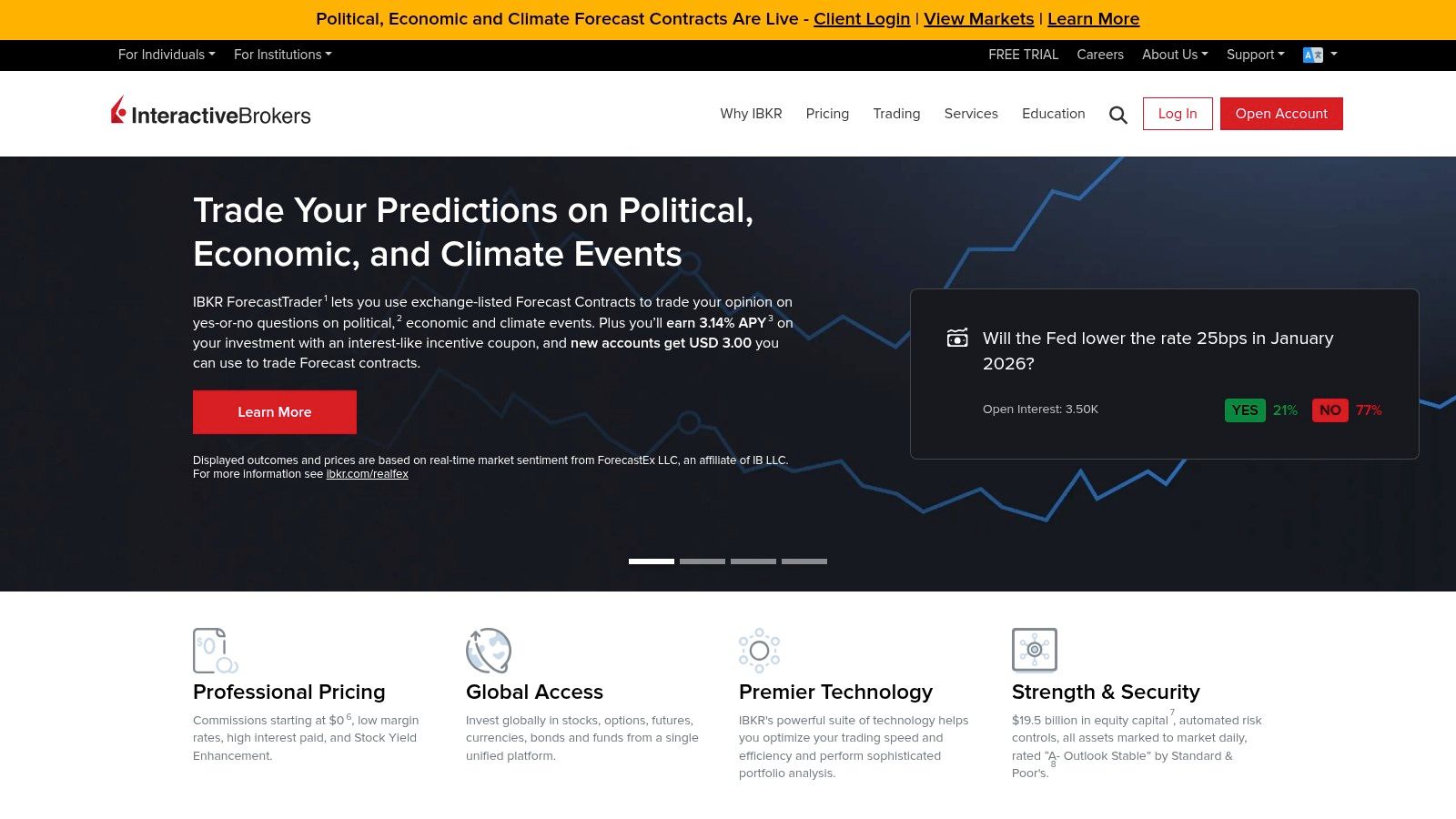
The Trader Workstation (TWS) desktop platform is powerful, offering algorithmic trading capabilities and access to over 160 global markets. This makes IBKR one of the best trading platforms for day traders who need to trade stocks, options, futures, and forex from a single account.
Key Considerations
- Pricing: The IBKR Pro plan offers tiered commissions that can be as low as $0.0005 per share for stocks, rewarding high-volume traders. However, data and exchange fees can add up.
- User Experience: TWS is built for function, not simplicity. It has a steep learning curve that may intimidate beginners but empower experienced traders.
- Prop Firm Compatibility: Many prop firms, including MyFundedCapital, rely on IBKR’s robust infrastructure for their trading challenges. Learn more about how prop firms use Interactive Brokers for their challenges.
- Best For: Experienced, high-volume, and algorithmic traders.
- Website: https://www.interactivebrokers.com
3. Charles Schwab (thinkorswim)
With Schwab’s acquisition of TD Ameritrade, the legendary thinkorswim platform is now available to Schwab clients. It’s a fantastic choice for technical day traders, particularly in stocks and options, known for its institutional-grade charting and strategy-testing tools—all without a platform fee. Its paperMoney simulator provides a realistic environment to practice strategies without risking real capital.

The thinkorswim platform offers seamless access to stocks, complex options, futures, and forex. Features like advanced market scanners and 24/5 trading on select ETFs are designed for active traders. For those who prioritize deep analytical power, thinkorswim is one of the best trading platforms for day traders who want professional tools from a major brokerage.
Key Considerations
- Pricing: Schwab offers $0 online commissions for U.S. stocks and ETFs. Options contracts are $0.65 per contract, which is competitive but not the absolute lowest.
- User Experience: The desktop platform is incredibly powerful but can be resource-intensive and presents a significant learning curve.
- Best For: Technical and options-focused day traders who want elite tools without platform fees.
- Website: https://www.schwab.com/trading/thinkorswim
4. Fidelity (Trader+ / Active Trader)
Fidelity’s Trader+ platform is an excellent choice for active traders who want the security and research of a major brokerage combined with modern, robust trading tools. It stands out with a seamless experience across desktop and mobile, allowing traders to manage their workflow on the go. Backed by Fidelity’s powerful execution engine, it provides a reliable environment for making fast-paced decisions.
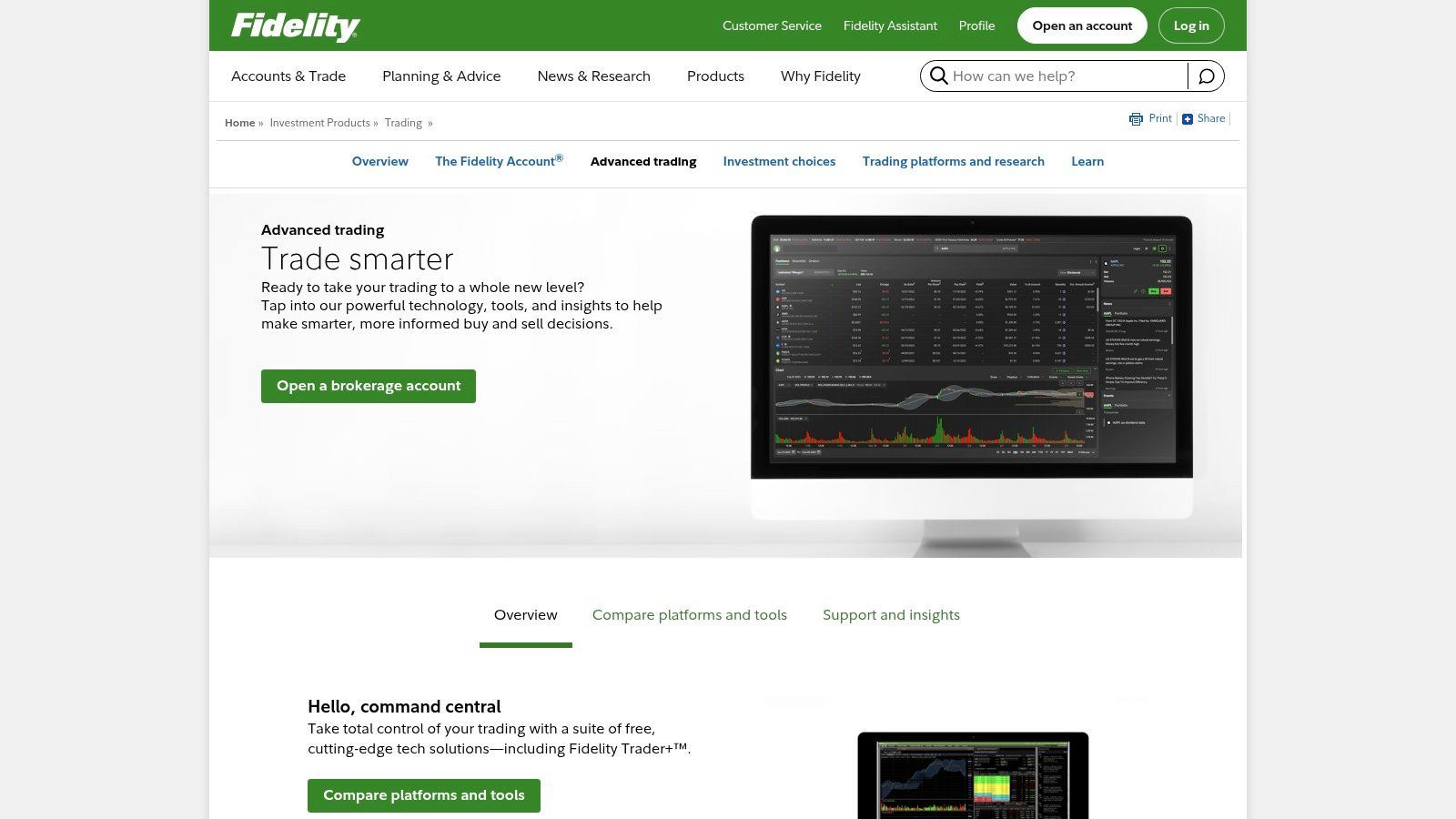
The platform is designed with streaming data and advanced charting, making it one of the best trading platforms for day traders who value stability and performance. Features like integrated options tools and customizable alerts help traders monitor market movements effectively.
Key Considerations
- Pricing: Trader+ is free to use, and Fidelity offers $0 commissions on U.S. stock and ETF trades. Options contracts have a per-contract fee.
- User Experience: The platform is more intuitive than traditional broker software, blending advanced functionality with a user-friendly interface suitable for intermediate traders.
- Prop Firm Compatibility: Fidelity is a retail brokerage and is generally not used by prop firms for trading challenges.
- Best For: Active retail traders seeking a reliable all-in-one platform with strong research tools.
- Website: https://www.fidelity.com/trading/active-trader
5. TradeStation
TradeStation has long been a favorite among serious day traders due to its powerful desktop software and sophisticated analytical tools. It excels in systematic trading with robust back-testing capabilities and its proprietary EasyLanguage, which allows traders to build, test, and automate their own custom strategies without being an expert programmer.
The platform’s desktop environment is its main draw, featuring tools like RadarScreen for real-time market scanning and OptionStation Pro for advanced options analysis. The Matrix tool offers an integrated order-entry and tracking system directly from a market depth window, providing the speed essential for day trading.
Key Considerations
- Pricing: TradeStation offers several commission plans, including TS SELECT with zero-commission stock trades. Active traders can benefit from tiered pricing that rewards high volume.
- User Experience: The desktop platform is feature-rich but can be complex for newcomers. It is designed for traders who prioritize deep analytical capabilities.
- Best For: Systematic and quantitative traders who build, back-test, and automate their strategies.
- Website: https://www.tradestation.com
6. Lightspeed
Lightspeed is a direct-access broker built for one thing: speed. This makes it a top choice for professional day traders, scalpers, and institutional clients. Its core advantage is low-latency execution and advanced order routing, allowing traders to control exactly where their orders are sent. This is crucial for strategies that rely on capturing liquidity rebates and minimizing slippage.
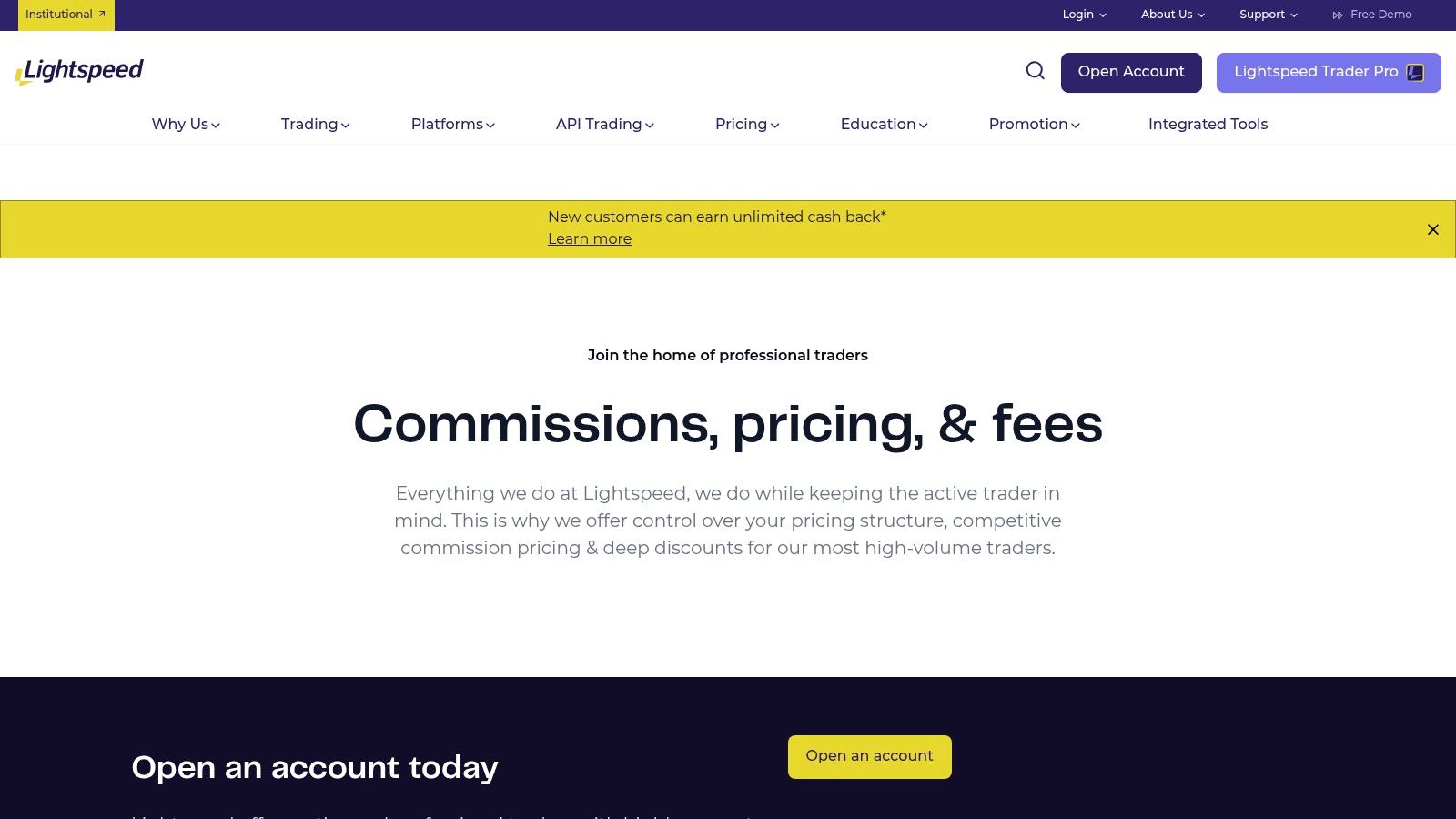
Traders can choose from several high-performance platforms, including Lightspeed Trader, known for stability and extensive hotkey customization. This focus on a professional desktop experience, combined with competitive, volume-tiered pricing, makes it a powerful tool for those executing many trades daily.
Key Considerations
- Pricing: Lightspeed offers highly competitive per-share pricing that can drop as low as $0.001 for high-volume equity traders. Options contracts can be as little as $0.20 per contract.
- User Experience: The platform is engineered for performance, not simplicity. Like other professional tools, there is a steep learning curve.
- Best For: Active stock and options scalpers and professional day traders.
- Website: https://lightspeed.com/pricing-fees
7. tastytrade
tastytrade is an options-centric brokerage designed by traders, for traders. It provides a fast, purpose-built platform and practical education for day traders who favor options and futures. Its interface is engineered for speed, making it simple to construct and manage complex multi-leg options strategies.
The platform’s transparent pricing and strong educational content, delivered through its affiliate tastylive, make it one of the best trading platforms for day traders looking to expand their skills in options. The content focuses on volatility and strategy, offering actionable insights.
Key Considerations
- Pricing: Highly competitive for active traders. Stock and ETF trades are $0, while options are $1 to open and $0 to close, capped at a maximum of $10 per leg.
- User Experience: The platform is intuitive and built for rapid order entry, but its strong focus on options may present a learning curve for newcomers.
- Best For: Active options and futures day traders.
- Website: https://tastytrade.com
8. NinjaTrader
NinjaTrader is a futures-focused platform built for active day traders specializing in markets like the E-mini S&P 500. It stands out for its high-performance charting, extensive customization through add-ons, and very low day-trading margins. This makes it one of the best trading platforms for day traders who prioritize advanced technical analysis and rapid order execution in the futures markets.
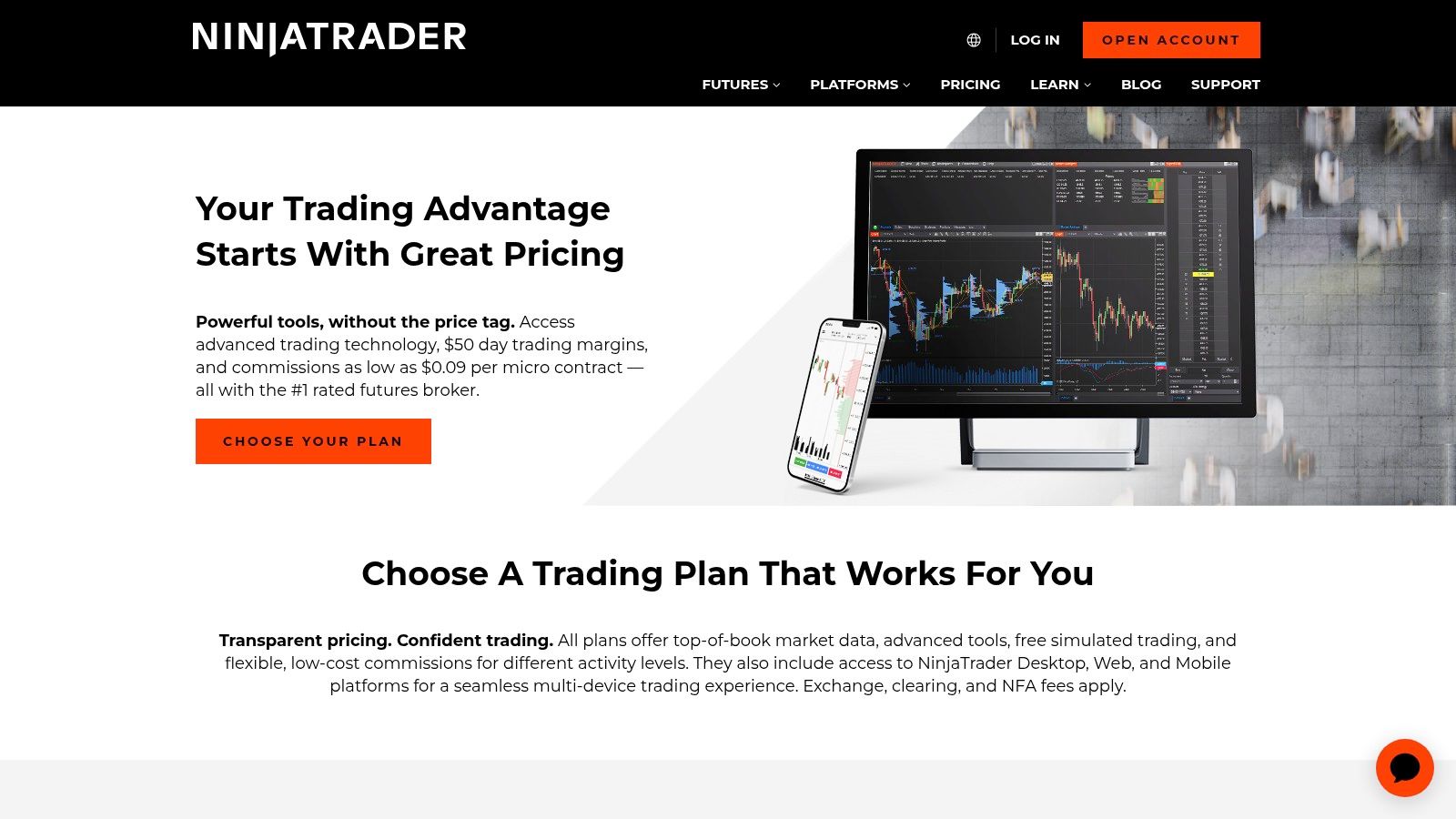
The platform empowers traders with its C#-based framework, allowing for the development of automated strategies and custom indicators. Its free simulation environment is a key feature, allowing traders to practice with professional-grade tools before committing real capital.
Key Considerations
- Pricing: NinjaTrader offers multiple models, including a “Free” license (with higher commissions) and paid/lifetime licenses that unlock lower commissions. For example, a lifetime license is a one-time payment of $1,499.
- Tools: Its Strategy Builder and backtesting engine are top-tier. Access to low day-trade margins (e.g., $50 for micro contracts) is a major draw.
- Best For: Dedicated futures traders, scalpers, and algorithmic strategy developers.
- Website: https://ninjatrader.com/pricing
9. Webull
Webull is popular among retail day traders for offering a powerful, modern platform with a commission-free pricing model. It stands out by providing advanced features like complimentary real-time Level 2 market data without the hefty fees of professional platforms. This makes it an excellent entry point for cost-sensitive traders who need more than a basic mobile app.
The platform offers a seamless experience across desktop and mobile, featuring robust charting tools, paper trading to test strategies risk-free, and extended trading hours. For those looking for one of the best trading platforms for day traders that balances powerful features with zero commissions, Webull is a compelling option.
Key Considerations
- Pricing: Offers $0 commission trading on U.S. stocks, ETFs, and most options.
- User Experience: The interface is clean and intuitive, making it far more approachable for beginners than complex platforms.
- Prop Firm Compatibility: Webull is a retail-focused broker and is not typically used by prop firms for trading challenges.
- Best For: New to intermediate day traders and cost-sensitive traders.
- Website: https://www.webull.com
10. Robinhood
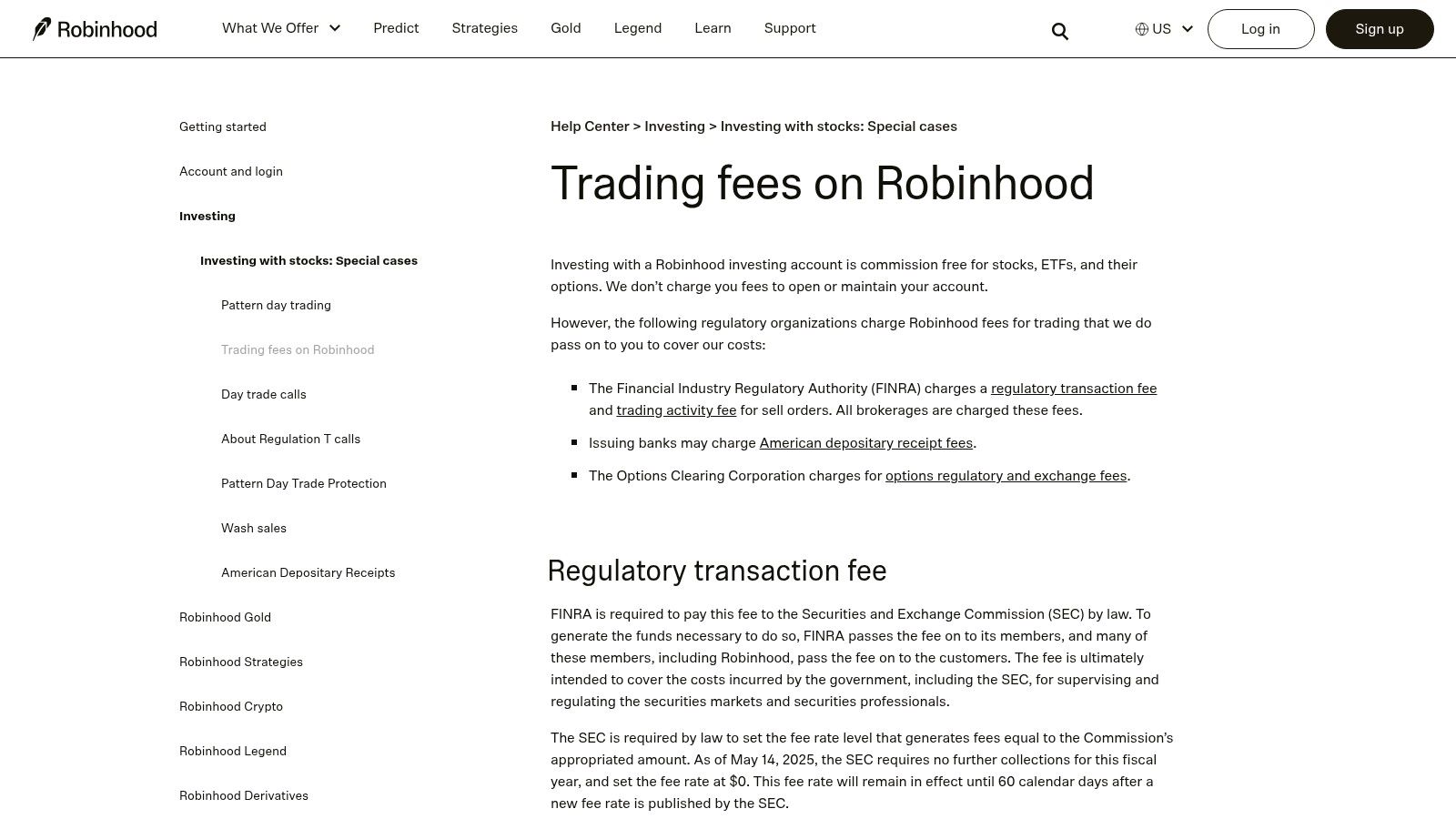
Robinhood has evolved from a simple mobile app into a more capable platform for active traders, making it a good option for those prioritizing simplicity and low costs. It offers zero-commission trading on stocks, ETFs, and options, appealing to fee-sensitive day traders. The platform has also expanded to include futures and index options trading.
The platform is best known for its clean, intuitive user interface, which lowers the barrier to entry for new traders. While it may not have the institutional-grade tools of a direct-access broker, its Robinhood Gold subscription adds valuable perks like higher instant deposit limits and attractive yields on uninvested cash.
Key Considerations
- Pricing: Core trading of stocks, ETFs, and options is commission-free, though regulatory fees still apply.
- User Experience: The platform offers one of the cleanest and most straightforward user experiences on both mobile and desktop.
- Tools: Its toolset for advanced order routing and in-depth analysis is less mature than professional-grade platforms.
- Best For: Cost-conscious retail traders and those who value a simple user experience.
- Website: https://robinhood.com/support/articles/trading-fees-on-robinhood/
11. TradingView
TradingView is not a standalone brokerage but a universal charting and analysis platform that has become essential for technical day traders. It excels with its browser-based platform, offering intuitive and powerful charts. Its strength lies in its social features, including a massive library of community-built indicators using its Pine Script language, and the ability to connect to various brokers for direct trade execution.

For day traders, TradingView serves as a central hub for market analysis and idea generation. It is one of the best trading platforms for day traders who prioritize charting quality, using it for analysis while routing orders through an integrated broker.
Key Considerations
- Pricing: Operates on a freemium model. A free plan is available, while paid tiers (starting around $14.95/month) unlock more indicators, multi-chart layouts, and alerts. Real-time data for specific exchanges often requires separate monthly subscriptions.
- User Experience: Exceptionally user-friendly, setting the industry standard for web-based charting.
- Prop Firm Compatibility: Many traders in prop firm challenges use TradingView for analysis before placing trades on their prop firm’s designated platform. Find out more about which platforms are compatible with prop firm trading.
- Best For: Technical analysts and chart-focused traders.
- Website: https://www.tradingview.com/pricing
12. DAS Trader
DAS Trader is a professional-grade, direct-access trading software built for speed and precision, making it a go-to choice for serious day traders, scalpers, and proprietary trading firms. It excels in ultra-fast order entry, powered by customizable hotkeys and advanced montage windows. The platform is designed for traders who rely on Level II data and keyboard-driven execution.
Unlike all-in-one brokers, DAS Trader is dedicated software that connects to a compatible broker. This focus on performance gives it an edge, offering advanced route control and direct access to market depth feeds.
Key Considerations
- Pricing: Operates on a subscription model, with monthly fees for the software (around $150/month) and additional costs for market data feeds.
- User Experience: The interface is highly functional but has a steeper learning curve. It is built for efficiency, not aesthetics.
- Prop Firm Compatibility: Many prop firms favor DAS Trader due to its professional-grade execution, making it a common platform for funded trader programs.
- Best For: Active equity day traders, scalpers, and proprietary trading firms.
- Website: https://dastrader.com
A Step-by-Step Guide to Choosing Your Platform
The “best” platform depends entirely on your personal trading style, experience, and goals. Follow this checklist to make an informed decision:
- Assess Your Primary Market: Are you trading stocks, futures, forex, or options?
- Futures: NinjaTrader is a specialized leader.
- Options: tastytrade and thinkorswim offer superior tools.
- Stocks/Equities: Lightspeed and DAS Trader are built for speed.
- All-in-One: Interactive Brokers and Schwab cover all bases.
- Evaluate Your Budget for Fees: How sensitive are you to costs?
- Lowest Cost: Webull and Robinhood offer commission-free trading.
- Volume Discounts: Interactive Brokers and Lightspeed reward active traders with very low per-share rates.
- Platform Fees: Be aware of monthly software and data fees with platforms like DAS Trader and TradingView’s premium plans.
- Test the Software (Demo Trading): Before committing real money, always use a demo or paper trading account.
- Check for execution speed during volatile market hours.
- Ensure the charting tools and order entry process feel intuitive to you.
- Confirm you can set up your workspace exactly how you like it.
- Consider Your Long-Term Goals: Do you plan to trade with your own capital or seek funding?
- If your goal is to get funded, your choice is limited to platforms compatible with prop firms, like those offered by MyFundedCapital.
- If you are building your own retail account, a major brokerage like Schwab or Fidelity provides security and a wide range of services.
Choosing your platform is a foundational step. The right software should feel like an extension of your strategy, reducing friction and allowing you to execute with confidence.
Disclaimer: Trading involves a high level of risk and may not be suitable for all investors. Past performance is not indicative of future results. This content is for educational purposes only and is not financial advice.
Frequently Asked Questions (FAQ)
What is the most important feature for a day trading platform?
For most day traders, execution speed and reliability are the most important features. Low latency ensures you get the price you want (or very close to it), minimizing slippage. Low commissions and robust charting tools are also critical.
Can I use my phone for day trading?
While most platforms offer powerful mobile apps, day trading seriously usually requires a desktop setup. A larger screen (or multiple monitors) allows you to view charts, Level 2 data, and order entry windows simultaneously, which is difficult on a small phone screen.
Do I need to pay for market data?
It depends. Brokers like Webull provide free Level 2 data, which is a huge benefit for beginners. However, professional-grade platforms like DAS Trader or Lightspeed often require paid monthly subscriptions for premium data feeds from specific exchanges (e.g., NASDAQ TotalView), which can cost $20-$150+ per month.
What is the difference between a broker and a prop firm?
A broker (like Interactive Brokers or Fidelity) is a company that executes trades on your behalf using your own money. A prop firm (like MyFundedCapital) provides you with access to trade its simulated capital after you pass an evaluation. If you are profitable, you share the profits with the firm, but you don’t risk your own funds in live trades.
Take the Next Step
Ready to trade on a professional platform without risking your own capital? MyFundedCapital offers a range of funding programs designed to give skilled traders the backing they need.
Compare our funding account types and start your challenge today.
