

 AR
AR
 NL
NL
 EN
EN
 FR
FR
 DE
DE
 ES
ES
 IT
IT
 PL
PL
 SV
SV

Entering a trade is easy, but knowing when to get out is what separates consistently profitable traders from the rest. Mastering the Take Profit (TP) and Stop Loss (SL) isn't just a technical skill—it's the core of disciplined risk management. This guide breaks down exactly how to use these essential orders to protect your capital and systematically secure profits, without the hype.

Why Your Exits Matter More Than Your Entries
Let's be direct: emotional trading is a fast track to draining your account. Long-term success comes from a rules-based approach. While finding the perfect entry feels like the main event, it’s your exit strategy—defined by your take profit and stop loss orders—that ultimately determines your profitability.
Think of these orders as your pre-trade safety checks.
- A Take Profit order is your planned exit for a winning trade. It automatically closes your position when the price hits a predetermined target, ensuring you lock in gains before the market can reverse.
- A Stop Loss order is your safety net. It automatically closes a losing trade at a specific price, preventing a small, manageable loss from becoming a major financial blow.
By setting these levels before you enter a trade, you are making a logical decision while your mind is clear. You are not reacting to the fear or greed that inevitably kicks in when real money is on the line. This discipline is a non-negotiable trait for any serious trader, especially those aiming to get funded.
Understanding Your Core Trading Tools
These aren't just optional features on your trading platform; they are the foundation of any sound trading plan. They are automated instructions that execute without your manual input, taking emotion out of the equation when it matters most.
The Stop Loss: Your Defensive Line
A Stop Loss (SL) is an order that automatically closes your position if the market moves against you by a certain amount. It's your line in the sand. Its sole purpose is to protect your capital from significant damage.
Trading without a stop loss is not a strategy; it's gambling. One unexpected market move can cause a catastrophic loss, potentially wiping out your account. A stop loss turns a speculative bet into a calculated risk with a clearly defined maximum loss.
Remember: A stop loss isn't an admission of failure. It's a tool used by professionals who understand that small, controlled losses are a necessary part of trading.
The Take Profit: Your Offensive Strategy
A Take Profit (TP) order is your pre-planned exit for a winning trade. This order automatically closes your position once it reaches your profit target, securing your gains.
It’s tempting to let a winning trade run, hoping for more profit. This is greed, and it often leads to watching a profitable position reverse back to breakeven or even a loss. A take profit order enforces discipline, ensuring you stick to the plan you made when you were thinking logically.
Understanding where to place these orders is crucial as it defines your risk-to-reward ratio. To learn more, check out our guide on how to calculate risk-reward ratio.
Stop Loss vs Take Profit At a Glance
Here’s a simple comparison of these two essential orders.
| Feature | Stop Loss (SL) | Take Profit (TP) |
|---|---|---|
| Purpose | To limit potential losses on a trade. | To secure potential profits on a trade. |
| Trigger | Price moves against your position. | Price moves in favor of your position. |
| Psychological Benefit | Mitigates fear and prevents catastrophic loss. | Combats greed and locks in gains systematically. |
A trader who consistently uses both a stop loss and a take profit is removing guesswork and emotion from their exits. This logical, systematic approach is what separates amateurs from professionals. It’s a discipline powered by the robust technology in modern platforms, which often relies on sophisticated data systems, similar to the frameworks behind an Open Banking API integration.
Why Smart Exits Are Non-Negotiable
If you're serious about trading, you must understand that a disciplined exit strategy is everything. Placing a take profit and stop loss order isn't just a setting for a single trade; it's how you manage your entire trading career. Without them, you're not trading—you're gambling.
These orders are the only way to truly calculate your risk-to-reward ratio before you put any money on the line. This metric is the mathematical engine of profitability. It forces you to answer the most important question in trading: "Is the potential reward worth the capital I am about to risk?"
Protecting Your Capital and Your Psychology
First and foremost, a stop loss is about capital preservation. In the world of prop firm trading, this isn't just a good idea; it's a hard rule. Prop firms have strict drawdown limits, and one bad trade without a stop loss can violate those rules and end a challenge or funded account instantly.
A well-placed stop loss is your best defense against a catastrophic loss. It’s an automated circuit breaker that protects your account from serious damage, ensuring you can trade another day.
On the other side, a take profit order is your defense against greed. It mechanically locks in your profits when your analysis is correct. This prevents you from giving back hard-won gains because you were hoping for "a little more." This discipline is what separates pros from speculators.
Conquering Emotional Decision Making
Every trader battles fear and greed. Fear tells you to close winning trades too early, leaving profit on the table. Greed convinces you to hold a losing position, hoping for a miraculous turnaround that rarely comes.
A pre-defined exit plan removes these emotions from the equation. When you set your take profit and stop loss levels during your calm, analytical pre-trade routine, you commit to a logical plan. To dig deeper into this core risk tool, check out our detailed guide on what a stop loss is in trading.
The Statistical Edge of Defined Exits
The power of a structured exit strategy isn't just trading wisdom; it's backed by data. Studies have shown that exit strategies have a significant impact on long-term performance. For example, analysis of market data often reveals that positions with wider take profit targets relative to their stop losses tend to have a higher positive expectancy, as markets can trend further than they reverse. You can find more insights about these historical backtesting findings.
This drives home a critical point: you need a statistically sound reason for where you place your exits. Trading isn't about being right every time. It's about ensuring your wins are large enough to more than cover your inevitable—but strictly controlled—losses.
Practical Methods for Setting Your Orders
Knowing you need a take profit and stop loss is the easy part. The real skill is knowing where to place them. Your exit points shouldn't be arbitrary; they must be based on a logical, repeatable plan that aligns with your strategy and current market conditions.
Here are four reliable techniques you can start using today.
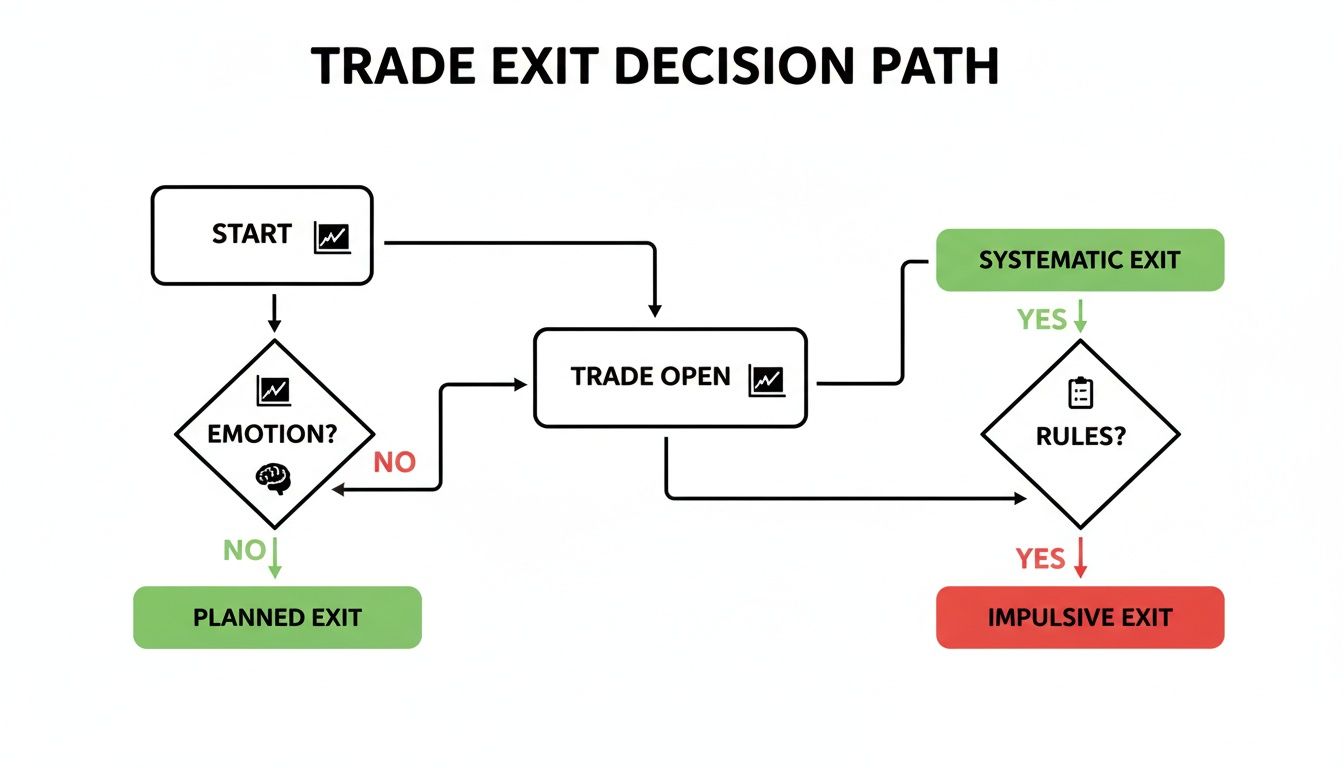
This flowchart illustrates the choice every trader faces: follow a pre-planned, rules-based exit, or react to fear and greed.
1. Using Support and Resistance Levels
This classic technical analysis method uses historical price zones where the market has previously reversed.
- For a Buy Trade (Long):
- Take Profit: Set your TP just below the next clear resistance level.
- Stop Loss: Place your SL just below a solid support level.
- For a Sell Trade (Short):
- Take Profit: Set your TP just above the next clear support level.
- Stop Loss: Place your SL just above a key resistance level.
Pro Tip: Avoid placing your orders exactly on the line. Price often reverses just before hitting these obvious levels. Placing your order slightly inside the level increases the probability of it getting filled.
2. Following Market Structure
This technique uses the recent peaks (swing highs) and valleys (swing lows) of the market to set logical exit points.
- For a Buy Trade: Place your stop loss just below the most recent swing low. Your take profit could target a previous swing high.
- For a Sell Trade: Place your stop loss just above the most recent swing high. Your take profit could target a previous swing low.
Using market structure aligns your exits with the market's natural flow and is particularly effective in trending conditions.
3. The Average True Range (ATR) Method
The ATR indicator measures market volatility. Using it helps you set stops that adapt to the current market environment.
Here’s a practical example:
- Add the ATR indicator to your chart (a 14-period setting is standard).
- Note the current ATR value before entering a trade.
- For your stop loss, multiply the ATR value by a factor (e.g., 2x) and place your stop that distance from your entry.
Example: You want to buy EUR/USD at 1.0850. The current 14-period ATR is 0.0025 (25 pips). Using a 2x multiplier, your stop loss distance is 50 pips (25 pips * 2). You would place your SL at 1.0800.
This method helps prevent your stop from being too tight in a volatile market or too wide in a quiet one.
4. The Fixed Pip or Percentage Method
This is the most straightforward approach: using a fixed value for every trade, such as a 20-pip stop loss or risking exactly 1% of your account.
- Pros: It’s simple, enforces consistency, and makes risk calculation easy.
- Cons: Its main weakness is that it ignores market volatility and context. A 20-pip stop might be suitable for a currency pair but completely inappropriate for a volatile index.
This method is often preferred by systematic or automated traders who prioritize unwavering consistency.
Setting Your Orders on Trading Platforms
Theory is one thing, but execution is what counts. Here’s a practical walkthrough of how to set your take profit and stop loss orders on common trading platforms.
The Order Entry Window
The order entry window is your command center for every trade. It’s where you define your position size, direction, and, most importantly, your exit points.
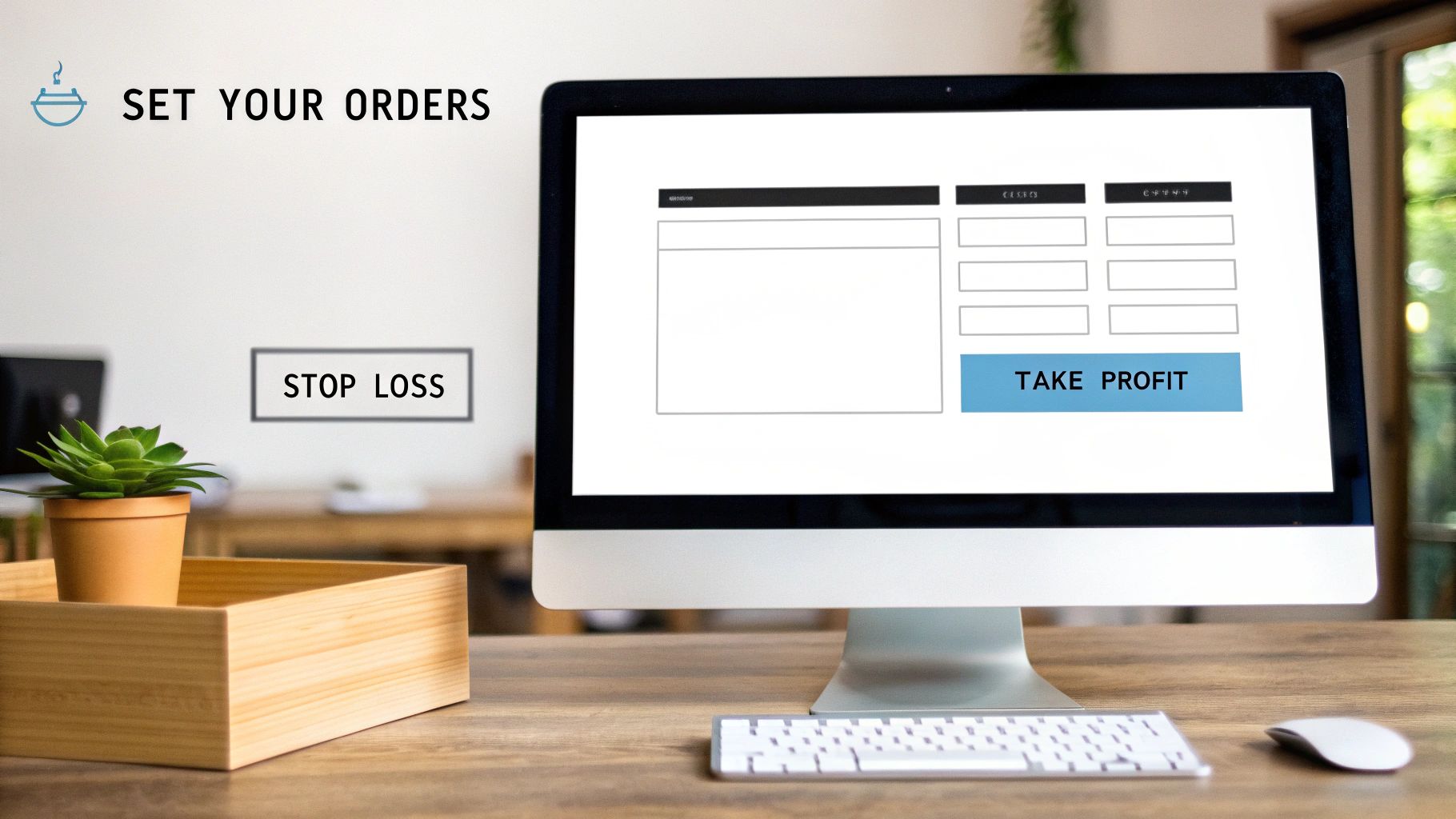
As shown above, you can input the exact price levels for your exit orders before the trade is even live.
A Step-by-Step Guide
While platforms like cTrader, DXtrade, and Match-Trader have different interfaces, the core process is nearly identical. You can explore our platform features for more details on each.
Here is the universal process:
- Open the New Order Window: Choose your asset and open the order ticket.
- Set Trade Parameters: Select order type (market or pending), direction (Buy/Sell), and position size (volume).
- Define Your Stop Loss: In the "Stop Loss" field, enter the exact price where you want to exit if the trade moves against you.
- Define Your Take Profit: In the "Take Profit" field, enter the price where you want to secure your profit.
- Review and Execute: Double-check all parameters to ensure they match your trade plan, then place the trade. Your entry, stop, and target orders are now active.
FAQ: Common Questions About Take Profit and Stop Loss
Here are answers to some of the most common questions beginner and intermediate traders have about setting their exits.
What is a good risk-to-reward ratio?
There is no single "best" ratio; it depends entirely on your strategy's win rate. A common benchmark is a 1:2 risk-to-reward ratio (risking $1 to potentially make $2), which requires you to be right only 34% of the time to break even. However, a high-win-rate scalping strategy might be profitable with a 1:1 ratio, while a low-win-rate trend-following strategy might require 1:3 or higher. The key is that your average wins are larger than your average losses over time.
Should I ever move my stop loss?
The golden rule is: never widen your stop loss once a trade is open. This is a purely emotional decision that turns a calculated risk into a gamble. However, it is a smart practice to tighten your stop loss to protect profits. This can be done by:
- Moving to Breakeven: Once the trade is significantly in profit (e.g., has moved a distance equal to your initial risk), move your stop loss to your entry price. This makes it a "risk-free" trade.
- Trailing Your Stop: Manually or automatically move your stop loss behind the price as it moves in your favor to lock in unrealized gains.
How do news events affect my orders?
High-impact news releases can cause extreme volatility and "slippage," where your stop loss is executed at a worse price than intended. This increases your risk. Many traders choose to close positions before major news events or widen their stops to account for the potential volatility. Be aware of the economic calendar and have a clear plan for how you will manage your trades around these events.
Disclaimer: This content is for educational purposes only and should not be considered financial advice. All trading involves substantial risk of loss.
Ready to apply a disciplined exit strategy in a professional trading environment? MyFundedCapital provides the tools and realistic rules you need to prove your skills.
