

 AR
AR
 NL
NL
 EN
EN
 FR
FR
 DE
DE
 ES
ES
 IT
IT
 PL
PL
 SV
SV

You can trade a clean setup, manage risk well, and still lose a prop challenge because of a move that barely shows on the candle you were watching. That usually happens when a trader thinks in candles while the account is being judged in ticks.
The confusion gets worse because “Funding Ticks” was also the name of a real prop firm. If you searched funding ticks prop firm, you may be looking for that company, or you may be trying to understand the tick-by-tick market data that decides fills, drawdown, and challenge survival. Both matter, but only one still matters going forward.
Introduction Why Every Pip of Your Prop Firm Challenge Is Made of Ticks
Most newer prop traders study chart patterns on the 1-minute, 5-minute, or 15-minute chart. That is normal. It is also incomplete.
A candle is only a summary. It shows open, high, low, and close. It does not show the sequence of price changes inside that candle, how fast price moved, where liquidity thinned out, or when your equity briefly dipped under a rule threshold.
That matters because prop firm limits are not philosophical. They are operational. Your account does not care that the candle later closed in your favor if your floating drawdown hit the danger zone first.
Here is the practical problem:
- A stop can get hit inside the candle even if the final candle shape looks harmless.
- A spread jump can change your real entry quality without changing your setup logic.
- A drawdown rule can trigger on a brief move that your chart compresses into a wick.
- A scalping edge can disappear if your testing used candle data instead of tick-level movement.
I see this mistake all the time. Traders blame bad luck, manipulation, or platform issues when the underlying issue is simpler. They never learned how price is delivered to their account.
Key takeaway: If you want to pass a prop challenge consistently, you need to understand the smallest moving part in the feed, not just the finished candle.
Tick awareness changes how you place stops, how you test EAs, how you trade around news, and how you judge whether a platform is suitable for your style.
It also changes how you evaluate firms. A firm can advertise flexibility, fast payouts, or generous profit splits, but if the rules shift or the execution model does not fit your strategy, those marketing points stop mattering.
The rest of this guide stays practical. No abstract market theory. Just what ticks are, why they matter, how they affect drawdown and execution, and how to build a strategy that survives the live feed you trade on.
Clearing the Air About The Funding Ticks Prop Firm
A trader searches “funding ticks prop firm” after hearing someone blame a failed payout on “Funding Ticks,” while another trader uses the same phrase to mean the tick-by-tick feed on a prop platform. Those are two different subjects, and mixing them up leads to bad research and worse decisions.
First, Funding Ticks was a real futures prop firm. It launched as a sister brand to Funding Pips and later shut down. The firm offered evaluation accounts and funded accounts through futures platforms, with details presented on its website at Funding Ticks.

The company existed, but that is not the whole story
On paper, the offer looked familiar to anyone who has spent time around prop evaluations. Profit split marketing, fast payout language, trailing drawdown rules, and multiple account tiers all fit the standard playbook. Traders looking only at the pricing page could easily treat it like one more futures firm and stop their research there.
That is the mistake.
The practical risk with any prop firm is not limited to whether you can pass the challenge. It includes whether the rules stay consistent after you pass, how the firm handles payouts, and whether execution conditions still fit your strategy once real money is on the line. Finance Magnates documented trader backlash around Funding Ticks, including reported retroactive rule changes, withdrawal caps, and delisting concerns in its report on the Funding Ticks backlash and delisting.
That matters because prop trading is an agreement, not just a charting exercise. If the agreement shifts after you structure your risk around it, your edge can disappear even if your entries are still solid.
Why the name matters in this article
This article uses the phrase “funding ticks” in the second sense. The live tick stream that controls fills, floating drawdown, stop-outs, and challenge survival on current platforms.
The defunct Funding Ticks firm still matters as a cautionary example. It reminds traders to separate marketing from operating reality and to check how a firm behaves under stress, not just how it advertises in calm conditions. If you are still getting familiar with the business model itself, this primer on what a prop trading firm is gives the right baseline.
My view is simple. A prop firm is a rules engine, an execution venue, and a payout counterparty. If any one of those pieces is weak, the headline offer means very little.
Once the company-name confusion is cleared out, the useful part of the discussion begins. The rest of this article focuses on ticks as market events, because that is what directly affects P&L on modern prop platforms such as DXtrade and cTrader.
What Are Ticks and Why Do They Matter in Prop Trading
A tick is the smallest recorded change in price for an instrument. Consider it a single pixel in a chart image. One pixel means almost nothing on its own. Thousands of them create the picture you react to.
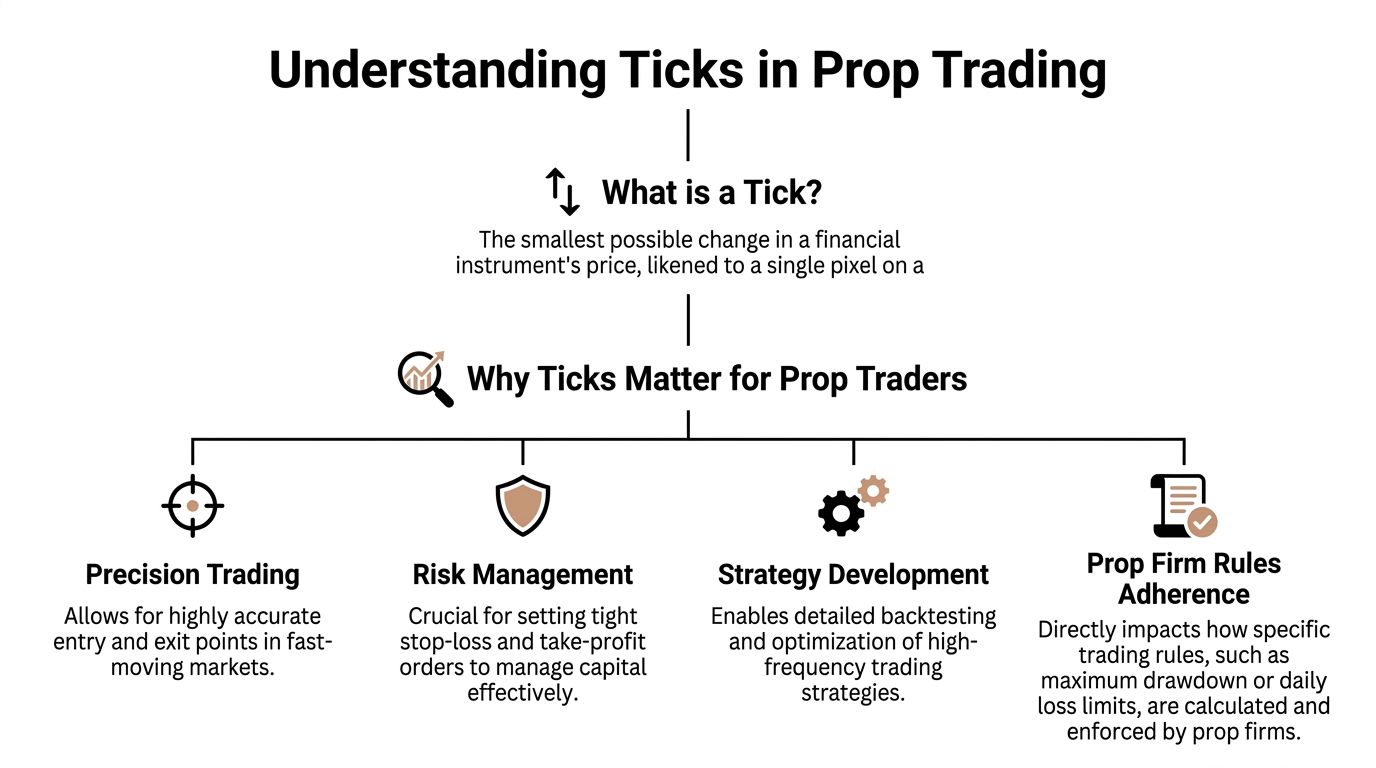
Candles are summaries, ticks are the raw event stream
When you look at a candle, you see a compressed report:
| Chart view | What you get | What you miss |
|---|---|---|
| OHLC candle | Open, high, low, close | Order of moves inside the bar |
| Tick stream | Every small price update | Nothing is compressed into one bar |
That missing sequence matters more than most traders realize.
A candle can show a high and a low. It does not tell you whether price first moved hard against you, nearly hit your threshold, then recovered. It also does not tell you whether your limit order had enough liquidity available when the market touched your price.
For a discretionary swing trader, that may be a minor issue.
For a prop trader running tight risk, that can be the whole game.
Why prop traders feel tick data more than retail hobby traders
Prop challenges are rule-driven environments. Your account is being monitored against loss limits, drawdown limits, and execution conditions. In practice, those rules interact with the live market feed one tick at a time.
Newer traders often get caught here.
They backtest on candle closes. They execute on visual patterns. Then they wonder why the live account behaves differently.
Usually the answer sits in one of these gaps:
- Intra-candle volatility: The chart looked stable, but the trade had a fast adverse move inside the bar.
- Spread behavior: The bid and ask moved differently than expected.
- Fill quality: The market touched your level, but not with enough available liquidity for your order.
- Rule measurement: The account tracked floating equity or drawdown in a way your chart review did not.
A simple trading example
Suppose you buy a breakout. The next one-minute candle closes green. On the chart, the trade looks fine.
But inside that minute, price first snaps lower, your floating PnL drops sharply, the spread widens, and your stop or rule threshold gets clipped before the move recovers.
That is not bad luck. That is a trader using a summary view to manage a tick-level risk problem.
Useful mindset: Trade ideas may come from candles, but trade survival is often decided by the tick stream.
Where beginners should focus first
You do not need to become a market microstructure specialist. You do need to stop treating the chart as the whole truth.
Start with these habits:
- Review wick behavior: Long wicks often signal the exact places where tick-level pain happened.
- Respect fast markets: Opens, closes, and news periods are where tiny feed details matter most.
- Test tighter strategies harder: The smaller your target and stop, the more every tick matters.
- Match style to feed reality: Scalpers and EA users need far more precision than higher-timeframe traders.
If you build that awareness early, you stop blaming mysterious platform behavior for problems that come from how markets print.
How Tick Data Directly Impacts Your Prop Firm Account
Here, theory becomes PnL. Tick data affects your account in three places every day: drawdown, execution, and strategy behavior.
Drawdown is often decided before the candle closes
A lot of challenge failures happen because traders think the rule is based on where the bar finished. It usually is not.
If your platform or prop firm monitors equity intraday, then the key number is the lowest point your account reached during the move, not the prettier closing value you remember afterward.
That changes how you should interpret these situations:
- A temporary spike against your position
- A stop placed too tight around routine noise
- A correlated basket of trades that all dip together
- A hold through a volatile session handoff
On the chart, these may look manageable. On the account, they can still breach your limits.
Different drawdown models create different trader behavior
Some firms have used a very different model.
BestProp’s Funding Ticks profile noted that some firms, including the former Funding Ticks, used an End-of-Day trailing maximum drawdown model instead of real-time intraday monitoring. That means a trader could dip under the line during the day and remain active as long as the account closed above the threshold. BestProp also noted that this approach introduced overnight gap risk and changed how traders needed to manage exposure. You can review that at BestProp on Funding Ticks drawdown structure.
That sounds forgiving at first. It is, in one sense. It can allow more intraday fluctuation.
But it also encourages bad habits if the trader misunderstands the risk. A system that tolerates larger intraday swings can hide how unstable your strategy really is.
Here is the practical difference:
| Drawdown style | What the trader tends to focus on | Main danger |
|---|---|---|
| Real-time intraday | Live floating equity | Fast temporary breaches |
| End-of-Day trailing | Closing state of account | Overnight or session-end risk |
Neither model is automatically better. They punish different mistakes.
Slippage lives at the tick level
Slippage is the gap between the price you expected and the price you received.
That gap is not random. It is tied to what was available in the market at the moment your order reached the book.
In fast conditions, several things happen at once:
- Price updates quickly.
- Liquidity at your chosen level gets consumed.
- Your order arrives a moment later.
- The next available fill is worse than planned.
That matters a lot if you trade:
- market orders on breakouts
- stop entries during momentum bursts
- exits during panic reversals
- short target scalps where a small execution difference changes expectancy
A strategy with a narrow edge can survive bad analysis and still recover. It usually cannot survive consistently poor execution.
Trading rule: The smaller your average win, the less slippage your strategy can tolerate.
EAs and scalpers are most exposed
If you run an EA or a very active manual scalping model, tick quality matters even more than chart quality.
Why? Because these strategies often depend on small, frequent moves. That means:
- a tiny fill difference changes your entry quality
- a brief spread expansion changes your stop-out rate
- a missing or simplified backtest feed creates a deceptive impression of strength
- a brief adverse move can invalidate a high-win-rate system
A strategy that looks strong on bar data can fall apart when exposed to actual tick-by-tick sequencing.
The hidden cost of rule mismatch
A lot of traders do not fail because their entries are terrible. They fail because the strategy and the account rules were never compatible.
If your method needs room to breathe, but the account monitors drawdown tightly intraday, you have a mismatch.
If your system depends on tiny targets, but the feed and execution environment produce variable fills, you have a mismatch.
If your process assumes stable rules and the firm changes them later, you have a business-model mismatch.
The account is not just capital. It is a structure. Tick data is where that structure becomes real.
Tick-Level Execution on DXtrade and cTrader
Platform choice matters more than many traders admit. If your strategy depends on precision, the platform is not just where you place orders. It is where you experience the market feed.
Why modern platforms help precision-focused traders
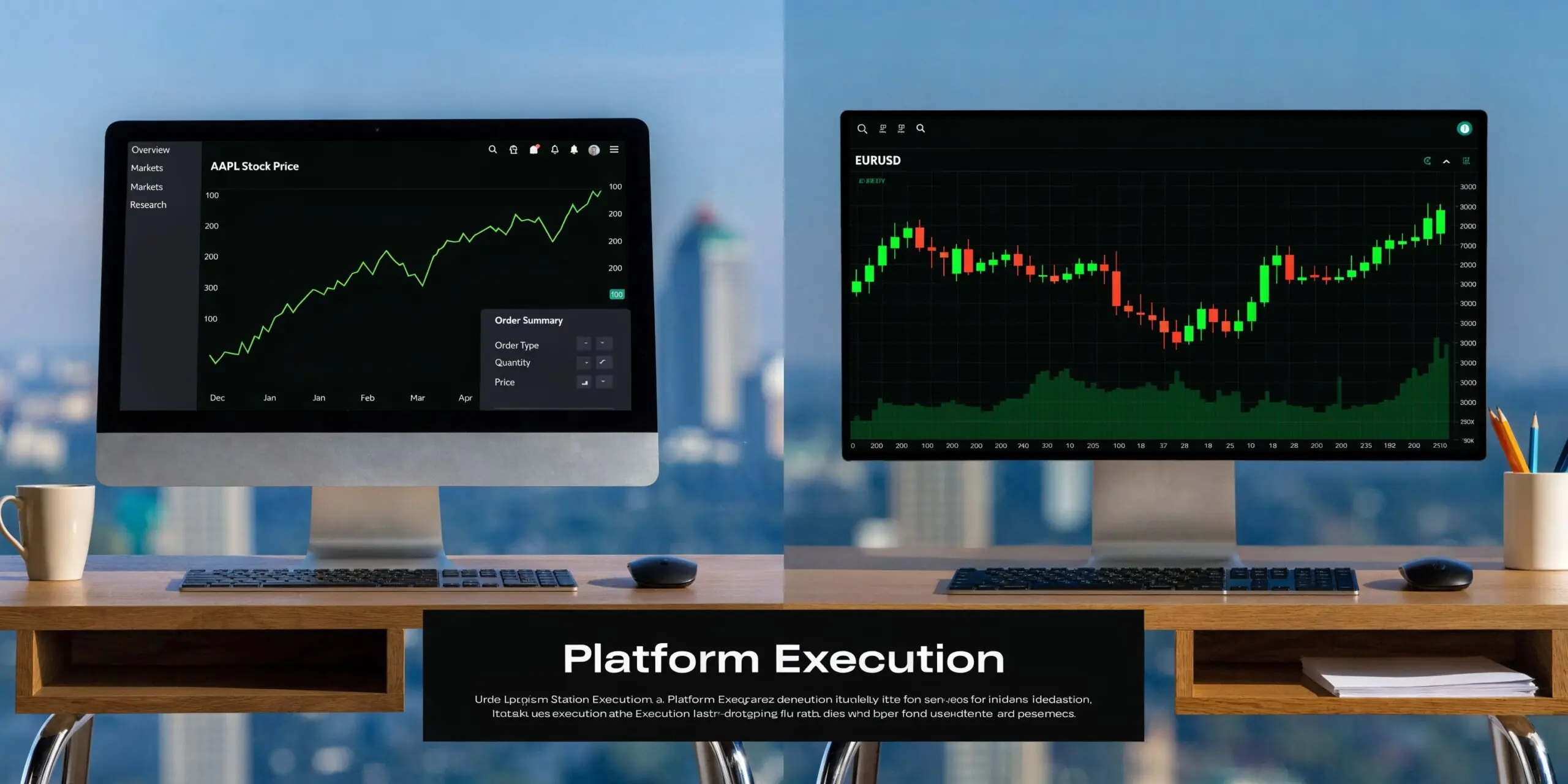
DXtrade and cTrader both appeal to traders who want a cleaner, more modern execution workflow than older retail setups often provide.
That does not mean the platform alone gives you an edge. It means a better platform can remove friction that hides what your strategy is doing.
For traders who care about entries, exits, and rule compliance, useful platform behavior includes:
- Clear order handling
- Responsive trade management
- A better view of live price movement
- Less clutter when monitoring active risk
If you are comparing interfaces for this kind of work, this review of the best FX trading platform gives a practical look at platform fit by trader style.
cTrader is especially useful when liquidity matters
cTrader stands out for traders who want more visibility into market depth and execution context.
The most practical example is Depth of Market. It can help you judge whether price is likely to move cleanly through a level or whether liquidity looks thin enough to create poor fills.
That matters most for:
- breakout traders
- scalpers
- news traders
- traders entering around session opens
- anyone managing size into fast-moving conditions
When you can see more of the execution environment, you make fewer naive assumptions about where your order will land.
DXtrade suits traders who want direct control
DXtrade tends to feel straightforward for manual execution and account oversight.
For many traders, that matters more than feature overload. You want to see your positions, track your risk, and react quickly without fighting the interface.
That makes DXtrade a good fit for traders who:
- focus on discretionary intraday setups
- monitor multiple instruments
- need a clean dashboard during active sessions
- want fewer distractions between analysis and execution
Platform rule of thumb: If your process is fast, your interface should reduce decisions, not create more of them.
Match the platform to the strategy, not your habit
A common mistake is choosing the platform you already know instead of the one that best fits the strategy you are trying to run.
Ask yourself:
- Does this setup need depth information?
- Am I managing multiple quick partial exits?
- Do I rely on very tight stop placement?
- Will my decision-making improve with a cleaner DOM or order panel?
If the answer is yes, platform selection becomes part of risk management, not just convenience.
Good traders treat software the same way they treat spreads, volatility, and rule structure. As a real trading variable.
How to Optimize Your Trading Strategy for Tick Realities
You buy a clean breakout in a challenge account. The chart still looks fine thirty seconds later, but your stop is already gone. That gap between what looked tradable and what was tradable on the live feed is where many prop evaluations are won or lost.
Tick reality needs to be built into the strategy before the challenge starts. If it only performs on tidy candles and ideal fills, the edge is too thin for a live prop feed.
Test the strategy at the level it lives on
Short-term systems break first in the testing phase, not the live phase. Traders just miss the warning because the backtest was too smooth.
Any setup with tight stops, active trade management, scale-ins, or small average wins should be tested with tick-sensitive data if you can get it. Candle-only testing hides the parts that usually hurt challenge accounts most:
- how often price tags your stop before reversing
- how much heat a trade takes intrabar
- how spread changes alter expectancy
- how a small delay changes the entry location
If you trade intraday indices, FX, or crypto, this guide on trading the tick in active markets is useful because it keeps the focus on executable price, not just chart structure.
Place stops where the trade is wrong, not where the picture looks neat
A clean chart invites lazy stop placement. Many traders set the stop exactly under the swing low, above the obvious high, or at the level everyone else can see.
Ticks punish that habit.
Price often pushes through the obvious level, clears clustered stops, and then rotates back in the original direction. That does not mean every stop needs to be wider. It means the stop needs a reason. On some instruments, one or two extra ticks beyond the obvious level can make the difference between normal noise and true invalidation. On others, the better answer is smaller size with a less crowded stop location.
Ask practical questions before placing it:
- Does this market regularly overshoot structure before moving cleanly?
- Is the level obvious enough to attract stop clustering?
- Does the account rule set allow the extra room without distorting risk?
- If the stop needs more space, does the reward still justify the trade?
Keep enough edge after friction
A strategy that targets a small move can work in theory and still fail in a prop account because the feed takes too much out of it. Spread, slippage, and small execution differences do not need to be dramatic to wreck a marginal setup. They only need to show up often.
That is why some strategies survive challenge conditions better than others.
| Fragile setup trait | More durable setup trait |
|---|---|
| Tiny profit target | Target leaves room after costs |
| Entry during the first burst | Entry after the first sweep settles |
| Stop at an obvious chart point | Stop beyond a level that breaks the idea |
| Requires perfect fill location | Still works if entry is a few ticks worse |
Simple usually improves performance for one reason. It leaves more tolerance for real execution.
If a few ticks of friction erase the edge, there was not much edge there to begin with.
Separate normal conditions from event conditions
A setup that behaves well at 10:15 can behave badly at the open, around red-folder news, or during a session handoff. The pattern may be the same on the chart. The tick behavior is not.
Treat those periods as separate environments in your journal and testing. I prefer to tag trades by session, event context, and spread conditions, then review them as separate samples. That shows whether the setup is sound or whether it only survives in calm periods.
Before trading a fast window, check:
- whether the setup assumes stable spread
- whether the stop can survive a fast sweep without breaking account risk
- whether a market order changes the expectancy too much
- whether your prior testing included the same type of tape
A valid setup traded in the wrong conditions is still a bad trade.
Adapt to current prop conditions, not old assumptions
Prop firms are less forgiving than many traders assume. Rules are tighter, consistency matters more, and there is less room for avoidable execution mistakes. The confusion around “Funding Ticks” as a firm name versus funding ticks as a trading concept has not helped. The firm is part of the article’s background. Your day-to-day problem in a challenge is the tick stream hitting your orders on DXtrade or cTrader.
That is the part to optimize.
A practical pre-challenge check
Run through this before you put the strategy on a funded evaluation:
- Review backtest quality. If the method is intraday and precise, use tick-aware assumptions.
- Measure adverse excursion. Know how far trades usually move against you before they work.
- Tag bad conditions. Session opens, data releases, and thin periods should be tracked separately.
- Remove fake precision. If the setup only works with near-perfect entries, it is too brittle.
- Log execution misses. Note where spread, slippage, or a fast print changed the result.
- Fit the method to the account. A solid strategy still fails if the rule set punishes its normal behavior.
Tick awareness does not make trading safe. It does cut out a category of self-inflicted losses that come from testing one market and trading another.
Frequently Asked Questions About Tick Data and Prop Firms
Do all asset classes behave the same at the tick level
No. The broad principle is the same, but the feel is different.
Forex, indices, crypto, and commodities each have their own rhythm. Some move smoothly until they do not. Others can print sharp bursts around opens, data releases, or thinner liquidity periods.
For traders, the practical point is this: do not assume a stop or execution style that worked on one market will behave the same on another. Tick behavior is part of the instrument’s personality.
Can I backtest properly without historical tick data
You can still learn from non-tick testing, but you need to be honest about its limits.
Higher-timeframe swing strategies may survive reasonably well with less granular testing. Scalping systems, tight intraday breakouts, and active EA logic usually need better data quality to avoid false confidence.
If your strategy depends on tiny edges, simplified data can make a weak system appear strong.
Why does a trade look fine on the chart but still fail in a prop account
Because the chart is a summary and the account reacts to live price movement.
A candle can later close in your favor while your floating equity briefly crossed a rule threshold during the move. The same thing can happen with execution. Price may appear to touch your level, but the tradable feed and available liquidity may not have given you the fill you expected.
This is why challenge traders need to think in both chart structure and feed behavior.
Are some account styles more sensitive to ticks than others
Yes.
Short-term, high-frequency, and tight-risk approaches are much more exposed to tick noise, spread shifts, and slippage. Slower swing approaches usually care less about every tiny fluctuation, though they still need to respect rule structure.
The account model matters too. A trader using a setup with larger intraday fluctuation needs to know whether the firm monitors risk continuously or with a different trailing structure. If you ignore that detail, you can trade a decent strategy inside the wrong framework.
Bottom line: The tighter your margins, the more every tick matters.
Conclusion Trade Smarter by Respecting the Tick
Serious prop trading starts with a simple truth. Your chart is the summary, but your account lives inside the feed. Drawdown, slippage, stop-outs, and challenge survival are all shaped by tick-level movement.
If you searched for funding ticks prop firm, the old company is now mostly a lesson in firm selection. The lasting lesson is better. Learn how ticks affect your trading decisions, and your strategy gets harder to break. Trading involves risk of loss, and this article is educational only, not financial advice.
If you want a transparent place to apply that understanding, explore MyFundedCapital to compare funding programs, account types, and platform options, then start a challenge that fits your trading style.
