

 AR
AR
 NL
NL
 EN
EN
 FR
FR
 DE
DE
 ES
ES
 PL
PL
 SV
SV
 PT
PT

You've found a setup, increased the position because the stop looked “too far,” then tried to win back a loss before the trading day ended. That cycle doesn't usually come from a bad strategy alone. It comes from trading without a risk management framework that defines what you can lose, how much you can trade, and when you must stop.
Why Traders Need a Risk Management Framework Before Strategy
A trader can pass several trades with a loose process and still fail a challenge quickly. The usual sequence is familiar: a normal loss feels frustrating, the next position is larger, the stop moves farther away, and a third trade appears only because the first two didn't produce the expected result. By the time the trader checks the account rules, the daily loss threshold is already close or breached.
The problem isn't emotional discipline alone. The account has no operating system. Without written limits, every decision gets renegotiated while money is at risk. That's when revenge trading, oversized positions, excessive borrowing, and improvised stop placement take over.
A usable framework answers five questions before the session begins:
- What's the maximum acceptable loss?
- How much capital can one trade risk?
- Where is the trade thesis invalidated?
- When does the session end, regardless of opportunity?
- What evidence allows a rule to change?
These questions matter more in funded trading because the account is governed by firm-level constraints. MyFundedCapital uses a 5% daily loss limit and up to 10% maximum drawdown as stated account parameters, so a trader needs personal controls that operate well inside those boundaries rather than treating the firm limit as a target.
The classic risk management framework steps provide a useful structure. NIST describes a sequence of Prepare, Categorize, Select, Implement, Assess, Authorize, and Monitor, with controls selected from assessed risk and then validated before an explicit decision and ongoing monitoring cycle. A trader can translate that sequence into preparation, exposure classification, rule selection, execution, review, permission to continue, and continuous supervision.
For broader context, a practical guide to risk frameworks in Canada can help clarify how organizations turn risk principles into documented operating processes. Trading requires the same basic discipline, even though the assets, decisions, and time horizons differ.
This article is educational content, not financial advice. Trading involves a risk of loss. The framework below won't make losses disappear, and it can't guarantee profits. It's designed to make each loss defined, visible, and survivable.
How to Define Your Risk Appetite and Build a Risk Register
Write a one-page risk appetite statement before placing the next trade. After a difficult session, traders often explain their actions instead of setting usable limits.
A practical trading risk framework defines maximum daily loss, maximum drawdown, maximum position exposure, and maximum concentration, then records those limits in a risk register and dashboard. This practical trading risk framework guide outlines that approach.
Write the appetite statement
Use direct language:
I stop trading when my personal daily loss limit is reached. I don't increase position size to recover a loss, and I don't open a new position if total exposure exceeds my concentration rule.
Your statement should specify:
- Daily loss: Set a personal ceiling below the firm's hard limit. Include realized losses and the open-risk allowance you choose to track.
- Maximum drawdown: Define the account-level point at which you reduce size, pause, or stop for a full review.
- Exposure: State the highest total exposure or margin you will permit, even if the platform allows more.
- Concentration: Limit exposure in one instrument, correlated instruments, or a single market theme.
- Trading frequency: Set a maximum number of trades or attempts per session if overtrading is a known weakness.
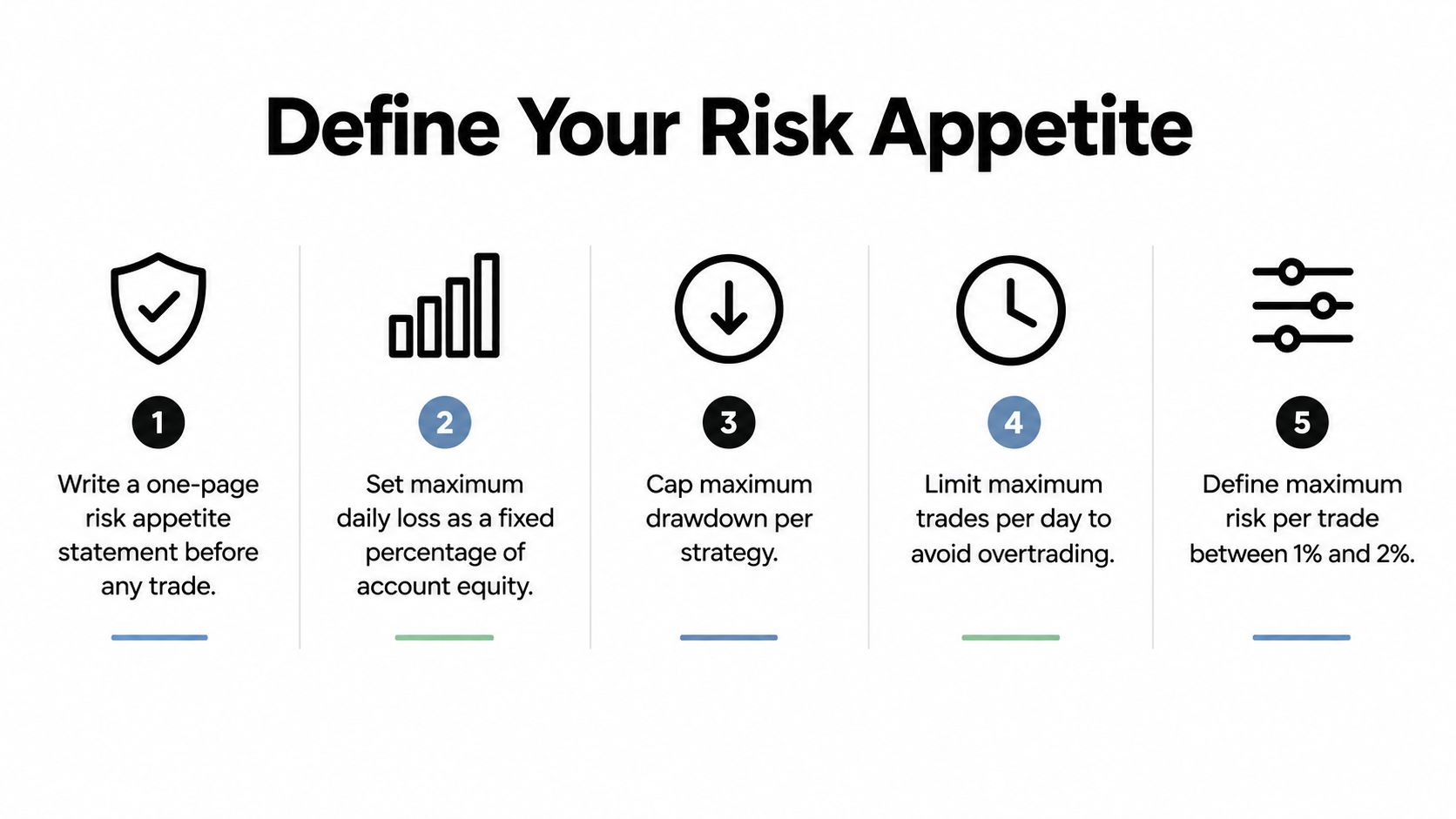
Set personal limits stricter than the firm's limits. MyFundedCapital states account parameters of a 5% daily loss limit and up to 10% maximum drawdown, but those figures should not become your operating targets. If reaching a firm limit would leave you emotionally compromised, your personal ceiling is already too high.
A rule works only when you can follow it without wondering whether the next trade will rescue the account.
Convert rules into a risk register
A spreadsheet is enough. Record each risk in five fields:
- Risk event: oversized trade, correlated positions, revenge entry, slippage, or news volatility.
- Trigger: the observable condition showing that risk is present.
- Limit: the maximum exposure or loss you will accept.
- Action: stop trading, reduce size, close exposure, or review.
- Owner and timestamp: who made the decision and when. This remains useful for a solo trader.
Keep the dashboard visible before and during the session. Track equity, realized daily loss, open risk, margin usage, current drawdown, trade count, and concentration by instrument. Use the MyFundedCapital risk assessment tool alongside the written register to check whether a planned trade fits the account's constraints.
The spreadsheet is not the control. The control is a repeatable record that replaces memory and mood with defined decisions. Update it when a limit is reached, a rule is tested, or evidence supports a change.
Position Sizing and Stop Rules That Keep Risk Fixed
A trade can follow the setup perfectly and still carry too much risk if the quantity was chosen before the stop. Set the invalidation level first, then calculate the position. That order keeps the trade plan in control rather than forcing the stop into a convenient location.
Many trading guides describe fixed risk per trade as a small portion of account equity, commonly 1% to 2%, with the stop placed where the trade idea fails and the quantity adjusted to its distance. The approach is summarized in this trading risk management explanation.
Use the fixed fractional formula
For contracts, use:
Contracts = (Account Size × Risk %) / (Stop Distance × Point Value)
Round the result down. Rounding up can push the position beyond the planned limit once spread, commission, or slippage is included. This position-sizing rule covers the same calculation and rounding principle.
Take a hypothetical $50K account with a 1% risk setting. The planned monetary risk is $500, calculated as $50,000 multiplied by 1%. With a stop distance of 25 points and a point value of $10, the calculation is:
($50,000 × 1%) / (25 × $10) = 2 contracts
The result is already a whole number. If the calculation produces a fraction, round down instead of up. The final quantity should never exceed the preset risk before the order is placed.
Place the stop where the idea fails
A stop belongs at the price level where the setup no longer makes sense. That could be beyond a swing point, outside a structure boundary, or past the condition that supported the entry. Choosing the stop for convenience makes the risk calculation look precise while weakening the trade thesis.
Check the practical risk before execution:
- Market movement: A stop inside ordinary price noise may trigger before the setup is tested.
- Spread: Entry and exit costs can increase effective risk, especially in thin conditions.
- Instrument value: Forex, indices, crypto, and commodities use different contract and point-value conventions.
- Execution conditions: Fast markets can create slippage, so planned risk may differ from the final loss.
If the valid stop is too wide for the account's allowance, reduce the quantity or skip the trade. Do not move the stop closer to fit more contracts, and do not widen it after entry because the loss feels uncomfortable.
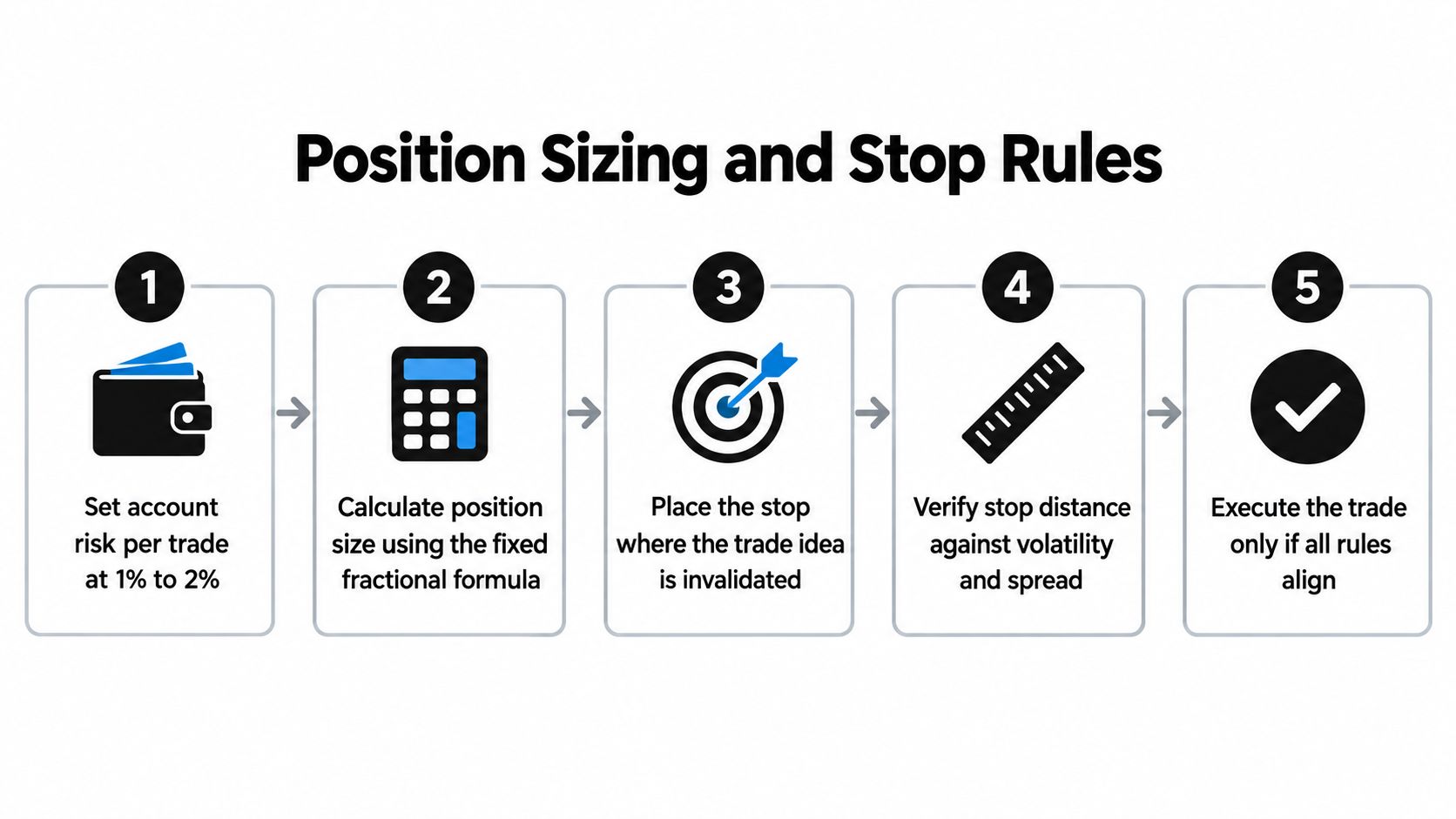
Before sending the order, check the account size, risk percentage, stop distance, point value, calculated quantity, and rounded-down quantity. The MyFundedCapital position size calculator can assist with the arithmetic, but verify the instrument specification and actual stop location yourself.
A fixed-risk system does not make every trade equally attractive. It keeps one mistake from becoming several times larger than the others. Record the planned risk and actual result, then use that record in the review loop before changing the rule.
Daily Loss Caps and Drawdown Controls for Prop Firm Trading
Single-trade sizing protects one idea. Daily and drawdown controls protect the account after several ideas fail. Those are separate jobs, and combining them into one rule leaves a gap.
MyFundedCapital's published account parameters provide concrete anchors: a 5% daily loss limit and up to 10% maximum drawdown. Those are hard boundaries, not sensible daily objectives. A trader who waits until the firm limit is reached has allowed the account to absorb too much stress before taking action.
A better structure uses three layers:
| Risk Layer | Example Personal Rule | MFC Hard Limit |
|---|---|---|
| Trade risk | Fixed fractional risk, with size calculated from the stop | Firm rules still apply |
| Daily risk | Stop at a personal soft cap before the firm threshold | 5% daily loss limit |
| Drawdown | Reduce size or pause as equity declines | Up to 10% maximum drawdown |
The personal rule must be the earlier trigger. For instance, you might use a warning level that reduces new exposure, followed by a hard personal stop that ends the session. The exact level should reflect your strategy, volatility, and ability to execute calmly. It shouldn't be chosen because it sounds aggressive.
Use drawdown as a size signal
Drawdown changes the risk budget. A position that felt manageable at the starting balance can become too large after a sequence of losses, particularly if the trader keeps using the original account figure rather than current equity.
A published multi-layer trading framework gives one example of this approach. It recommends a 3% daily loss cap, soft and hard limits of 2% and 3.5%, then suggests reducing size by 50% at 10% drawdown and to 25% at 15% drawdown. Those figures are an example from the source, not a universal prescription, and they may not align with a specific prop firm's rules.
For an MFC account, the key decision comes earlier: a trader should reduce exposure well before the 10% maximum drawdown boundary. Once the account reaches a personal drawdown trigger, the correct response is smaller size, fewer trades, or a pause for review. Chasing the deficit with higher trading power turns a controlled drawdown into a rule breach.
Practical rule: A daily cap tells you when to stop today. A drawdown rule tells you how to trade tomorrow.
The MyFundedCapital daily loss limit should be read alongside the firm's current rules, because platform calculations and account conditions matter. Track your own equity and exposure independently as well. A dashboard that updates only after positions close can hide open risk during a fast session.
The strongest funded traders often quit early. They don't need to prove that the next setup would have worked. Their job is to preserve decision quality and keep the account eligible for another session.
Monitoring Review and Continuous Improvement Loop
A risk management framework fails when it becomes a document that nobody consults. The account changes after every trade, and the market can change the quality of a setup before the next entry appears. Monitoring must therefore happen during the session, while review must happen after the session.
NIST's risk management framework follows seven operational steps, Prepare, Categorize, Select, Implement, Assess, Authorize, and Monitor, and its structure separates assessed risk from control selection, validation, authorization, and ongoing supervision. NIST also describes risk assessment through identification, analysis or measurement, and weighting or prioritization, which maps well to a trader's process of finding exposure, measuring it, and deciding what deserves action. See the NIST risk management framework for the formal structure.
Monitor open risk in real time
During each session, watch the numbers that can force a decision:
- Open loss: Include all live positions, not only closed trades.
- Distance to the daily cap: Know how much room remains before your personal stop and the firm limit.
- Total correlated exposure: Two different symbols can still express the same market view.
- Execution quality: Record spread expansion, slippage, rejected orders, or delayed fills.
- Rule status: Mark whether the next trade is permitted, restricted, or prohibited.
Alerts can help, but automation doesn't replace judgment. A platform alert may show that a threshold was reached, while only the trader can decide whether the correct action is to close, pause, or investigate a data issue.
Review evidence, not feelings
Log every trade immediately after exit. Record the setup, entry reason, stop location, planned risk, actual result in R, execution notes, and whether the trade followed the written rules.
A weekly audit can then examine:
- win rate
- average R
- maximum consecutive losses
- average planned versus actual risk
- rule violations
- performance by instrument and session
Don't change the strategy after one frustrating trade. Authorize a rule change only when the journal shows a repeatable issue, such as consistent slippage during a certain market condition or a recurring pattern of entries taken outside the plan.
A monthly refinement cycle is enough for many traders, while high-volatility periods may justify more frequent checks. The principle stays constant: monitor, log, review, refine, then monitor the revised rule. That living loop is more reliable than completing the risk management framework steps once and treating the work as finished.
Frequently Asked Questions and Next Steps With MyFundedCapital
How should I scale the framework for a small account?
A small account needs fewer tools, not weaker controls. Write down the risk appetite, set fixed risk per trade, place the stop at invalidation, and define a daily stop before trading begins. A large risk department or complex dashboard is unnecessary.
Use a spreadsheet that shows current equity, planned risk, open exposure, drawdown, and rule status. Start with one or two instruments you understand instead of distributing limited risk across several markets. Match the process to the account and your experience, while keeping the core controls in place.
How should I handle news releases and weekend holds?
News releases and weekend holds are separate operating conditions. Check whether your account type and firm rules allow an open position through the event or market closure. If they do not, close the position or skip the entry.
If holding is allowed, reassess spread, liquidity, expected volatility, and slippage risk. A stop sets the intended risk, but a fast market may prevent an exit at the exact stop price. Optional firm add-ons can affect access to news trading or weekend holding, so confirm the current terms before building either condition into your plan.
What should I do after hitting my daily cap?
Stop opening trades immediately. Do not widen the stop, increase position size, change instruments, or start a new strategy to recover the loss.
Save the trade history and record what caused the cap. Review the session away from the platform. A rule violation requires a behavior correction before the next session. Valid trades that still reached the cap require a check of market conditions against your assumptions. The next session begins with the written risk plan, not a recovery target.
For a funded account, the operating limits must remain visible before every order. MyFundedCapital's framework uses a 5% daily loss limit and a 10% maximum drawdown, so calculate open and closed exposure against those boundaries rather than relying on a balance glance. A smaller personal risk limit may still be appropriate if it gives you room to handle correlated positions and slippage.

Trading involves risk of loss, and this article is educational only, not financial advice. Review the current rules, calculate exposure before every order, and choose limits you can follow under pressure.
MyFundedCapital offers Instant Funding alongside 1-Step and 2-Step Challenges, with simulated accounts designed to assess trading skill and discipline under defined risk parameters. Visit MyFundedCapital to compare account types and choose a funding route that fits your risk management framework before starting a challenge.
