

 AR
AR
 NL
NL
 EN
EN
 DE
DE
 ES
ES
 IT
IT
 PL
PL
 SV
SV
 PT
PT

You take a breakout that looks clean. Price clears resistance, the candle closes strong, and the move feels obvious. Then the next candle snaps back, your stop gets hit, and a challenge day that started well is suddenly close to the daily loss limit.
That usually isn't a chart-pattern problem. It's often a volume problem.
Most traders learn entries before they learn participation. That's backwards. If you want a practical answer to what is volume in trading, especially as a Forex or CFD prop trader, you need to understand what volume is showing, what your platform is really measuring, and how to use that information to avoid weak trades. This article is educational only, not financial advice. Trading involves risk, and losses are part of the business.
Introduction
A lot of aspiring funded traders make the same mistake. They treat price as the whole story.
Price matters, but price alone doesn't tell you how many traders are behind a move, whether the breakout is attracting real participation, or whether bigger players are using that move to exit into retail momentum. That's where volume comes in.
In practical terms, volume helps you judge conviction. It won't predict the next candle. It won't save a bad setup. But it can stop you from taking trades that look good on the surface and fall apart as soon as they're tested.
For prop trading, that matters more than most retail traders realize. When you're trading with a flat daily loss limit and a maximum drawdown rule, one fake breakout can do more damage than a week of average mistakes. Volume analysis isn't magic. It's a filter. Used properly, it's one more layer that helps you protect risk, stay selective, and avoid forcing trades in thin or deceptive market conditions.
Understanding Trading Volume Fundamentals
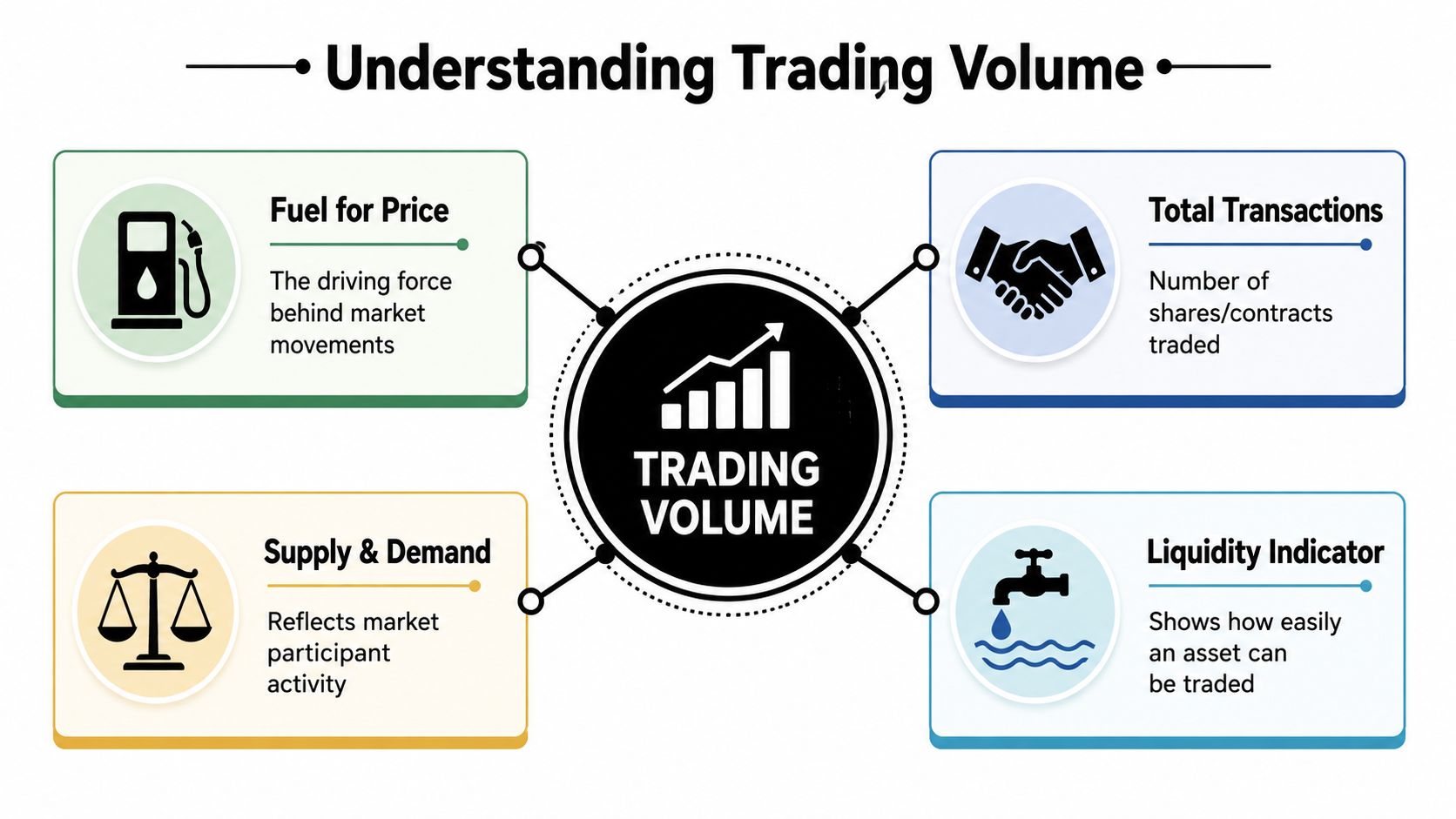
At its simplest, trading volume is the total number of shares or contracts exchanged in a market during a defined period. It's one of the oldest market statistics traders use to judge liquidity and participation, and it's considered foundational because higher volume usually means more active participation and stronger conviction, while lower volume often signals weaker interest, as described in Investopedia's explanation of why trading volume matters.
What volume tells you
Think of volume as the fuel behind price movement.
Price shows direction. Volume shows participation. When price moves higher and volume expands, more traders are involved in that move. When price drifts higher but volume fades, the move may still continue, but the support behind it is thinner.
On most charts, volume appears as bars at the bottom. A new bar prints for each candle or time period. Many platforms also color volume bars to match the candle direction, but the color matters less than the size of the bar relative to recent activity.
A practical way to read it:
- High volume means the market is engaged
- Low volume means fewer participants are committing
- Rising volume during a move often supports that move
- Falling volume during a move can warn that momentum is weakening
Practical rule: Price tells you what the market did. Volume tells you how much commitment sat behind it.
Why beginners misread it
New traders often use volume as a signal generator. That's the wrong job.
Volume works better as a confirmation tool. If you already have a level, a setup, and a reason to trade, volume can help you decide whether the move is worth trusting. If you don't have a real setup, volume won't fix that.
Here are the main jobs volume does well:
- Confirms participation: A move with broad involvement is usually more trustworthy than a move with weak participation.
- Helps judge liquidity: Busy markets tend to absorb orders better than quiet ones.
- Filters weak breakouts: A level break with poor participation is more likely to stall.
- Adds context to candles: The same candlestick means something different when volume is heavy versus quiet.
What works and what doesn't
A lot of generic education says, "high volume is bullish." That's too simplistic.
Use this instead:
| Situation | What volume suggests |
|---|---|
| Price rises with stronger participation | Buyers are supporting the move |
| Price rises with fading participation | The move may be running on weak conviction |
| Price breaks a level with broad activity | The break has a better chance of holding |
| Price breaks a level quietly | The move may be vulnerable to reversal |
Volume won't replace structure, timing, or execution. But if you're trying to answer what is volume in trading in a useful way, this is the core idea: it's a measure of market activity that helps you judge whether price is moving with support or just drifting.
The Critical Difference Between Real and Tick Volume
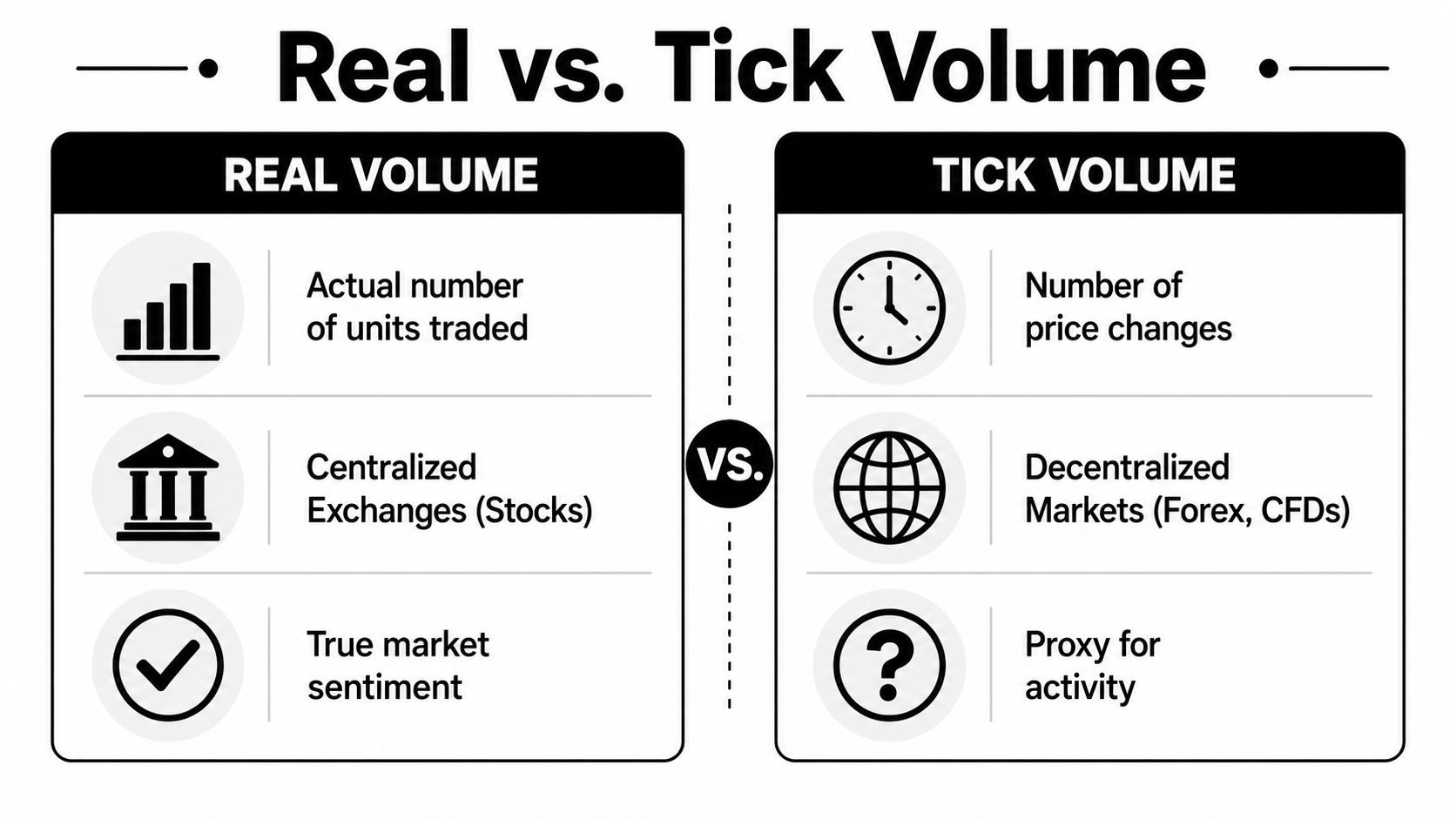
Stocks trade on centralized exchanges. Forex doesn't.
That difference changes how you should read volume on platforms like cTrader, DXtrade, or MT5. In decentralized Forex markets, what most retail traders see isn't true transaction volume. It's tick volume, meaning the number of price changes during a candle, not the actual number of contracts traded.
Why this matters in Forex and CFDs
Many traders frequently stumble at this point.
They learn volume concepts from stock-market content, then apply them directly to EURUSD, XAUUSD, NAS100 CFDs, or exotic FX pairs as if all volume data is identical. It isn't.
In Forex, there's no single central exchange reporting all transactions. That means the volume bar on your chart is usually a proxy. It's useful, but it has limits. Verified research in the brief shows that tick volume correlates with true liquidity at 85 to 90 percent in major pairs, but that relationship can break down in less liquid markets and create false signals.
That has real consequences for challenge trading. If your breakout model assumes every volume spike represents broad transactional participation, you're building confidence on top of imperfect data.
When tick volume is useful
Tick volume still has value. On major pairs, during active sessions, it often does a decent job reflecting whether activity is expanding or contracting.
It's most useful when you apply it with context:
- Major pairs during liquid sessions: Better conditions for using tick volume as a proxy
- Clean trend continuation setups: Helpful for confirming whether momentum is still active
- Repeated observations on the same instrument: Better than jumping between unrelated pairs and expecting identical behavior
A lot of traders also improve their read by combining volume with tape-style concepts. If you want a stronger grasp of how price updates and activity interact, this guide to trading the tick is worth reviewing alongside your chart work.
Tick volume is good enough to be useful. It isn't clean enough to trust blindly.
When tick volume becomes a trap
The trap appears when traders act as if every spike means the same thing.
Be more skeptical in these situations:
- Exotic or thin pairs: The proxy is less reliable
- Session transitions: Price can jump around without clean participation
- Low-liquidity hours: Tick spikes can look dramatic without supporting follow-through
- News volatility: Fast repricing can produce noisy readings that don't tell you who is committed
A practical adjustment is to stop treating Forex volume as precise. Treat it as contextual evidence.
A better way to think about it
Use this comparison:
| Market type | What volume usually represents | What the trader should assume |
|---|---|---|
| Centralized exchange markets | Actual traded units | Closer to true transactional participation |
| Decentralized Forex and many CFDs | Number of price changes | A proxy for activity, not exact traded size |
That's the piece most beginner guides skip. If you're asking what is volume in trading from a prop trader's perspective, the answer depends on the market. In Forex and CFDs, volume can help a lot, but only if you remember that what you're seeing may be tick activity, not complete market-wide transaction data.
How to Interpret Volume for Actionable Signals
Volume becomes useful when you tie it to a specific job. In live trading, I care about three jobs most: trend confirmation, breakout validation, and reversal warning.
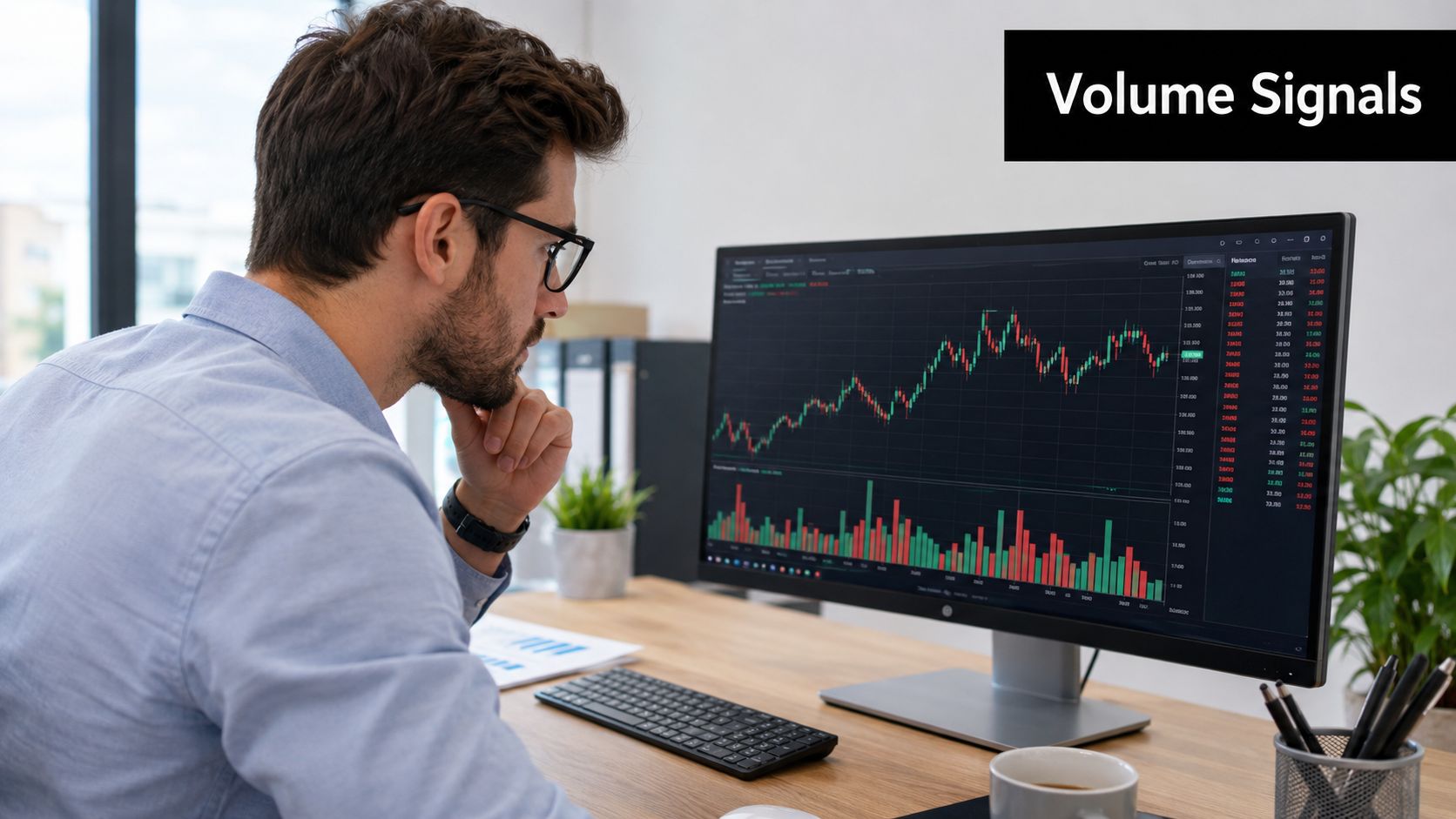
A widely used technical rule is that a breakout becomes more credible when volume expands to at least 1.5x to 2x its average daily level, and rising prices on increasing volume are generally seen as stronger than rising prices on declining volume, as outlined in this breakdown of volume analysis and breakout confirmation.
Confirming a trend
A healthy trend usually has a rhythm.
In an uptrend, you want to see stronger participation on pushes higher and lighter participation on pullbacks. That doesn't mean every green candle needs bigger volume than the last one. It means the market should generally become more active when price moves in the trend direction, and less active when price retraces.
What to look for:
- Impulse legs with stronger volume: Buyers are still involved
- Pullbacks with quieter volume: Selling pressure looks less committed
- Repeated expansion on continuation moves: The trend still has sponsorship
What usually fails:
- Price drifting higher while volume fades for too long
- Sharp pullbacks on stronger activity than the prior advance
- Late entries after several weak continuation attempts
Validating a breakout
Most traders prioritize volume in this context, but many also misuse it.
A breakout above resistance or below support becomes more believable when activity expands materially relative to recent average conditions. The common rule above gives a useful benchmark, but don't treat it like an automatic trigger.
Use a checklist instead:
- Is the level obvious? Volume matters more when the market is breaking a meaningful area.
- Did the candle close through the level? Intrabar pokes often fail.
- Is volume clearly above recent average? Relative expansion is what matters.
- Did price hold after the break? Real breakouts usually don't give back the entire move immediately.
Desk note: A breakout with volume but no hold is often distribution or absorption, not strength.
This is also where studying understanding abnormal trading activity can help. Even though the examples are stock-focused, the underlying idea is useful: unusual activity matters most when you compare it to normal behavior for that instrument and session.
For traders who want to go beyond simple bars and start reading participation with more precision, learning order flow analysis is the natural next step.
Spotting reversal risk
Volume can also warn you when a move is running out of road.
Two patterns matter most in practice:
Exhaustion volume
This happens when a trend extends hard, draws in late participants, and prints a large volume surge near the end of the move. The key point isn't the big volume by itself. It's the failure to continue cleanly after that surge.
Signs of possible exhaustion:
- Extended trend already in place
- Large volume spike near the end of that move
- Poor follow-through after the spike
- Fast rejection from the high or low
Volume divergence
This is simpler. Price makes a fresh high or low, but volume doesn't confirm with comparable participation. That doesn't guarantee a reversal. It tells you the move may be losing support.
A practical response is to tighten standards, not predict tops and bottoms.
| Pattern | Better response |
|---|---|
| Trend continuation with supportive volume | Trade with the trend if the setup is already valid |
| Breakout with expanding activity and hold | Consider the trade if structure and risk make sense |
| New high with weak participation | Reduce aggression, avoid chasing |
| Spike volume with immediate rejection | Watch for trap conditions |
The traders who use volume best usually aren't trying to forecast. They're filtering. That's a much better mindset for preserving risk capital.
Essential Volume Indicators Compared
Raw volume bars are enough for many traders, but some indicators make volume easier to apply. The right tool depends on the job.
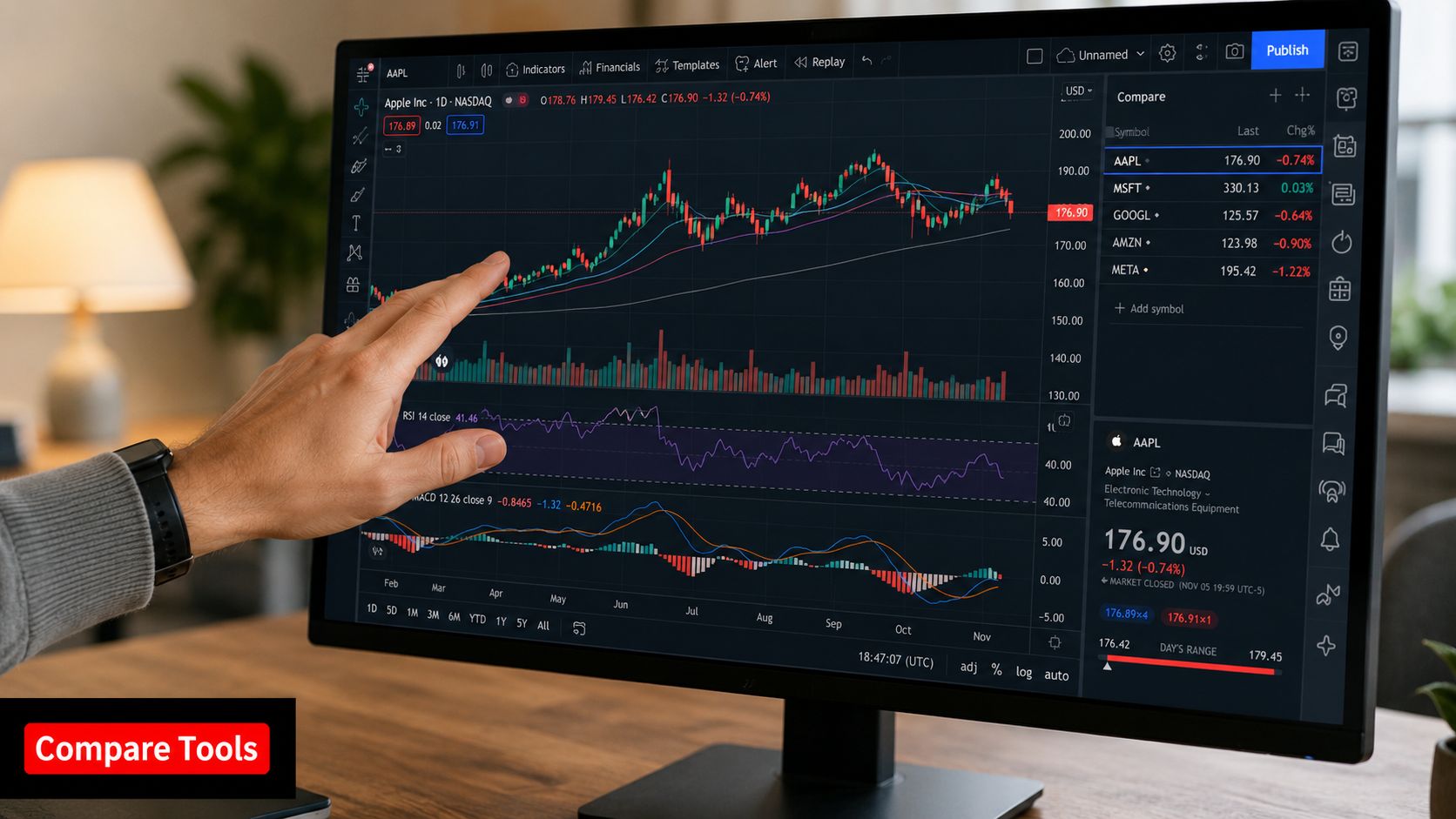
Which indicator fits which task
Here's the practical view:
| Indicator | Best use | Where it helps most | Main limitation |
|---|---|---|---|
| OBV | Trend confirmation and divergence | Swing structure, continuation analysis | Can get noisy in choppy conditions |
| VWAP | Intraday value and mean reference | Day trading, session bias | Less useful for broad multi-day context |
| Volume Profile | Identifying high-activity price zones | Support, resistance, auction-style reads | Needs practice to interpret well |
| MFI | Momentum with volume input | Spotting stretched conditions | Can tempt traders into early reversals |
OBV for direction
On-Balance Volume (OBV) keeps a running total based on whether price closes up or down. Traders use it to see whether volume is generally supporting the trend.
What it does well:
- Helps confirm whether participation is moving with price
- Makes divergence easier to notice than raw bars alone
- Works reasonably well on higher time frames
What it doesn't do well:
- Doesn't help much with exact entries
- Can flatten out or whipsaw in sideways markets
VWAP for intraday decision-making
Volume Weighted Average Price (VWAP) shows the average traded price weighted by volume. For day traders, it often acts like a live reference point for fair value.
If price is holding above VWAP and structure is bullish, many traders treat that as supportive intraday context. If price keeps rejecting VWAP from below, that can support a weaker bias.
For a practical primer on setup ideas, execution, and where VWAP fits in a trading plan, review this guide to Volume Weighted Average Price.
VWAP isn't magic support or resistance. It's a location tool. Context still decides the trade.
Volume Profile for price levels
Volume Profile organizes activity by price, not by time. That makes it useful for finding areas where the market spent a lot of business and areas where it didn't.
In practical trading, it helps answer:
- Where did traders do the most business?
- Which price zones were accepted?
- Which zones were rejected quickly?
This is especially useful for traders who hold positions longer than a single intraday move, or who build setups around retests of value areas and low-volume ledges.
MFI for pressure and stretch
Money Flow Index (MFI) is often described as an RSI-style oscillator with volume included. It can help spot when a market is becoming stretched while participation remains high.
That said, MFI works best as a secondary filter. It shouldn't be your whole reason for taking a reversal.
If you're trading prop rules, simpler is often better. Many traders do well with just:
- Raw volume bars
- VWAP for intraday context
- Volume Profile for key zones
You don't need four volume indicators stacked on the chart. You need one or two that support your existing execution model.
Applying Volume Analysis in a Prop Trading Environment
A funded trader buys a breakout on EURUSD during London open. Tick volume expands, the candle looks strong, and the move clears the morning high. Two minutes later, price slips back into range, spreads widen, and the trader is forced out for a full loss near the worst price on the chart.
That sequence is common in prop challenges because the loss limit is tight and Forex volume data has a built-in weakness. In spot FX and many CFD platforms, you are usually reading tick volume, not centralized exchange volume. Tick volume can still be useful, but it can also make weak moves look more convincing than they are. If you treat every volume spike as confirmation, you will donate a lot of small losses to false breaks.
Where volume helps challenge traders
Volume matters most as a risk filter.
In a prop environment, the goal is not to find more trades. The goal is to avoid the trades that can hit your daily drawdown fast. A volume read is useful only if it improves entry quality, trade location, or exit discipline.
The hardest trap is the breakout that shows high activity but no follow-through. In live markets, that often means one of two things. Either short-term traders all hit the same trigger at once, or larger participants used that burst of interest to fill the other side. For a funded trader, the reason matters less than the consequence. Price fails to expand, the trade loses auction quality, and you are now risking challenge capital on a setup that already stopped acting right.
A practical checklist for Forex and CFD traders
Use volume after structure gives you a reason to care.
- Start with the level: Prior high, session range edge, sweep, retest, or clear consolidation boundary.
- Read the close, not the mid-candle drama: A breakout bar that cannot hold near its highs is weaker than the raw volume number suggests.
- Compare effort to result: If tick volume jumps and price barely moves, assume resistance or absorption is in play.
- Treat off-session volume carefully: Asian session drift, rollover periods, and thin holiday trade can distort the read.
- Cut faster when volume and price disagree: If participation expands but continuation dies immediately, reduce risk or get out.
- Size for the challenge, not for the setup: Even a good read can fail. Position size has to respect daily and overall loss limits.
In funded trading, a scratch is often a good trade management decision. Holding and hoping because volume looked strong is usually what breaks consistency.
There is also a platform issue. Some firms give traders access to DXtrade and cTrader across forex, indices, crypto, and commodities with defined loss rules. That matters because volume-based execution depends on stable charts, familiar order entry, and knowing how your platform prints activity during fast conditions.
Traders who pass challenges consistently use volume to disqualify trades more than to justify them. They ask simple questions. Did price accept above the level? Did the candle close with intent? Does the tick volume fit the session, or is it just noise? Is this setup good enough to risk part of today's limit?
That approach is less exciting. It is also how traders stay in the challenge long enough for skill to matter.
Frequently Asked Questions About Trading Volume
Does volume analysis work for swing trading
Yes. The same principles apply on higher time frames. On daily and weekly charts, volume can help you judge whether breakouts, trend continuation, and reversals have broader participation behind them. The pace changes, but the logic stays similar.
How important is volume in cryptocurrency trading
It's important, especially because many crypto instruments trade on centralized exchanges where volume data is often closer to real transaction activity than what Forex traders see. That can make volume analysis more straightforward, though crypto still has its own liquidity and volatility issues.
What counts as high or low volume
Volume is always relative. A bar is only high or low compared with recent activity in that instrument, on that time frame, during that session. Looking at a recent moving average of volume is often more useful than focusing on the raw number alone.
Should you trade based on volume alone
No. Volume is a confirmation tool, not a standalone strategy. It works best when combined with levels, market structure, timing, and disciplined risk management.
Volume won't tell you the future. It helps you judge the quality of the move in front of you. That's a better use of it anyway. For funded trading, the point isn't to find a magic signal. It's to avoid low-quality trades, protect your drawdown, and stay in the game long enough for your edge to play out.
If you trade with discipline and want to put that discipline to work in a structured prop environment, explore the funding options at MyFundedCapital. You can compare challenge types, review the risk parameters, and choose an account style that fits how you trade.
