

 AR
AR
 NL
NL
 EN
EN
 DE
DE
 ES
ES
 IT
IT
 PL
PL
 SV
SV
 PT
PT

Most advice on set and forget trading leaves out the part that matters most in a prop firm. It tells you to place the trade, walk away, and stay disciplined, but it rarely explains what happens when spread widens, slippage hits, or a daily loss rule turns one bad fill into an account problem.
Used correctly, set and forget can help a trader stop interfering with good setups. Used carelessly, it can break a funded account fast. The difference is planning, risk control, and knowing when hands-off execution fits the rules.
What Set and Forget Trading Really Means
Set and forget trading doesn't mean placing a trade and ignoring reality. It means making the important decisions before the trade is live, then refusing to improvise while the trade is open.
That distinction matters. Newer traders often hear the phrase and assume it means no monitoring, no review, and no responsibility after entry. Professionals use it differently. They define the entry, stop-loss, take-profit, invalidation point, and trade size in advance. Then they let the plan execute without emotional tinkering.
Where the idea comes from
The phrase comes from a much older discipline in finance. In investing, “set and forget” is closely tied to passive index investing. John C. Bogle launched the first retail index fund in 1976, and that low-cost, low-maintenance model helped establish the idea that disciplined allocation can beat reactive decision-making over time, as discussed in this overview of Bogle and index investing.
Trading borrowed the language, but not the exact structure. Passive investing works over long horizons with broad diversification. A single high-exposure trade in FX or indices doesn't have that same cushion. So when traders use the phrase, they should mean pre-committed execution, not neglect.
Practical rule: If you haven't decided how the trade ends before you enter it, you're not using set and forget. You're improvising.
What disciplined setting looks like
A proper set and forget trade usually includes:
- A specific trigger: A pending buy stop above structure, a sell limit at supply, or an indicator condition that has already been tested.
- A predefined stop: Placed where the setup is invalid, not where the loss merely feels uncomfortable.
- A realistic target plan: One target, multiple targets, or a rules-based management action such as moving to breakeven.
- A position size that matches the stop distance: Size comes after the stop, never before it.
- A reason to stay out: News risk, low liquidity, session change, or poor market structure.
Common versions traders use
Set and forget shows up in a few different forms:
- Swing trading from key levels: Traders place pending orders around support, resistance, or breakout levels and let price come to them.
- Supply and demand entries: Orders sit at zones with a clear invalidation point and predefined reward logic.
- Indicator-driven execution: A trader or system places trades when a ruleset aligns, often with attached stop and target orders.
This approach works best when the process is repeatable. If your plan changes every time price twitches, then “forget” becomes impossible because the setup was never fully set in the first place.
The same logic shows up outside trading too. Good automation removes repetitive decisions but still needs rules, exceptions, and review. If you're interested in that mindset, these expert tips on task automation are a useful parallel. The principle is the same. Automate what can be planned. Keep oversight where errors are costly.
Evaluating Set and Forget for Prop Trading
In a personal account, set and forget can be inconvenient when execution goes wrong. In a prop environment, it can be terminal for the account.
That is the filter. The strategy itself isn't automatically bad. The issue is whether your version of it can survive live execution friction plus firm rules. A trader who understands chart structure but ignores slippage, spread expansion, and drawdown rules usually learns that lesson the hard way.
The upside and the problem
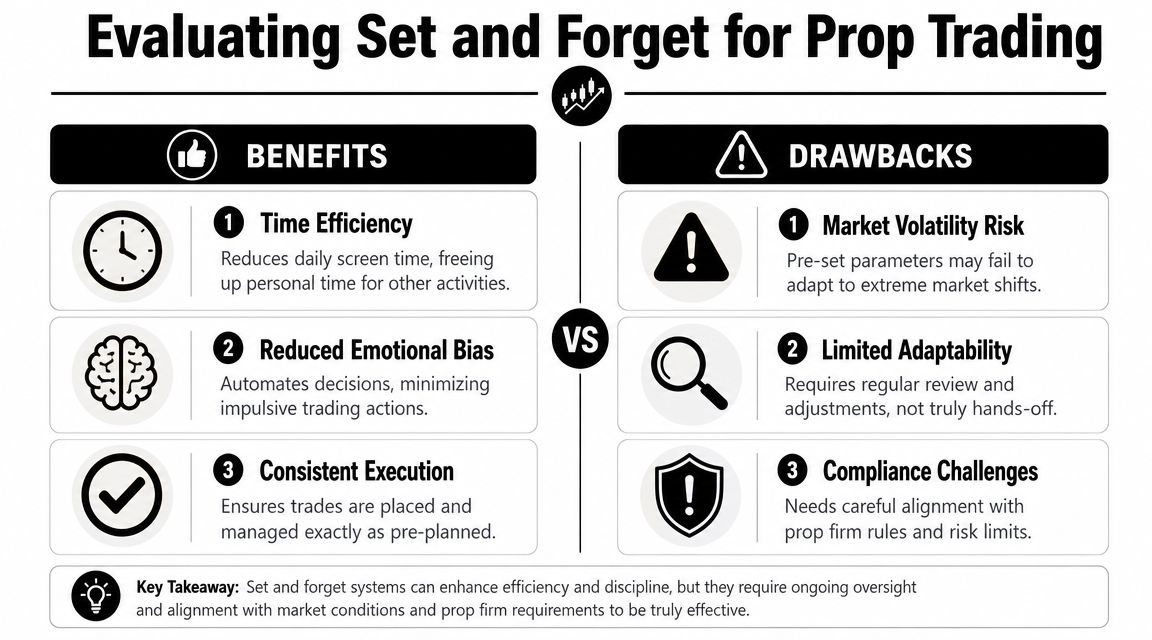
Set and forget can help in three areas that matter:
- Emotional control: It reduces the urge to move stops, chase entries, or close winners too early.
- Time efficiency: You don't need to sit in front of the screen all day waiting to react to every candle.
- Consistency: Orders can be executed the same way each time, which makes review easier.
But those benefits only matter if the trade survives execution. Educational content on set and forget trading also points out a core weakness: the method can break down in volatile or news-driven markets where gaps and slippage trigger stops unexpectedly, which is especially dangerous for prop traders because a fixed daily loss limit can magnify one bad event, as noted in this set and forget trading risk discussion.
Set and Forget Strategy in a Prop Firm Context
| Pros | Cons |
|---|---|
| Less emotional interference when the trade is open | Slippage can distort planned risk and make a clean setup fail on execution |
| Lower screen time for traders with jobs or limited availability | Daily loss rules punish surprises more than personal accounts do |
| Cleaner journaling because the trade logic is fixed before entry | Volatility can invalidate the hands-off model during news or thin liquidity |
| Better process discipline if entries and exits are standardized | You still need oversight for rule compliance, market conditions, and platform behavior |
A funded account changes the meaning of risk. The chart can be right, the setup can be valid, and the trade can still be unacceptable if the execution profile doesn't fit the rules.
What usually fails
The versions of set and forget that struggle most in prop trading are the ones sold as pure convenience:
- Wide-stop swing trades held through unstable conditions
- Pending orders left active around major scheduled events
- Systems that assume fills will match the backtest
- Traders who stack multiple positions without considering combined exposure
The strong version is narrower. It uses pre-planned execution, but within a risk framework built for drawdown limits. That often means smaller size, fewer simultaneous trades, better timing, and a willingness to cancel trades when conditions change before entry.
For a prop trader, the right question isn't “Can I walk away from this trade?” It's “If this fills at the worst reasonable moment, does it still fit my account rules?”
Critical Risk Controls to Stay Funded
Set and forget only works in a funded setting when risk controls are tighter than the setup itself. Entry quality matters. Survival matters more.
A lot of traders reverse that order. They spend most of their time perfecting the pattern and almost none defining the failure size. That's backward in a prop account with a flat 5% daily loss limit and up to 10% maximum drawdown in the publisher's stated rules.
Build the trade around the loss limit
Start with the account rule, not the chart.
If the firm gives you a daily loss cap, your single trade should sit comfortably below it. Many disciplined traders choose to risk only a small fraction of that daily room on one position so that a bad fill, spread jump, or second mistake doesn't put the account in emergency mode. The exact fraction is your decision, but the principle isn't optional.
Use this order of operations:
- Mark the invalidation level first. That's where the setup is wrong.
- Measure the stop distance. Don't tighten it just to increase size.
- Choose the cash risk for the trade. Base it on account rules, not confidence.
- Calculate position size from the stop distance.
- Check the combined risk if other positions are open or pending.
If one stop-out leaves you emotionally frustrated, your size is probably too big for a set and forget approach.
Non-negotiable controls
- Cap the day before the market does it for you: Decide on a daily stop for yourself that is stricter than the hard account limit. When it's hit, trading ends.
- Cancel pending orders before major scheduled news: If you don't have a specific news plan, don't let the market choose one for you.
- Respect session quality: A setup that looks clean during liquid hours can behave very differently when liquidity thins and spreads shift.
- Watch correlated exposure: Two different charts can still express the same idea. If they move together, your true risk is larger than it appears.
- Define what happens after partial profit: If you plan to move to breakeven or trail, write the rule down before entry.
A broader practical financial risk guide from AuditReady is useful reading because it reinforces a professional point traders often miss. Risk control isn't a separate task done after the plan. It is the plan.
Keep the math boring
Your process should be dull enough to repeat under pressure. That's the target.
For forex traders who want a more detailed breakdown of position sizing, drawdown awareness, and daily exposure control, this guide on forex risk management strategies is a practical reference.
The best set and forget traders aren't relaxed because the market is safe. They're calm because the loss was accepted, sized correctly, and contained before the order was placed.
Implementation Guide for DXtrade and cTrader
A strategy isn't real until it's entered correctly. Most execution mistakes in set and forget trading happen in the platform, not in the idea.
That means wrong order type, missing stop-loss, incorrect size, or a take-profit entered on the wrong side. None of those are strategy errors. They're process errors, and prop firms punish them the same way.
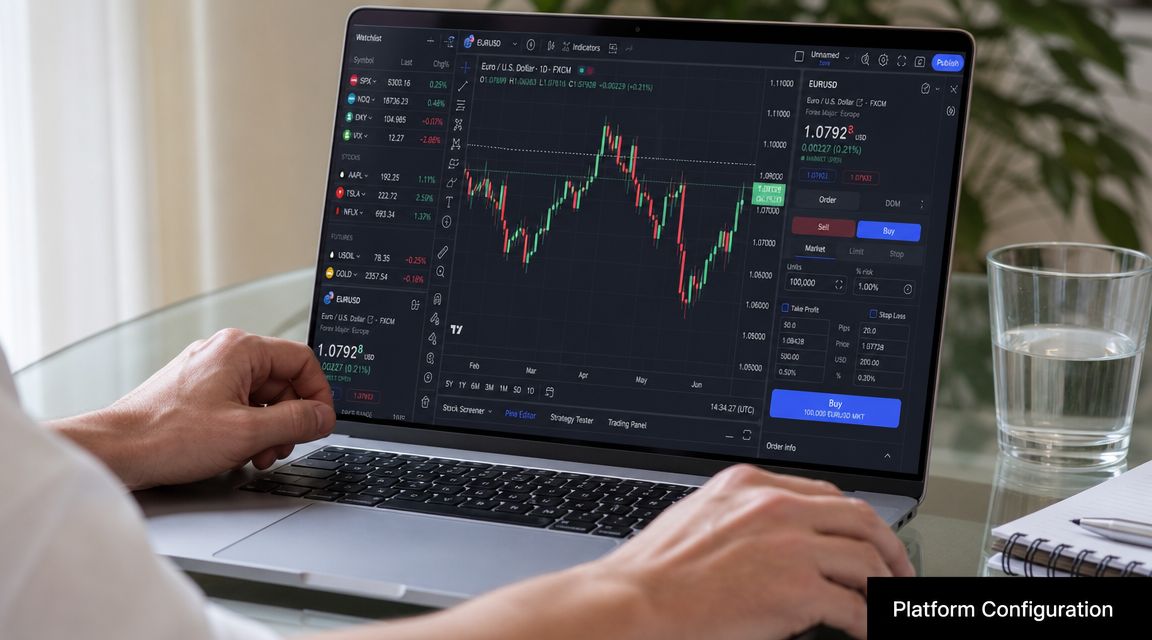
How to place a set and forget trade on DXtrade
DXtrade is straightforward if your workflow is structured.
Use this sequence:
Choose the instrument and timeframe
Confirm you're on the right market and session. A pending order placed on the wrong symbol happens more often than traders admit.Select the correct pending order type
Use limit orders if you want price to retrace into your level. Use stop orders if you want confirmation through a breakout.Enter the position size last
First define where the order goes, where the stop sits, and where the target sits. Then calculate the size that matches that stop.Attach stop-loss and take-profit immediately
Don't place a naked pending order with a plan to “fix it after.” In fast markets, there may be no after.Review the order ticket before sending
Check direction, price, size, stop, target, and expiration if your platform supports it.
A clean platform setup matters as much as the trade logic. If you're comparing interfaces, execution workflow, and supported tools, this overview of the best FX trading platform helps clarify what to look for.
How to handle cTrader
cTrader gives you more flexibility, which is good if you're disciplined and dangerous if you're not.
For a manual set and forget workflow, focus on:
- Pending orders: Buy Limit, Sell Limit, Buy Stop, and Sell Stop
- Attached protection: Stop-loss and take-profit entered with the order
- Expiration logic: Useful if the setup is only valid during a certain session
- Stop-Limit orders: Helpful when you want a breakout trigger with a defined tolerance for execution
For more advanced traders, cTrader also supports automated execution through cBots. That can suit a set and forget approach if the rules are explicit and tested. The trap is assuming automation solves judgment. It doesn't. It only follows whatever logic you gave it.
A practical pre-send checklist
Before clicking submit on either platform, check these items:
- Is the order type correct? A stop order instead of a limit order changes the whole setup.
- Is the stop based on invalidation? Not on a random round number.
- Does the target reflect actual structure? Not just a hoped-for payout.
- Is the size correct after spread and execution friction?
- Should the order expire if price doesn't reach it soon?
The platform should execute your plan, not force you to babysit it. If the order ticket doesn't fully express the trade idea, the setup isn't ready.
One factual point worth noting in the context of automation and funded trading conditions: MyFundedCapital states that it supports manual, algorithmic, and copy trading on DXtrade and cTrader, which makes platform mechanics especially relevant for traders building rule-based execution.
Backtesting and Monitoring Your Strategy
A set and forget strategy that hasn't been tested is just a story you like. A strategy that was tested once and never reviewed becomes stale faster than most traders expect.
Backtesting answers one question. Did this ruleset behave acceptably across past conditions? Monitoring answers another. Is it still behaving acceptably now?
Backtest the rule set, not the dream
Keep your test simple and strict.
You need a written model with clear conditions for:
- Entry
- Stop placement
- Target or exit logic
- Trade cancellation
- Session or news exclusions
Then test it across different market conditions, not just the clean periods that flatter the idea. A breakout model may look great in directional periods and behave poorly in chop. A supply and demand entry may thrive in structured swings and struggle when volatility becomes erratic.
If you need a starting point for building a process, this guide on what backtesting is and how traders use it gives a solid framework.
Monitoring isn't meddling
The word “forget” confuses traders here. You're not supposed to interfere with an active trade just because you're nervous. But you are supposed to review the system on a schedule.
A practical review routine might include:
- Weekly review: Did the trades follow the written rules?
- Monthly review: Is the strategy still suited to current market conditions?
- Execution review: Are fills, spread, or timing issues damaging results?
- Rule drift check: Have you changed the setup without documenting it?
That's normal operational maintenance. Other industries do the same thing with automated systems. In banking, for example, teams use analytics to monitor abnormal behavior and maintain controls over time. This piece on fraud detection in banking is a good analogy for traders building systematic oversight. The lesson is simple. Automation without review creates blind spots.
Review the system on a schedule. Leave the open trade alone unless your written rules require action.
What to watch for
Three warning signs usually mean the strategy needs adjustment or a pause:
- The market structure has changed
- Execution quality has worsened
- You keep making exceptions to your own rules
If any of those are present, don't defend the system out of pride. A professional trader updates the process before the account pays for the delay.
MyFundedCapital Compliance Checklist
Before placing any set and forget trade in a funded environment, run a hard compliance check. This isn't paperwork. It's protection.
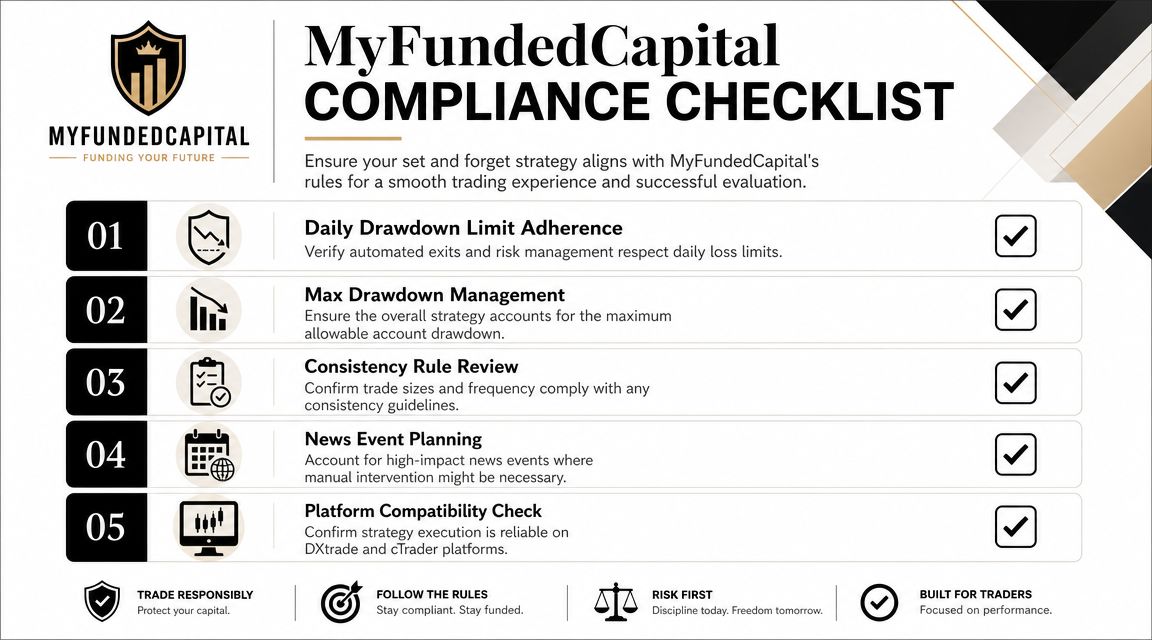
Answer yes before the order goes live
- Have you sized the trade so a normal stop-out is well below the daily loss rule? If the answer is no, reduce size or skip the trade.
- Have you checked total account exposure, not just this one setup? Pending orders, correlated pairs, and open positions all count in practice.
- Does your automation behave predictably on your chosen platform? If you're using a bot or semi-automated process, test the mechanics before account evaluation or funded trading.
- Have you reviewed scheduled news and session conditions? A valid chart idea can become a bad prop trade if the timing is wrong.
- If you plan to hold longer, does the setup account for gap risk and rule constraints? Longer holding periods require a stronger reason, not a looser standard.
- Is your management plan written down before entry? Breakeven rules, partials, trailing logic, and cancellation rules should already be decided.
- Would this trade still be acceptable if execution is slightly worse than expected? If the answer is no, it isn't strong enough.
Why this checklist matters
Most funded-account failures don't come from not knowing a setup. They come from letting a decent setup run inside a weak process.
A checklist forces honesty. It catches the preventable mistakes. It slows down impulsive orders. And for set and forget trading, it does something even more important. It makes sure “forget” only applies to emotion, not to responsibility.
Frequently Asked Questions
Is set and forget trading the same as using an EA?
No. A discretionary trader can use set and forget by placing a fully planned manual trade and leaving it alone. An EA or cBot automates that process in software. The common thread is pre-defined rules, not whether a human or platform sends the order.
How often should I check an open trade?
Check for compliance and platform stability, not for emotional comfort. If your stop, target, and management rules are already in place, constant chart-watching usually leads to unnecessary intervention.
Does set and forget still work in current prop trading conditions?
It can, but the model has changed. The question isn't just which method has the cleanest setup, but which fits strict loss limits and payout goals. Recent trading content looking ahead to 2026 notes that many traders are moving toward rules-based management such as pre-planned breakeven moves and multiple targets, rather than a literal “walk away forever” approach, as described in this discussion of set and forget indicator methods.
What's the biggest mistake beginners make with set and forget?
They confuse discipline with passivity. Good set and forget trading removes impulsive decisions during the trade. It doesn't remove planning, review, risk control, or accountability.
A good funded trader doesn't need more excitement. They need cleaner execution, tighter risk, and a process that survives real rules. If you're ready to test a disciplined approach, learn more about the funding programs, compare account options, and start a challenge with MyFundedCapital. Trading involves risk of loss. This content is educational only and not financial advice.
