

 AR
AR
 NL
NL
 EN
EN
 FR
FR
 ES
ES
 IT
IT
 PL
PL
 SV
SV
 PT
PT

The New York forex session runs 8:00 AM to 5:00 PM ET, which is 13:00 to 22:00 UTC during standard time. That sounds simple until Daylight Saving Time shifts the UTC conversion, and that's where a lot of traders end up watching the right market at the wrong hour.
If you've ever opened your charts expecting movement and got a flat grind instead, timing is usually the issue. The New York session matters because it brings in U.S. banks, macro funds, hedgers, and the overlap with London, which is often where the cleanest intraday moves show up. This guide breaks down the practical side of New York session forex time, how to trade it, and where newer traders usually get caught out.
Decoding the New York Session Forex Time
The standard anchor is straightforward. Most U.S. market references define the New York forex session as 8:00 AM to 5:00 PM Eastern Time, and that converts to 13:00 to 22:00 UTC during standard time according to OANDA's session timing guide.
Core anchor: New York session forex time starts at 8:00 AM ET and ends at 5:00 PM ET.
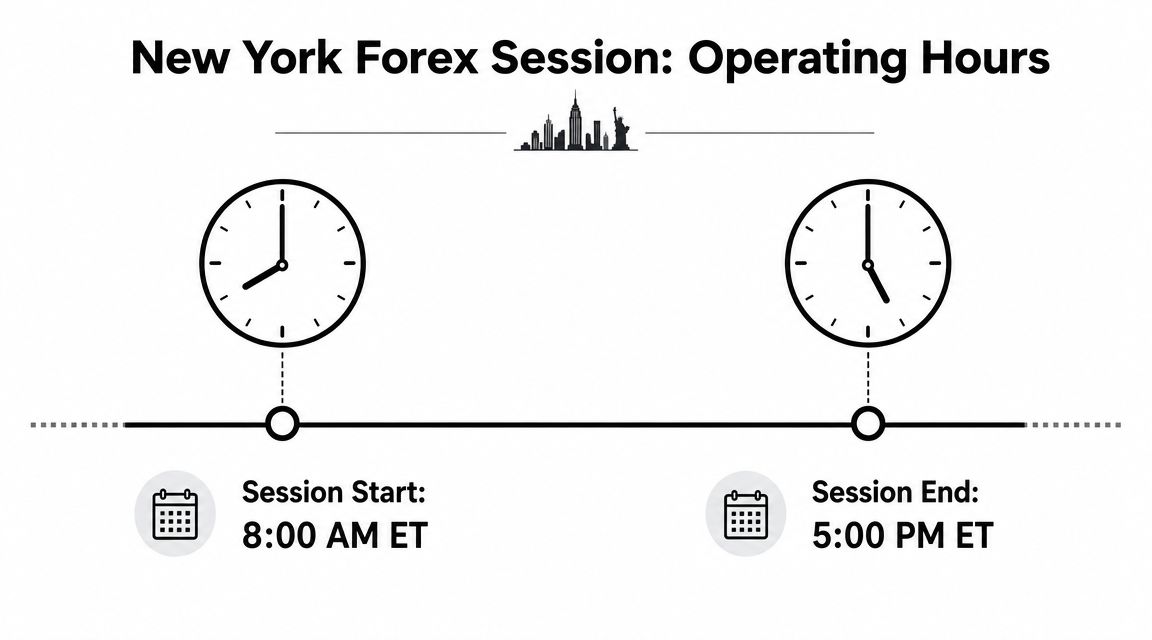
That's the local market clock you should memorize first. After that, convert it into your own timezone and platform timezone. Traders who skip that step often end up planning around screenshots or generic session charts instead of the live market they trade.
The session in practical terms
The New York session sits inside the global 24-hour forex cycle, but it has a different character from the quieter Asian hours. The early part of New York usually matters most because U.S. participants come in while London liquidity is still active.
OANDA notes that the first 1 to 3 hours after the New York open are often the most actionable because order flow from U.S. banks and funds enters while London is still active, which can tighten spreads on major pairs such as EUR/USD, GBP/USD, and USD/JPY through that overlap window.
What traders should actually track
For day trading, I'd keep a short checklist:
- Local open: Know when 8:00 AM ET hits in your timezone.
- Platform time: Check whether your broker charts display New York time, UTC, or server time.
- Session focus: Build your watchlist before the open, not after price has already expanded.
- Sunday reset: If you also trade weekly opens, this guide on when forex opens on Sunday helps frame the market around New York time.
Trading involves substantial risk of loss and isn't suitable for every investor. This article is educational only and isn't financial advice.
The London-New York Overlap The Market's Power Hour
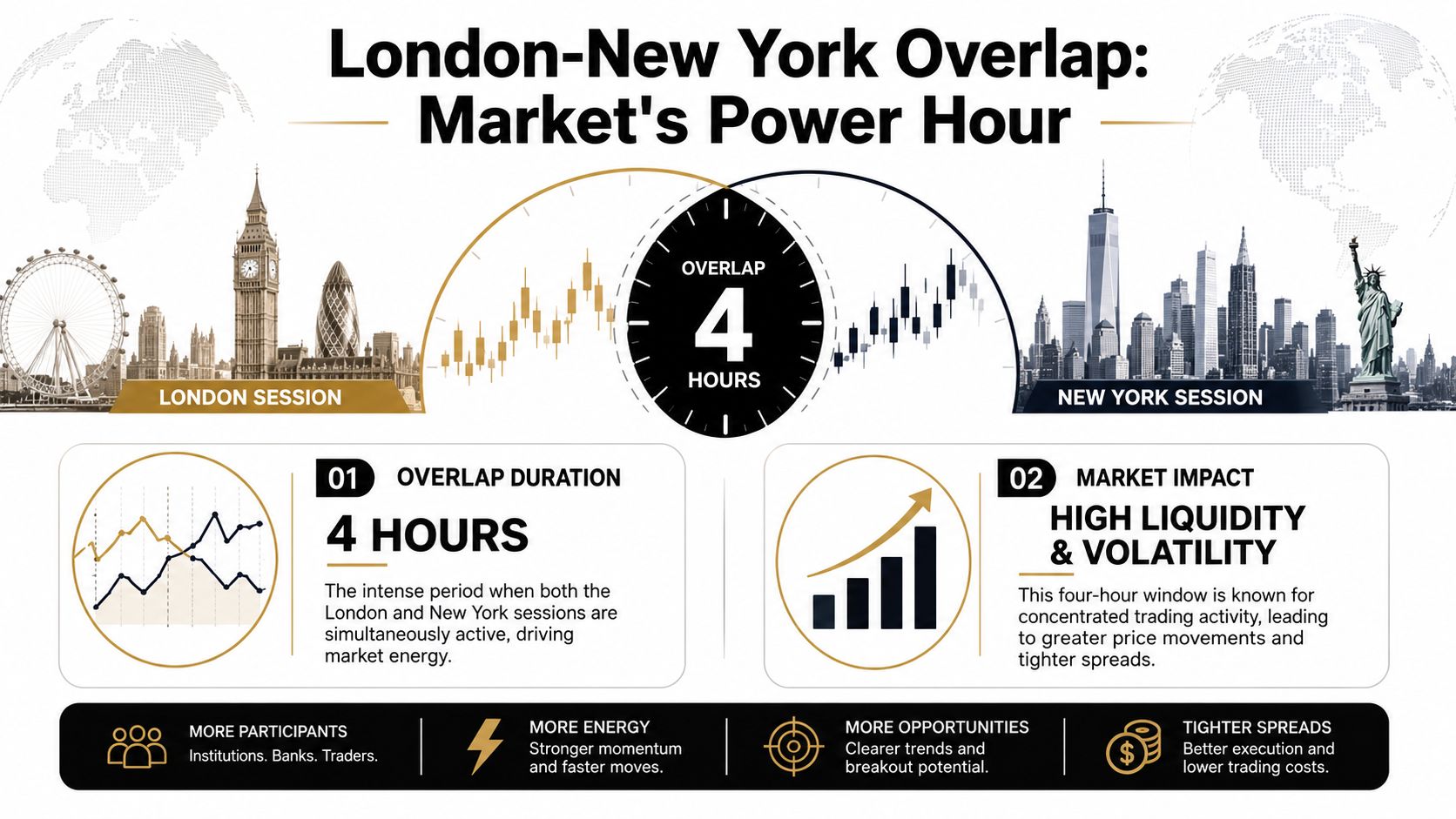
At 8:30 AM New York time, a trader can go from waiting on a sleepy chart to managing a fast breakout in minutes. That shift usually happens during the London and New York overlap, when European flow is still active and U.S. orders start hitting the market.
The overlap matters because participation is broad on both sides of the Atlantic. Banks, macro funds, corporates, and short-term traders are all active in the same window. That concentration changes market behavior. Levels break more cleanly, failed moves reverse harder, and hesitation gets expensive.
When the overlap happens
A practical benchmark is the overlap between roughly 13:00 and 16:00 UTC, based on London trading around 07:00 to 16:00 UTC and New York around 13:00 to 22:00 UTC, as outlined in this session overlap explanation.
Use that as a working reference, not a fixed law. Daylight Saving Time shifts can move the relationship between local clocks, which is why prop traders track the session in market time first and only then convert it to broker time and local time.
Why price tends to move harder here
The driver is order flow.
Overnight ranges have already formed. European traders have shown their hand. Then U.S. participation comes in, often around major data releases, and the market has enough liquidity to move with conviction. That is why the overlap often produces the cleanest intraday expansion, but it also produces some of the worst entries if you chase after the first impulse.
On the chart, that usually shows up in a few repeatable ways:
- Asian session highs and lows get tested quickly: Once fresh U.S. flow arrives, quiet-session boundaries often stop acting as reliable barriers.
- Breakouts either follow through fast or fail fast: The overlap is good at exposing weak setups early.
- Momentum strategies have a better fit: If a pair is repricing on real news or broad dollar demand, continuation trades make more sense than trying to fade every extension.
- Risk rises with opportunity: Spreads may be tighter, but slippage and sharp reversals still show up around U.S. releases.
Tighter spreads help with execution. They do not make the trade safer.
What tends to work, and where traders get hurt
From a risk desk perspective, the overlap rewards preparation more than prediction. The traders who do well here usually come in with pre-marked levels, a clear invalidation point, and a rule for standing aside when data is due.
Setups that often fit this window:
- Breakouts from overnight consolidation
- Continuation trades after a real catalyst
- Retests of levels that already proved they matter during London
Setups that often fail here:
- Fading the first strong push without confirmation
- Using stops so tight that normal overlap volatility clips them
- Trading pairs with no clear link to U.S. or European flow
One trade-off matters more than beginners expect. The overlap gives better liquidity, but it also removes the luxury of indecision. If your plan depends on wide discretion after entry, this window will expose that weakness quickly.
For broader context on how the European side of that handoff develops before New York comes in, compare it with this London trading session time guide.
Best Currency Pairs to Trade During the New York Session
Pair selection matters more than a lot of beginners think. During New York hours, I'd rather trade the pairs that respond to U.S. flow than force setups on instruments that are active somewhere else.

Pairs that usually deserve screen space
The first group is the obvious one. USD majors should lead your watchlist.
- EUR/USD often reacts cleanly because it sits at the center of both European and U.S. participation.
- GBP/USD can move sharply during overlap conditions, but it also punishes late entries.
- USD/JPY often responds well when U.S. rates, risk sentiment, or broad dollar direction take over.
- USD/CAD becomes especially relevant when North American themes dominate.
These pairs make sense because the New York session is driven by U.S. participation. If U.S. data or dollar repricing is the engine, you want instruments directly tied to that engine.
Pairs I'd treat more carefully
Some crosses can still trade well, but they need more selectivity.
GBP/JPY can deliver strong movement when momentum is broad-based, but it doesn't forgive sloppy execution. If your stop placement is inconsistent, this pair will expose it fast.
By contrast, pairs like AUD/NZD often make less sense for a New York-focused intraday plan. Their primary liquidity story belongs elsewhere, so New York can feel patchy, with less convincing follow-through and less useful structure for a fast day trade.
A simple watchlist rule
Use this decision filter before the session opens:
| Pair type | New York session fit | Why |
|---|---|---|
| USD majors | Strong | Direct exposure to U.S. flows and macro headlines |
| European USD pairs | Strong during overlap | Active while London participation remains in the market |
| Volatile crosses | Selective | Can trend well, but execution errors get expensive |
| Asia-focused pairs | Lower priority | Often less aligned with the session's main drivers |
Don't try to trade everything. Two or three pairs you understand well will usually beat a cluttered watchlist.
Practical Strategies for Trading This Session
The New York session accounts for roughly 17% of total daily forex turnover, and with daily FX volume around $7.5 trillion, that implies over $1.1 trillion is traded during these hours alone according to MarketMates' New York session breakdown. That's why breakout and momentum strategies tend to get more real movement here than they do in slower parts of the day.
What matters is structure. Not prediction.
Breakout trading
This is one of the cleanest ways to approach the session, especially if the market spent the prior hours compressing.
The setup
Mark the overnight or Asian range. Identify the obvious high, low, and any level price has tested multiple times without breaking.The entry trigger
Don't buy the first touch of a level just because price reaches it. Wait for a break that clears the range and shows acceptance beyond it. On fast mornings, the market often gives one push, one hesitation, then either follows through or snaps back.The risk rule
If the breakout immediately falls back into the range, that's information. Cut it. New York breakouts that work usually don't need much time to prove themselves.
News trading
U.S. data can change the session tone quickly. That doesn't mean every release is tradable.
A practical framework:
- Before the release: Know which pairs are directly exposed. Don't improvise your watchlist seconds before the number.
- At the release: Let the first reaction print. Chasing the first spike often turns a trade plan into a slippage event.
- After the release: Trade only if price forms a structure you can define, such as a pullback after an impulse or a clean break from a news-driven range.
Momentum continuation
Some of the best New York trades aren't fresh reversals. They're continuation moves after London already established direction.
Look for:
- a clear directional move earlier in the day
- a shallow pullback near the New York open
- renewed participation once U.S. flow joins the existing trend
This works best when the market already has a reason to move. It works poorly when you're trying to manufacture trend out of random noise.
Risk control from a prop trader's perspective
Volatility doesn't excuse bad process. It punishes it faster.
Practical rule: If your setup only works with wider hope and looser discipline, it isn't a New York session edge. It's just exposure.
A prop-style approach means setting limits before the open:
- Choose your max daily loss first
- Reduce size around major U.S. releases if fills matter to your strategy
- Skip marginal trades after a strong early move if your plan depends on fresh expansion
- Journal the time of your best and worst executions
If you trade in evaluation environments, firms like MyFundedCapital let traders operate under defined loss limits and simulated capital conditions, which can be useful if you want your session plan tested against strict risk rules rather than vague self-discipline.
This is educational content only, not financial advice. Trading involves risk of loss, and no session or setup guarantees profit.
Navigating Timezones and Daylight Saving Time
A lot of traders learn the session once, write down one UTC conversion, and assume it stays fixed. That's the mistake.
The New York session still starts at 8:00 AM ET, but its relationship to UTC changes when Daylight Saving Time changes. IG notes that a DST-aware schedule is critical because a one-hour mismatch can change news-entry timing and whether a setup is inside the London-New York overlap in its guide to trading the New York session.
The reference table you actually need
| Period (Approximate) | New York Local Time (ET) | UTC Time | London Overlap (UTC) |
|---|---|---|---|
| U.S. standard time | 8:00 AM to 5:00 PM ET | 13:00 to 22:00 UTC | 13:00 to 16:00 UTC |
| U.S. daylight time | 8:00 AM to 5:00 PM ET | 14:00 to 23:00 UTC | changes by season |
That second row is where people slip. The local New York session hasn't changed. Your UTC conversion has.
How to avoid timing errors
Use a simple process:
- Build around ET first: Keep New York local time as your anchor.
- Convert second: Translate into UTC only for your own location, alerts, and calendar.
- Check seasonal changes: Don't assume London and New York shift in sync every week of the year.
- Review your schedule monthly: A stale calendar creates avoidable mistakes.
For a broader schedule across sessions, this guide to the best times to trade forex is a useful companion.
One hour off can mean the difference between trading the real overlap and trading the dead air after it.
FAQ and Your Next Step in Trading
Can I trade the New York session if I live in Asia or outside the U.S.?
Yes, but the issue is practicality, not access. You need a routine that lets you trade the session with focus. If you're tired, late, or trying to multitask through the open, the session's speed becomes a liability.
What happens after London closes?
The market often changes character. You can still get movement, especially around U.S.-specific themes, but the texture usually shifts. Price may continue trending, or it may lose the clean two-center flow that made the earlier part of the day attractive.
Is the New York session better than London?
Not better. Different. London often starts the day's main directional moves, while New York either accelerates them, reverses them, or re-prices the market around U.S. information. For many intraday traders, the best conditions come when both are active together.
What's the biggest beginner mistake with New York session forex time?
Treating session hours like a trivia answer instead of a trading variable. Knowing “8 AM to 5 PM ET” isn't enough. You need to know when your pairs move, when your strategy performs, and whether you're trading the live overlap or a slow period that only looks active on paper.
The next step is simple. Pick one or two pairs, mark the New York open on your charts for a few weeks, and study how price behaves in the first part of the session versus later in the day. You'll learn more from that focused review than from jumping between every pair and every session.
If you want to apply this with real structure, explore MyFundedCapital and compare its funding paths, account types, and rule sets against the way you trade. If your edge depends on session timing, disciplined execution, and respecting risk, a prop-style environment can be a useful way to test whether your New York session plan holds up under defined loss limits.
