

 AR
AR
 NL
NL
 EN
EN
 FR
FR
 ES
ES
 IT
IT
 PL
PL
 SV
SV
 PT
PT

Most advice about academy financial trading is backwards. Traders are told to find a course, learn a setup, then profits will follow. In real prop evaluations, that sequence fails fast because firms don't fund knowledge. They fund repeatable execution under risk limits.
A trading academy can help, but only if it builds skills you can prove under pressure. The useful question isn't whether an academy looks professional. It's whether its training converts into disciplined decisions, clean risk control, and behavior that survives a funded challenge.
What Is a Financial Trading Academy Really Selling?
Most academies aren't selling an edge. They're selling structure.
That matters, because beginners usually don't fail from lack of information. They fail because they collect strategies, switch markets too often, oversize when they're confident, and abandon rules after a losing streak. A decent academy can reduce that chaos. A bad one packages chaos in nicer branding.

The product is usually process, not performance
If you're evaluating academy financial trading offers, strip away the webinar language and ask what is being delivered.
A real program usually offers:
- A learning sequence so you stop jumping from candlestick patterns to macro news to indicators with no framework
- A repeatable routine for market prep, execution, review, and error correction
- Feedback loops through mentorship, journaling, or trade review
- Risk habits that stop one bad day from turning into account damage
What it usually cannot deliver is guaranteed profitability. No course can hand you emotional control, patience, or clean execution. You still have to build those through repetition.
The gap most traders miss is simple. Learning the language of trading isn't the same as proving you can trade under rules.
That gap shows up far beyond trading. One analysis highlighted a large mismatch between people completing training and people leaving with job-ready skills, noting that many programs don't answer the practical question of who can perform after training. The same critique applies directly to trading academies, especially when they avoid discussing who can pass risk-based evaluations in live test conditions, as discussed in the Acumen Academy awardees analysis.
What a good academy should really be
The right mental model is skill incubator, not secret society.
Useful academies help traders do three things:
- Narrow their focus to one market type or playbook.
- Build decision quality before they worry about payout fantasies.
- Translate education into measurable behavior.
That last point is where most marketing breaks down. If a course can't tell you what a student should be able to do after training, it probably isn't teaching a serious process.
A trader finishing a solid program should be able to define a setup, explain invalidation, size risk consistently, and review mistakes without rewriting the rules every week. That's a trading education with real value. Everything else is packaging.
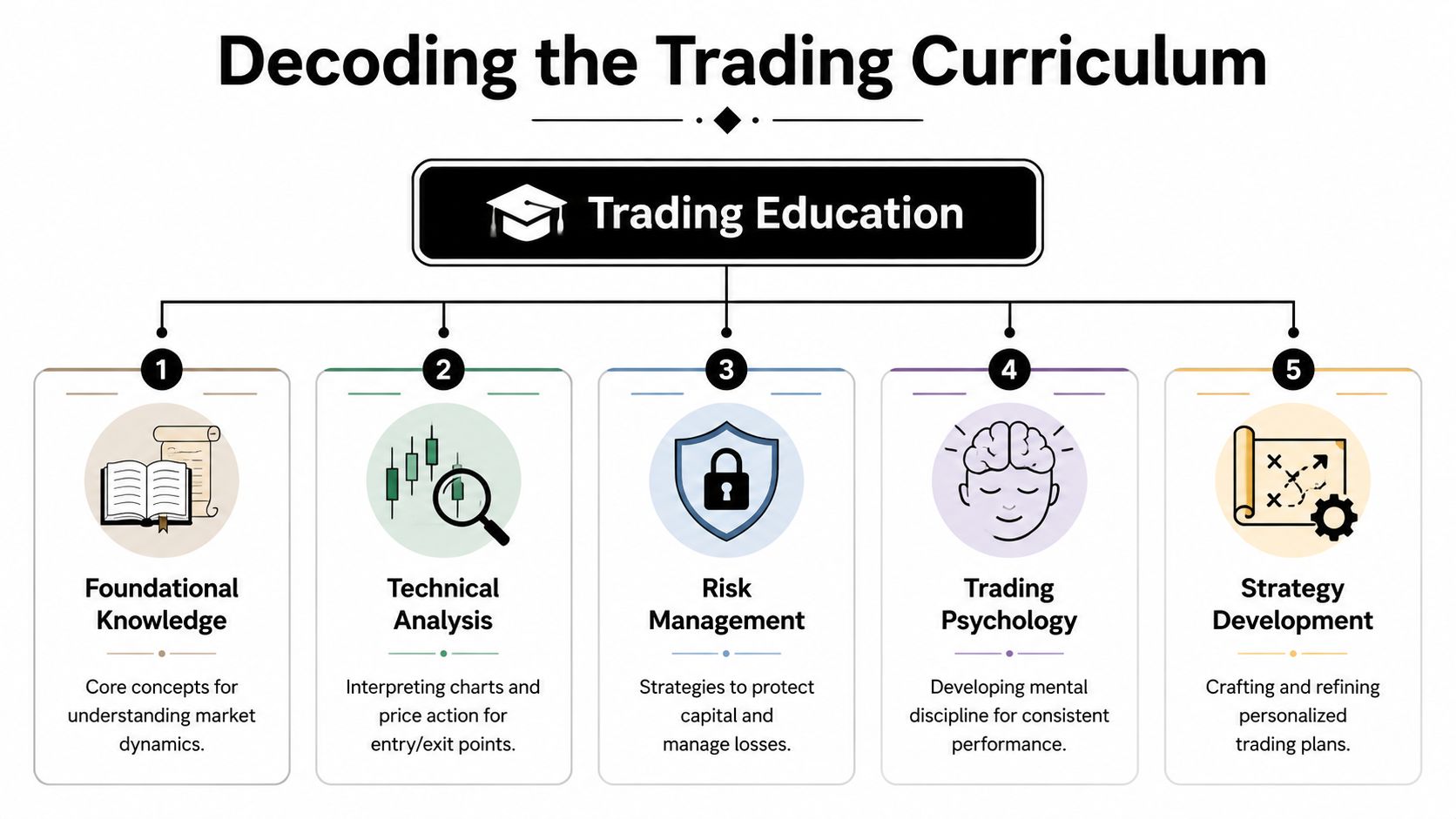
Decoding the Curriculum and Essential Skill Outcomes
A weak curriculum teaches entries. A strong curriculum teaches decision architecture.
Most trading education still rests on two core pillars: fundamental analysis and technical analysis. Trading Academy's materials describe fundamental analysis as evaluating equities through factors such as revenue growth, profitability, debt levels, turnover rates, and management quality, while technical analysis studies price movement and chart behavior using tools like MACD and Bollinger Bands, as outlined on its fundamental analysis resource.
The non-negotiable pillars
If I were screening traders based on educational background, I wouldn't care much about how many modules they completed. I'd care whether the curriculum forced competence in these areas:
- Risk management first. Can the trader define per-trade risk before entry? Can they explain when not to trade?
- Trading psychology in behavior terms. Not motivational talk. I want to see rules for revenge trading, overtrading, hesitation, and FOMO.
- Position sizing logic. If size changes randomly, the strategy doesn't matter.
- Journal-based review. Traders need a record of setup quality, execution quality, and rule violations.
- Strategy development. A setup needs market conditions, trigger, stop logic, target logic, and invalidation.
A lot of academy financial trading programs bury those topics behind flashy modules on sniper entries. That's backwards. Entries are easy to teach. Risk discipline is what separates trainable traders from gamblers.
How fundamental and technical work together
New traders often treat fundamental and technical analysis as competing camps. In practice, they serve different jobs.
Fundamental work helps a trader understand what they're trading and why an asset may attract sustained interest. Technical work helps the trader decide when to act and where price structure gives a clean decision point.
A practical blend looks like this:
- Fundamentals set context
A trader builds directional bias or avoids trading against major underlying drivers. - Technicals time execution
The trader uses chart structure, momentum, and volatility behavior to frame entry and exit. - Risk rules override both
Even a strong idea is a bad trade if the stop placement and account rules don't fit.
For traders building their own path, curriculum design matters more than branding. A good reference for organizing learning outcomes is this guide to GroupOS curriculum development strategies, because it pushes you to define skills and outcomes instead of collecting disconnected lessons.
What a serious student should produce
By the end of training, a trader should have deliverables, not just notes.
That includes:
- A written trading plan
- A setup checklist
- A market selection rule
- A trade journal
- A review process for weekly errors
If your technical base is still shaky, a beginner-friendly explainer like this technical analysis guide for traders is more useful than another strategy video. Use it to clean up your process, not to chase new indicators.
Practical rule: If a course can't show you the documents and habits a trader should leave with, the curriculum is incomplete.
Vetting Instructors and The Myth of Accreditation
Retail trading education loves the word accredited because it sounds institutional. In most cases, that label doesn't tell you much about whether the instructor can train traders for real performance.
What matters more is whether the people behind the program have a professional footprint, a coherent method, and enough transparency to survive scrutiny. That doesn't mean they need to publish brokerage statements online. It means they should be able to explain their process in a way that a serious trader can test.
What institutional credibility actually looks like
A useful benchmark is an actual financial firm with a visible operating footprint. Academy Securities presents itself as the nation's first post-9/11 veteran-owned and operated investment bank and states that it operates across capital markets, asset management, public finance, geopolitical intelligence, fixed income, and equity trading, with offices including Del Mar and Chicago, according to Academy Securities.
That kind of profile matters because it shows what a real institutional operation looks like. Multiple business lines. Public contact structure. Market-facing services. A training brand with none of that isn't automatically bad, but it shouldn't borrow institutional language it hasn't earned.
Green flags and red flags
When I review instructors, I care less about charisma and more about whether they teach in a way that survives contact with live markets.
Green flags
- They define risk before opportunity
Serious instructors talk about invalidation and trade selection early. - They show losing trades
If every example is perfect, you're watching marketing. - They can explain when their setup doesn't work
That's the mark of a trader, not a content creator. - They teach process over prediction
Good mentors build habits, not dependency.
Red flags
- Guaranteed outcome language
Any promise of income or easy funding should end the conversation. - Broker or affiliate pressure
If education constantly funnels you into a product, be careful. - No framework for review
Traders improve through feedback, not inspiration. - No distinction between analysis and execution
Knowing a setup isn't the same as trading it well.
If the instructor's main skill is audience growth, the training usually reflects it.
Accreditation doesn't save a weak mentor. A plain, disciplined teacher with a clear method is worth more than a polished salesperson with cinematic charts and no accountability.
Comparing Learning Formats In-Person Online and Bootcamps
Format won't make you profitable, but the wrong format can waste months. The best choice depends on how you learn, how much accountability you need, and whether you have time to practice between lessons.
The trade-offs in plain English
In-person training works best for traders who need direct structure. You show up, ask questions live, and usually stay more focused. The downside is rigidity. Fixed schedules don't help if you work full-time or trade around another job.
Online courses fit traders who are self-directed. You can replay lessons, study on your own schedule, and revisit material after a rough week. The problem is obvious. Flexible learning also makes it easier to drift, binge content, and confuse consumption with skill building.
Bootcamps sit in the middle. They're tighter, faster, and usually built around applied work. That can be useful if you already know the basics and need a concentrated push toward execution, evaluation prep, or system refinement.
For traders exploring intensive options, these trading boot camps programs show the general model well: focused training aimed at sharpening strategy, confidence, and funded-account readiness.
Trading Academy Format Comparison
| Format | Typical Cost | Best For | Pros | Cons |
|---|---|---|---|---|
| In-Person | Varies widely | Traders who need structure and direct interaction | Real-time Q&A, stronger routine, easier networking | Less flexible, often time-heavy, location-dependent |
| Online | Varies widely | Self-directed learners with schedule constraints | Flexible access, replay value, easier to combine with work | Easy to procrastinate, weaker accountability |
| Bootcamp | Varies widely | Traders who want concentrated application and feedback | Faster immersion, practical focus, strong momentum | Intense pace, can overwhelm beginners |
What tends to work best
Beginners usually overvalue access and undervalue implementation. They think more live calls will fix inconsistency. Usually, what fixes inconsistency is a smaller set of rules followed repeatedly.
A practical way to choose format is to ask:
- Do you need external accountability, or do you already study consistently?
- Can you practice between sessions, or are you only collecting theory?
- Are you trying to build foundations, or pressure-test a strategy?
If you're honest about those answers, the right format becomes clearer. The wrong one usually reveals itself after you've paid.
A Practical Checklist for Choosing the Right Program
Most traders don't need more persuasion. They need a filter.
Use this checklist before you buy any academy financial trading program. If the provider dodges basic questions, that's useful information by itself.
Curriculum integrity
Ask to see the actual learning path.
- What comes before strategy?
If risk management and journaling appear late, the curriculum is upside down. - What are the required outputs?
A proper course should lead to a plan, checklist, and review routine. - How is progress evaluated?
Completion badges don't matter. Behavioral standards do.
Instructor credibility
The right question isn't "Are they famous?" It's "Can they teach a process I can verify?"
Ask:
- Can the instructor explain their setup in rule-based terms?
- Do they show failed trades and rule violations?
- Is there mentorship, or only content delivery?
Good instructors don't just answer why a trade worked. They explain why the same setup should have been skipped in a different context.
Community and support
A community can help. It can also become a noise machine.
Look for:
- Structured review channels
Trade feedback beats chat-room hype. - Clear boundaries
Constant signal sharing often creates dependency. - Access to correction
You need honest critique, not motivational spam.
If you're comparing support models, broader thinking around self-paced and guided learning from this learn on demand guide can help you judge whether a program fits your schedule and retention style.
Cost versus value
Price matters less than fit, but bad fit makes any price expensive.
Check whether the program gives you:
- A method you can test
- A review process you can repeat
- Support that improves decision-making
- Post-course direction for real-world application
Don't buy based on brand aesthetics. Buy based on whether the program leaves you more rule-based, more measurable, and less impulsive than before.
The Bridge From Academy Education to Funded Trading
Most traders' limitations become evident. They leave an academy able to talk about market structure, indicators, and psychology, yet fail a funded challenge because they can't apply any of it under risk limits.
A prop evaluation doesn't reward your knowledge library. It rewards controlled execution.

What changes when rules matter
In a funded environment, timing errors get expensive quickly. IG's technical analysis guide notes that traders use chart patterns and indicators to infer where price reacted previously and may react again, and that technical analysis works as a probabilistic framework rather than a prediction engine. That matters in prop trading because combining signals such as trend alignment and RSI divergence can improve setup quality, while poor timing increases the chance of violating daily loss or max drawdown constraints, as explained in IG's beginner's guide to technical analysis.
That means academy education only becomes useful when you convert it into challenge-specific behavior.
The conversion process that actually matters
A trader moving from education to evaluation should tighten everything:
- Define one primary setup
Don't bring five half-tested ideas into a challenge. - Start with higher-timeframe structure
Bias first. Entries second. - Require confluence
Trend, level, and momentum should agree before you act. - Know your invalidation before entry
If your stop logic is fuzzy, the trade isn't ready. - Protect mental capital
Two poor trades can do more damage to decision quality than to the account itself.
This is why single-indicator trading fails so often in evaluations. One oscillator can flash signals all day. That doesn't mean the market is offering quality entries. The edge comes from stacking evidence.
Execution test: If you can't explain the trend, the level, and the trigger in one short sentence each, you're probably not looking at an A-grade trade.
Education that survives a funded challenge
The bridge from academy to prop is built from habits, not theory.
A useful workflow looks like this:
- Mark higher-timeframe structure.
- Identify valid support or resistance.
- Wait for momentum confirmation.
- Check whether the risk fits account rules.
- Enter only if the setup still makes sense after all four checks.
Some firms make this transition easier by publishing practical material around evaluation logic. For example, this guide on how to get a funded trading account outlines how funded models work and what traders need to prepare for before attempting one. Use resources like that to translate classroom knowledge into testable behavior.
Trading involves risk of loss. A funded challenge doesn't remove that. It just makes your discipline visible faster.
Frequently Asked Questions
Are financial trading academies worth it?
They can be, but only if they improve behavior you can measure. A course is worth paying for when it helps you build a repeatable plan, manage risk consistently, and review mistakes with discipline. It isn't worth it if it mostly sells lifestyle imagery, constant signal drops, or vague promises about fast funding.
Do I need an academy to become a funded trader?
No. Plenty of traders build skill through self-study, chart time, journaling, and deliberate practice. A key question is whether you can stay structured on your own. If you can't, a good academy may shorten the trial-and-error phase by forcing process and accountability.
What background produces better trading candidates?
The strongest candidates usually come from backgrounds that reward patience, process, and review. That can include analytical fields, competitive performance environments, or any work where rules matter and feedback is constant. The weakest candidates usually chase novelty, switch systems often, and treat education like entertainment.
Can an academy teach me to pass a prop challenge?
It can help, but it can't do the hard part for you. Passing a challenge requires more than understanding setups. You need to execute within risk rules, avoid emotional damage after losses, and stay selective when the market is messy. That's why trading education should be judged by what it helps you do under pressure, not by how impressive the curriculum sounds.
Trading involves risk of loss, and none of this is financial advice. Treat academy financial trading as education, not a shortcut to guaranteed income.
If you're ready to test your skills in a real evaluation environment, explore MyFundedCapital to compare funding programs, review account rules, and choose a challenge model that fits your trading style.
