

 AR
AR
 NL
NL
 EN
EN
 FR
FR
 DE
DE
 ES
ES
 IT
IT
 PL
PL
 SV
SV

A stop loss is the single most important tool separating a professional trader from a gambler. This guide explains how to use stop loss orders to protect your capital, manage risk like a pro, and meet the strict requirements of a funded trading account. You'll learn practical, actionable steps for setting and managing stops that can keep you in the game for the long haul.
What Is a Stop Loss and Why Is It Your Most Important Tool?
A stop loss is a pre-set order you place with your broker to automatically close a trade if the price moves against you to a specific level. It's not a mental note or a guideline; it's a hard rule that executes without your emotions getting in the way. When you're in a losing trade, your judgment can be compromised by hope or fear, leading you to hold on too long. A stop loss takes that dangerous decision out of your hands.
At its core, stop loss trading is about capital preservation. Your trading capital is your business inventory; once it's gone, you're out of business. By defining your maximum risk before entering a trade, you ensure no single loss can knock you out. This is non-negotiable for prop firm traders who must respect strict drawdown rules.
- Takes Emotion Out of the Equation: The exit is automated. No more hoping for a bounce or widening your stop in a panic.
- Forces You to Define Risk: You can't place the trade until you know exactly how much you're willing to lose.
- Protects Your Capital: It's the ultimate safety net against unexpected market spikes and catastrophic losses.
- Builds Professional Discipline: Using a stop loss on every single trade hammers home the disciplined habits that lead to consistency.
Think of a triggered stop loss not as a failure, but as the successful execution of your risk plan—a small, calculated expense to protect your account. For more on the mechanics and other order types, see our comparison of stop loss vs limit order or check this general trading glossary.
The 4 Main Types of Stop Loss Orders
Choosing the right stop loss is like a mechanic picking the right tool—it has to fit the job. Understanding the different types is the first step toward using them strategically.
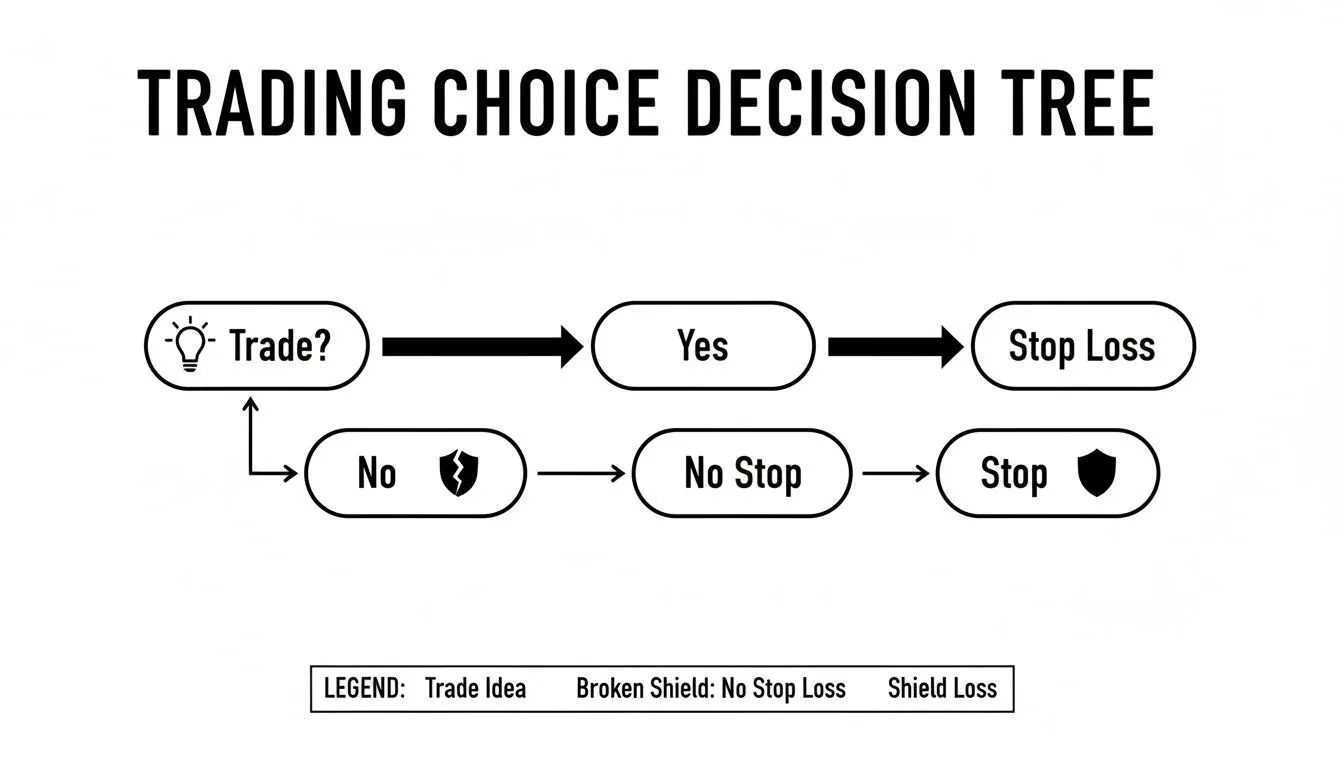
A Quick Comparison of Stop Loss Order Types
This table gives you a bird's-eye view of the four primary stop loss types, comparing how they work, where they shine, and their potential drawbacks.
| Stop Loss Type | How It Works | Best For | Pros | Cons |
|---|---|---|---|---|
| Fixed Stop | A specific, unchanging price level that closes the trade if hit. | Beginners, range-bound markets, and trades with clear price-based invalidation points. | Simple to set and understand. Provides a definitive "line in the sand." | Inflexible. Can be triggered by normal market volatility or a temporary price spike. |
| Trailing Stop | A dynamic stop that follows price in your favor by a set distance but never moves back down. | Trend-following strategies where you want to lock in profits while letting a winning trade run. | Maximizes profit potential on strong moves and protects unrealized gains automatically. | A sharp but temporary pullback can trigger the stop prematurely, even if the main trend continues. |
| Volatility-Based | The stop's distance from the current price is determined by a volatility indicator like ATR. | Volatile or choppy markets where a fixed stop might be too tight or too loose. | Adapts to current market conditions, reducing the chance of being stopped out by "noise." | More complex to calculate. The stop can become very wide during extreme volatility, increasing potential loss. |
| Time-Based Stop | Closes a trade after a pre-determined amount of time has passed, regardless of price. | Day trading, news trading, and strategies where momentum is expected to kick in quickly. | Frees up capital from stagnant trades (opportunity cost) and enforces discipline. | Can exit a trade right before it starts to move in your favor. Price action is ignored. |
The Fixed Stop Loss
The Fixed Stop—or static stop—is the most straightforward. You pick a price, set your order, and if the market hits it, the trade is closed. It's an immovable line in the sand.
This type of stop is a solid choice for:
- Newer Traders: Its simplicity makes it easy to apply immediately.
- Ranging Markets: Place a fixed stop just beyond an obvious support or resistance boundary.
- Clear Invalidation Points: If your trade idea depends on price holding a certain level, a fixed stop just below it is a logical exit.
The Trailing Stop Loss
The Trailing Stop is a dynamic tool that moves up automatically as a trade becomes more profitable. You set it to "trail" the price by a certain amount (e.g., 20 pips or 2%), and it locks in gains as the price moves in your favor. Critically, it never moves back down. It's designed to protect profits while letting winners run.
The Volatility-Based Stop
A Volatility-Based Stop is adaptive. Instead of a fixed amount, it uses market volatility—often measured by the Average True Range (ATR) indicator—to set the stop distance. When the market is choppy (high volatility), the stop automatically sets itself wider. When things are calm (low volatility), it tightens up.
The Time-Based Stop
A Time-Based Stop ignores price and closes a trade after a specific amount of time has passed. The logic is that a good trade should work relatively quickly. If a trade just sits there doing nothing, it's tying up mental and financial capital. This isn't just about limiting losses; it's about opportunity cost. It’s a common tool for day traders who must be flat by the end of the day.
How to Place Your Stop Loss Like a Pro
Setting a stop loss isn't guesswork; it's about finding the one spot on the chart that proves your trade idea was wrong. This is your point of invalidation. Let's walk through four effective methods for placing your stop.
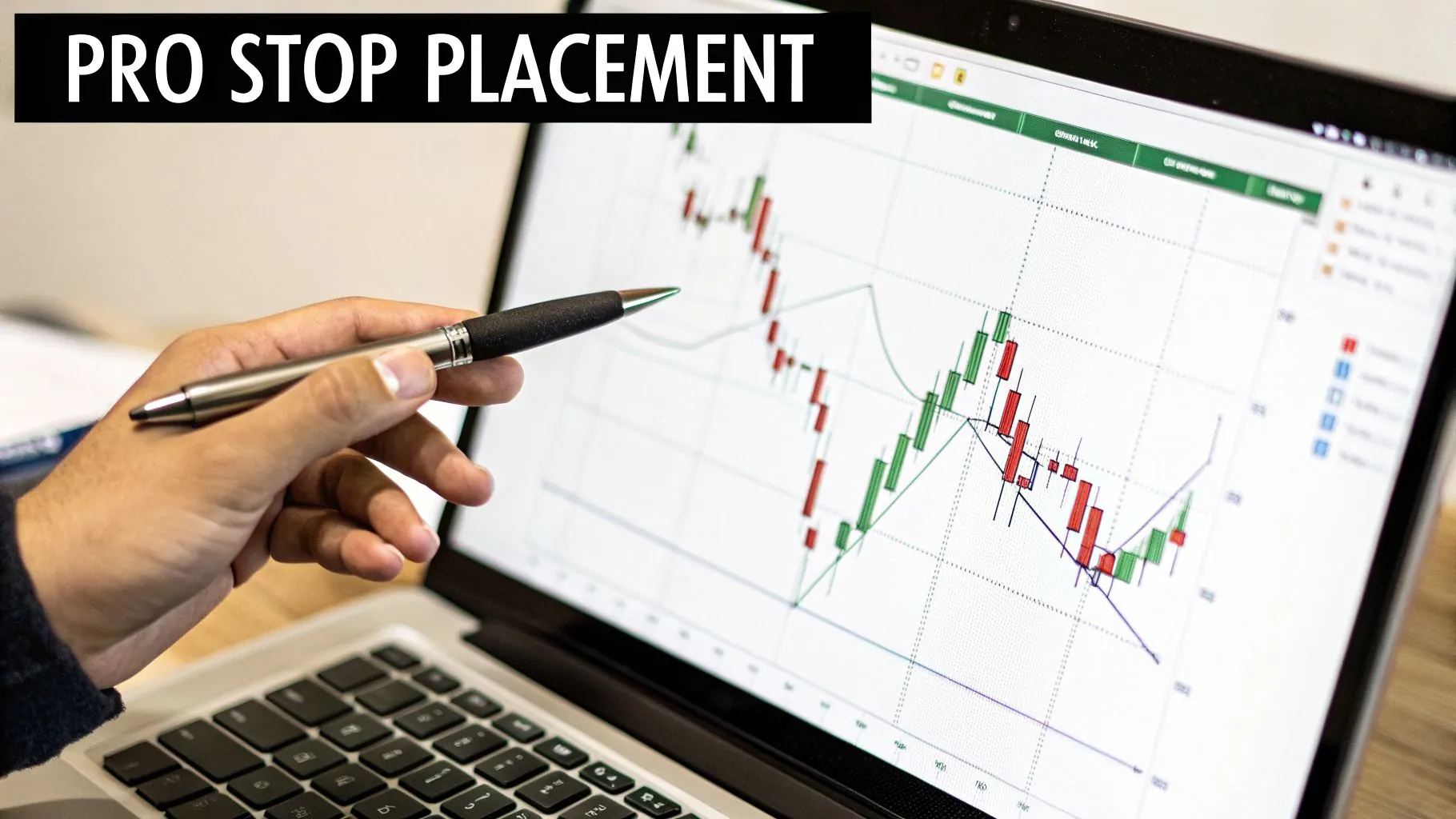
1. Use Chart Structure for Logical Stops
One of the most reliable methods is using the market’s own chart structure. This means looking for key technical markers like swing highs and swing lows—the natural turning points where price has reversed.
- For a long (buy) trade: Set your stop loss just below a recent, significant swing low. If the price breaks that level, the bullish structure is broken, and your trade idea is invalidated.
- For a short (sell) trade: Place your stop just above a recent, significant swing high. If the price pushes past this peak, the bearish momentum has likely failed.
This approach grounds your risk in actual market behavior. Mastering this is a huge part of learning how to read stock charts.
2. Set Stops with Support and Resistance
Support and resistance levels are price floors and ceilings. Placing your stop just on the other side of these levels is a classic and powerful tactic.
For example, if you buy a stock that keeps bouncing off $50 (a strong support level), you might set your stop at $49.80. If your stop gets hit, it’s a clear signal that the established support has failed.
3. Use a Simple Percentage Method
The percentage method is a straightforward way to keep your risk consistent. You simply decide on a fixed percentage—say, 2%—and set your stop loss that far from your entry price.
While simple, a pure percentage stop can be too rigid. A 2% stop might be fine for a currency pair but too tight for a volatile stock. It’s often best used as a starting point or combined with other methods.
4. Adapt with an ATR Multiplier
For a stop that adapts to the market’s current mood, use the Average True Range (ATR) indicator. The ATR measures market volatility. Using an ATR multiplier ensures your stop is wide enough to avoid getting knocked out by normal daily fluctuations but tight enough to protect your capital.
Here’s the simple process:
- Find the current ATR value for your chart's timeframe (14-period is standard).
- Pick a multiplier (e.g., 1.5x, 2x, or 2.5x).
- Calculate stop distance: Multiply the ATR value by your multiplier.
- Set your stop: For a long trade, subtract this distance from your entry. For a short trade, add it.
Example: You go long on EUR/USD at 1.0750. The 14-day ATR is 60 pips. Using a 1.5x multiplier, your stop distance is 90 pips (60 * 1.5). You’d place your stop loss at 1.0660.
The Psychology of Stop Losses and Common Mistakes
Knowing you should use a stop loss is easy. Honoring it when a trade moves against you is one of the toughest challenges in trading. This is a battle you fight in your own head.
The primary psychological trap is loss aversion: studies show the pain of losing feels roughly twice as intense as the pleasure of an equivalent gain. This bias tempts traders to move their stop further away, trying to avoid a small, planned loss, which often results in a much larger, unplanned one.
Common Stop Loss Mistakes to Avoid
Beyond the mental games, several tactical errors can undermine your strategy. Are you making any of these?
- Setting Stops Too Tight: Your stop must be placed outside the market's everyday "noise." A stop that’s too tight will get hit constantly, even if your trade idea is sound. Using the ATR can help you find the right amount of breathing room.
- Placing Stops at Obvious Round Numbers: Big players know retail traders place stops at clean round numbers ($100.00, 1.2500). These areas become liquidity pools where "stop hunts" can occur. Research on market dynamics from the New York Fed's research confirms that stop orders cluster around these levels. Place your stop slightly beyond these obvious spots.
- Widening Your Stop Mid-Trade: Never widen your stop loss once a trade is live. The only direction a stop should move is in your favor (to breakeven or to trail profit). Widening a stop is gambling, not trading.
Stop Loss Trading in a Prop Firm Environment
Trading with a prop firm is about mastering risk. Rules like a 5% daily and 10% maximum drawdown are a mandatory training ground for professional discipline. They force you to build the habits that keep traders in the game.
Your stop loss is the most important tool for navigating this environment. Every trade must be planned so that a loss is a minor, acceptable expense. The goal is to ensure no single position can ever get you close to breaching a drawdown rule. This requires a shift from "How much can I make?" to "How do I survive if I'm wrong?"
Aligning Your Stop Loss with Prop Firm Rules
The drawdown limits are the hard boundaries of your trading career. Your stop loss strategy must be built around them.
For example, on a $100,000 account, a 10% maximum drawdown gives you a $10,000 buffer. A professional trader would never risk more than 1-2% of their account on a single trade, which is $1,000 to $2,000. This builds a cushion to absorb a string of normal losses without endangering your account. The history of trading is filled with cautionary tales of what happens when risk is not managed, which is why risk limits are so important, as detailed in these case studies on how they underscore the value of risk limits.
Practical Scenario on a Funded Account
Let's put this into practice on a $100,000 funded account with a EUR/USD long trade setup:
- Your Plan: You identify support and decide your stop should be 30 pips below your entry.
- Your Risk Limit: You stick to a 1% risk rule, capping your maximum loss at $1,000.
- Position Size Calculation: You take your max risk ($1,000) and divide it by your stop distance (30 pips). The result tells you the precise position size to use, aligning your trade with the firm's rules.
This methodical process links every decision back to the account’s survival. For a deeper dive on account limits, see our guide on what is trailing drawdown.
FAQ: Your Stop Loss Questions Answered
Should I use a "mental stop" instead of a hard stop order?
For 99% of traders, the answer is no. A mental stop is just an idea, and ideas are flimsy when real money and emotions are involved. A hard stop order is a mechanical circuit-breaker that enforces the discipline you need, especially in a prop firm environment with strict drawdown limits.
How wide should my stop loss be?
There is no single "correct" number. The right distance depends on your strategy and the market's current volatility. A great starting point is using the Average True Range (ATR) indicator, setting your stop at a multiple like 1.5x or 2x the ATR value. The unbreakable rule is that your stop distance and position size must never risk more than 1-2% of your capital on a single trade.
Can I move my stop loss after I'm in a trade?
Yes, but only in one direction: to lock in profit. It's smart to move your stop to your entry point (breakeven) once a trade is profitable. Using a trailing stop is another great way to protect gains. You must never move your stop further away to give a losing trade 'more room.' This is the single most destructive habit in trading.
Why does my stop get hit right before the price reverses?
This "stop hunt" frustration usually happens for two reasons. First, your stop is probably too tight, and you're not giving the trade enough room to handle normal market volatility. Second, you might be placing your stop at extremely obvious psychological levels (like $50.00). These areas attract price. Try placing your stop just beyond these obvious spots.
Putting Your Stop Loss Strategy into Practice
All the theory about stop loss trading boils down to one thing: staying in the game. It's not just about knowing the concepts; it's about building a practical, everyday discipline. You've learned the types of stops and how to place them using market structure, and you understand the psychology involved.
This is exactly why prop firms have strict drawdown rules—they force the good habits that professionals live by. The rules create the framework, and your stop loss is the tool you use to navigate it. If you have the discipline to manage capital like a pro, it's time to put it to the test.
This content is for educational purposes only and does not constitute financial advice. Trading involves a significant risk of loss and is not suitable for all investors.
Ready to put your risk management skills into practice? Compare our funded account types and find the challenge that best fits your trading style. If you're ready to prove you can manage capital with discipline, explore our funding programs and start your challenge today.
