

 AR
AR
 NL
NL
 EN
EN
 FR
FR
 DE
DE
 ES
ES
 IT
IT
 PL
PL
 SV
SV

Staring at a losing trade and feeling the urge to "win it back" by doubling down is a common but dangerous impulse for traders. This guide explains why using a martingale strategy calculator isn't a tool for profit, but a simulator to show you exactly how this high-risk approach can quickly destroy your trading account. You'll learn the math behind its inevitable failure and discover safer, professional risk management alternatives.
What Is a Martingale Strategy Calculator?
Think of a martingale strategy calculator less as a trading tool and more as a risk-of-ruin simulator. Its primary function is to demonstrate, in clear mathematical terms, the devastating consequences of doubling your position size after every loss. This tool is not designed for success; it's designed to be a stark warning.

The Martingale strategy originated with gamblers in 18th-century France who believed they had a foolproof system for roulette. The logic seemed simple: after a loss, double your bet. A single win would eventually recover all prior losses plus a small profit. While traders have tried to adapt this for the financial markets, a calculator quickly reveals how flawed this logic is in a real-world trading environment.
Key Inputs and Outputs
A martingale calculator uses a few basic inputs to project the consequences of a losing streak.
- Initial Position Size: Your starting risk on the first trade (e.g., $50).
- Multiplier: The classic Martingale uses a 2x multiplier, but some tools allow you to test less aggressive options like 1.5x.
- Total Trading Capital: Your entire account balance, used to determine how many consecutive losses you can sustain before your account is depleted.
- Win/Loss Ratio: Your strategy's historical win rate. For simplicity, many calculators default to a 50/50 scenario.
After entering this data, the calculator shows how a string of losses impacts your account. It perfectly illustrates the strategy’s fatal flaw: it's designed to produce a series of small wins followed by one catastrophic, account-ending loss.
The core function of a Martingale calculator is to demonstrate how quickly a losing streak can demand more capital than you possess, making total account failure a mathematical certainty over time.
For example, starting with a $50 risk:
- After one loss, your next trade must risk $100.
- Lose again, and it's $200.
- Then $400.
After just six consecutive losses—a common event in trading—your next trade would require a position size of $3,200. That's a 64x increase from your initial risk. This exponential explosion in position size is why the strategy is incompatible with sound money management, especially for funded traders operating under strict drawdown limits.
How a Martingale Calculator Really Works
Let's look at the mechanics of a martingale strategy calculator to see how it operates. The logic is simple: it applies exponential doubling to your trading strategy after each loss. Think of it as a risk amplifier, not a profit generator.
Imagine you risk $10 on a trade. If you lose, your next trade is for $20. Lose again? Now you must risk $40. The calculator simply automates this frightening progression.
Core Calculator Inputs
To get started, the calculator needs a few key variables:
- Initial Trade Size: The amount of money you risk on your first trade (e.g., $100 or 1% of your account).
- Multiplier: The engine of the strategy. The classic Martingale uses a 2x multiplier, doubling your position size after each loss.
- Total Capital (Bankroll): The full size of your trading account. The calculator uses this to show how many consecutive losses you can take before going bust.
With just these inputs, the tool can map out the potential destruction of your account.
The Terrifying Outputs
The calculator's outputs reveal the grim reality of compounding losses. It shows a direct route to ruin, not a path to riches.
Key outputs include:
- Position Size Progression: The exact size of your trade after each consecutive loss.
- Cumulative Loss: A running total of how much money you've lost.
- Probability of Ruin: A statistical calculation of the odds that a losing streak will wipe out your entire bankroll.
The Martingale strategy dates back to 18th-century France. As you can learn about the Martingale system's history), the theory breaks down spectacularly in practice. A streak of just 10 consecutive losses, for example, would force you to risk 1,023 times your original stake, a demand that can obliterate even a massive bankroll.
A Martingale calculator's true purpose is to serve as a warning. It proves with cold, hard numbers that you are always just one bad losing streak away from a catastrophic account blow-up.
Let's see this in a simple table, starting with a small $10 risk.
Martingale Progression After Consecutive Losses
This table shows how quickly your position size and cumulative losses spiral out of control.
| Loss Number | Position Size Risk | Cumulative Loss | Capital Required for Next Trade |
|---|---|---|---|
| 1 | $10 | $10 | $20 |
| 2 | $20 | $30 | $40 |
| 3 | $40 | $70 | $80 |
| 4 | $80 | $150 | $160 |
| 5 | $160 | $310 | $320 |
| 6 | $320 | $630 | $640 |
| 7 | $640 | $1,270 | $1,280 |
After just seven straight losses, your initial $10 risk has ballooned into a $1,270 drawdown, and you are now required to risk $1,280 on the next trade just to break even. This is the mathematical trap the calculator is designed to expose.
A Step-by-Step Martingale Failure Scenario
It's one thing to discuss the "risk of ruin" in theory; it's another to see it destroy a trading account. Let's walk through a realistic simulation to show how dangerous the Martingale strategy is.
Imagine you're trading with a $10,000 account. Your plan is to use a martingale strategy calculator to manage your positions, starting with a 0.1 lot trade. If you lose, you'll double the size to win your money back.
The First Loss and the Initial Double-Down
You open your first trade, a 0.1 lot position. The market moves against you, and you're stopped out for a $100 loss. Your account now sits at $9,900.
To recover the loss, your Martingale logic dictates you double your position. The next trade must be 0.2 lots.
The Unfolding Disaster: A Losing Streak Begins
You open the 0.2 lot trade, but you lose again. This one costs you $200, knocking your account down to $9,700. Your total drawdown is now $300, or 3% of your starting capital.
The strategy is unforgiving: double down again. Your next trade must be 0.4 lots. A single trade now carries four times the risk of your first one, and anxiety starts to set in.
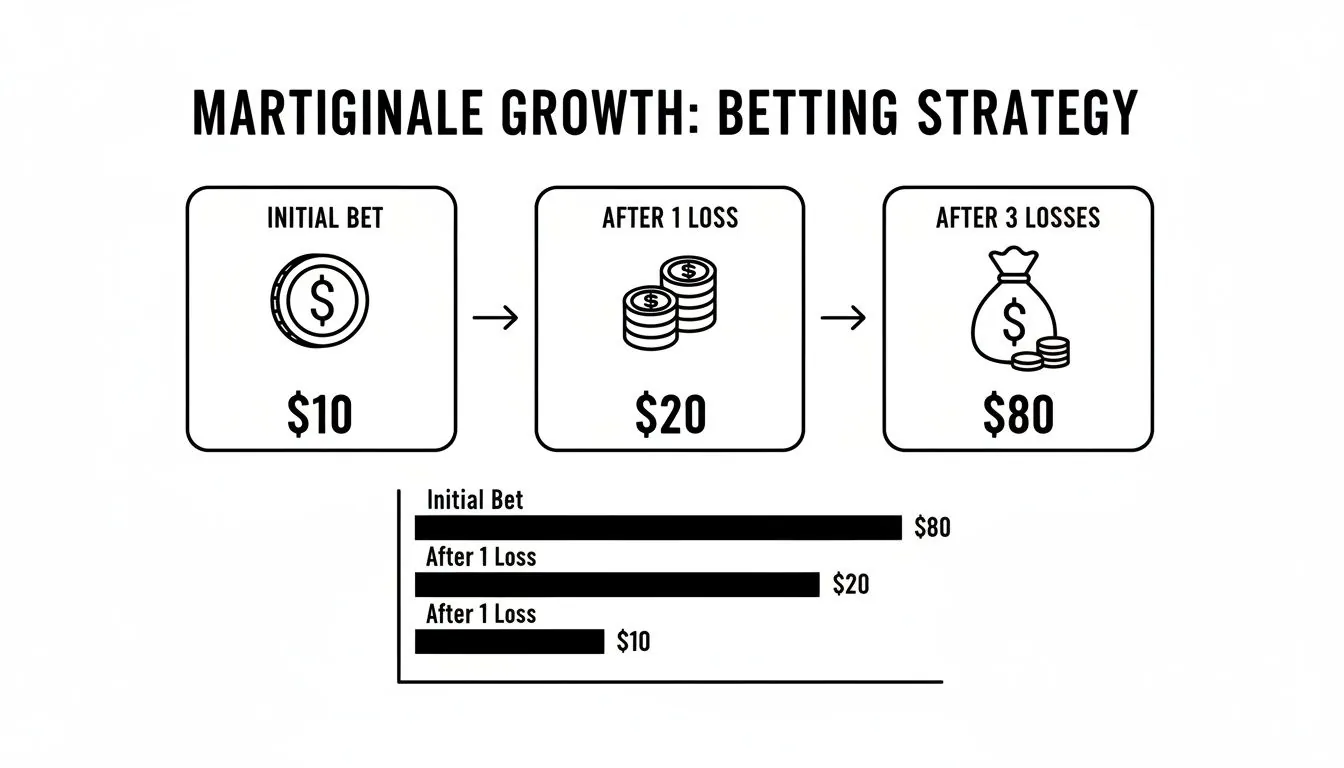
The visual above perfectly shows how a small initial risk suddenly requires a huge amount of capital to sustain after just a few bad trades.
The Point of No Return
Sticking to the plan, you open the 0.4 lot trade. Disaster strikes a third time. This loss costs $400, and your account balance is now $9,300. You’re down $700 in total.
Your calculator spits out the next number: 0.8 lots. You’re now being told to risk $800—8% of your original capital—on one trade. Let’s lay out the damage:
- Trade 1 (0.1 lots): Loss of $100. Account at $9,900.
- Trade 2 (0.2 lots): Loss of $200. Account at $9,700.
- Trade 3 (0.4 lots): Loss of $400. Account at $9,300.
- Trade 4 (0.8 lots): Loss of $800. Account at $8,500.
After just four consecutive losses, your account has lost 15% of its value. To continue, the system demands you open a 1.6 lot position, risking $1,600 on a single trade. That’s 18.8% of your remaining capital, a risk so large it would horrify any professional risk manager.
This scenario exposes the fatal flaw of the Martingale strategy: it forces you to take your biggest risks when your account is most vulnerable and your decision-making is clouded by stress.
This exponential scaling of risk is unsustainable. Another loss would bring your total drawdown to $3,100. At this point, you're not trading your strategy; you're just desperately trying to dig out of a massive hole created by the very system that promised an easy recovery.
Why Prop Firm Rules Make Martingale a Non-Starter
A funded trading account is a huge opportunity, but success requires solid risk management, not high-stakes gambling. The Martingale strategy is fundamentally incompatible with the rules that govern prop firm trading.
Prop firms protect their capital with non-negotiable risk limits, mainly the daily loss limit and the maximum drawdown. Breaching these rules results in instant account failure. A martingale strategy calculator doesn't just show the risk; it predicts the exact moment you'll fail a prop firm challenge.
The Daily Loss Limit Collision
Most prop firms, including MyFundedCapital, enforce a daily loss limit, often around 5% of the starting balance. This circuit breaker prevents one bad day from destroying an account.
Imagine you're trading a $10,000 challenge account with a $500 daily loss limit. Let's see what happens with a Martingale sequence starting with a 1% risk ($100).
- Loss 1: Risk $100. For the next trade, you double down to $200.
- Loss 2: Risk $200. Now you must double again, to $400.
- Loss 3: Risk $400. The strategy dictates you risk $800 on the next trade.
Stop. If that third trade results in a loss, you will have lost $800 on that single position. This instantly smashes through your $500 daily limit, and the challenge is over.
Maximum Drawdown: The Inevitable Game Over
Even if you somehow avoid the daily limit, the maximum drawdown rule will eventually catch you. This is the total amount your account can fall from its peak, typically around 10% of the initial balance. For a $10,000 account, that's a hard stop at a $1,000 total loss.
Let's look at the cumulative losses from our sequence:
- After Loss 1: $100 total loss.
- After Loss 2: $300 total loss ($100 + $200).
- After Loss 3: $700 total loss ($300 + $400).
- After Loss 4: $1,500 total loss ($700 + $800).
After just four consecutive losses, your total drawdown hits $1,500. You've blown past the $1,000 maximum drawdown rule and failed the challenge. The math of Martingale makes this a certainty, not a possibility. Learn more about how these evaluations work in our guide on what is a prop firm challenge.
Prop firm risk rules are a filter designed to find disciplined traders. Martingale is the polar opposite of discipline, making failure a built-in feature of the strategy.
Trying to use a Martingale approach to pass a prop firm challenge is doomed from the start. The rules are the foundation of a long-term trading career. To succeed, you must work within these limits, something the Martingale strategy cannot do.
The Inevitable Blow-Up and the Math of Ruin
Any trader who uses a Martingale strategy is starting a countdown to zero. It’s not a question of if their account will blow up, but when. This harsh reality is baked into the math of Probability of Ruin.
The core problem is that every trader has a finite amount of capital. With a finite bankroll, the long-term odds of hitting a losing streak long enough to wipe you out approaches 100%. A martingale strategy calculator may show many small wins, but it's also plotting a course toward a single, catastrophic loss that erases everything.
The Certainty of Failure
Even if your trading setup has a high win rate, a string of losses is statistically inevitable. With Martingale, that one bad run is all it takes. The strategy creates an illusion of control, making you feel safe while hiding the exponential risk building beneath the surface.
It can appear to work for days or even months. But you are always just one bad run of trades away from an account-ending disaster. You can see this in action in these Martingale simulations on YouTube.
The Martingale strategy doesn't eliminate risk; it simply postpones it and concentrates it into a single, devastating event. Your account isn't just at risk—it's mathematically guaranteed to fail over time.
Gambler's Fallacy and Sunk Cost Fallacy
Two psychological biases pull traders deeper into the Martingale death spiral:
Gambler's Fallacy: The belief that if you've had a string of losses, a win must be next. In reality, the odds of your next trade are independent of past results. The market doesn't owe you a win.
Sunk Cost Fallacy: The trap of sticking with a failing plan because you've already invested so much capital. This leads you to place the next, even larger trade to "win it all back" instead of cutting your losses.
These biases convince you to keep doubling down at the exact moment a sound risk management plan would tell you to stop. Understanding your maximum drawdown is vital, as it acts as a hard stop before these biases take over. Learn more in our guide on what is maximum drawdown.
Smarter Risk Management Alternatives
Now that we've established that a martingale strategy calculator only maps a path to ruin, let’s discuss what professionals actually do. Sustainable trading is about managing losses so you can stay in the game long enough for your wins.
Here are actionable, time-tested risk management strategies that build trading careers.

Unlike Martingale, these methods are about protecting capital and maintaining consistency. This is how you shift from a gambler's mindset to that of a trading professional.
Fixed Fractional Sizing
The most common and respected risk model is fixed fractional sizing. The concept is simple: risk a small, fixed percentage of your account on any single trade, typically 1% per position.
This acts as an automatic brake during a losing streak. As your account shrinks, the dollar amount you risk also shrinks, protecting your capital. Conversely, as your account grows, your position size grows with it, creating organic compounding.
Example: Fixed Fractional Sizing
On a $10,000 account with a 1% risk rule:
- Trade 1: Risk 1% of $10,000, which is $100. It's a loss.
- Account Balance: $9,900.
- Trade 2: Risk 1% of $9,900, which is $99. You lose again.
- Account Balance: $9,801.
Your risk decreased after a loss—the exact opposite of Martingale. This is a built-in defense mechanism. Applying sound risk assessment techniques like this is the first step toward professional trading.
Scaling into Winners (Anti-Martingale)
Another powerful approach is to flip the Martingale concept on its head. Instead of adding to a losing trade, you strategically add to your winning positions. This is often called "pyramiding" or scaling in.
When a trade is moving in your favor, it's a signal that your analysis was right. By carefully adding to that position, you can maximize profit from your best ideas without reckless risk. You press your advantage from a position of strength, not desperation.
Professional traders increase their exposure when they are right and reduce it when they are wrong. Martingale forces you to do the exact opposite, which is why it always fails.
Fixed Dollar Risk
A simpler but still effective alternative is the fixed dollar risk model. You decide on a maximum cash amount you're willing to lose on any trade (e.g., $150) and stick to it.
This method provides rigid control and makes it easy to calculate potential losses. Its main drawback is that it doesn't automatically scale with your account balance like fixed fractional sizing does. Still, it's an excellent method for newer traders to enforce strict discipline. To calculate the correct position size, you can use a lot size calculator.
Any of these professional strategies is infinitely better than using a martingale strategy calculator as a trading guide. These methods are built on longevity, capital preservation, and discipline.
Frequently Asked Questions
Is the Martingale strategy illegal?
No, the Martingale strategy is not illegal. However, it is an extremely high-risk money management technique that is banned by most prop trading firms because it violates their maximum drawdown and daily loss limit rules. While you can use it with your own capital, it's universally discouraged by professional traders because it almost guarantees you will eventually blow up your account.
Can a Martingale strategy ever be profitable?
In theory, Martingale is only profitable if you have infinite capital and face no trading limits. In the real world, where traders have finite capital and must follow broker or prop firm rules, the answer is a hard no. A long enough losing streak is a mathematical certainty, and it will either wipe out your account or force you to break a rule, leading to failure.
Are there less risky versions of Martingale?
Traders sometimes try to modify the strategy by using smaller multipliers (like 1.5x instead of 2x) or applying it in reverse (Anti-Martingale). While an Anti-Martingale can be part of a trend-following strategy, it still risks giving back all your gains in a single reversal. "Softer" versions with smaller multipliers only delay the inevitable; the fatal flaw of increasing risk after a loss remains, ensuring an eventual account blow-up.
Why do so many trading bots use Martingale?
Many commercial Expert Advisors (EAs) use Martingale to generate a perfect-looking backtest with a smooth, upward-sloping equity curve. Sellers use these misleading backtests to market their products, fully aware that the bot will detonate a live account as soon as it hits a real-world losing streak. It's a marketing gimmick, not a viable long-term trading strategy.
All content is for educational purposes only and does not constitute financial advice. Trading involves substantial risk of loss.
Ready to trade with a firm that values smart risk management and discipline? At MyFundedCapital, we provide the capital and support that serious traders need to succeed.
Compare our funding programs and find the account that fits your strategy.
