

 AR
AR
 NL
NL
 EN
EN
 FR
FR
 DE
DE
 ES
ES
 IT
IT
 PL
PL
 SV
SV


Learning how to make a profit in trading requires a shift from chasing get-rich-quick schemes to building a repeatable, rules-based process. This guide provides a direct, honest framework for developing a professional trading approach. You will learn the practical steps to find a statistical edge, manage risk, validate your strategy, and execute with discipline, all while understanding that trading involves a significant risk of loss.
Building Your Foundation for Profitable Trading
Before placing a single trade, you must treat trading as a business, not a hobby. This means having a clear business plan that outlines your competitive advantage (your edge), your standard operating procedures (your trading plan), and your financial controls (your risk management). This foundational work isn't glamorous, but it's what separates consistently profitable traders from those who gamble.
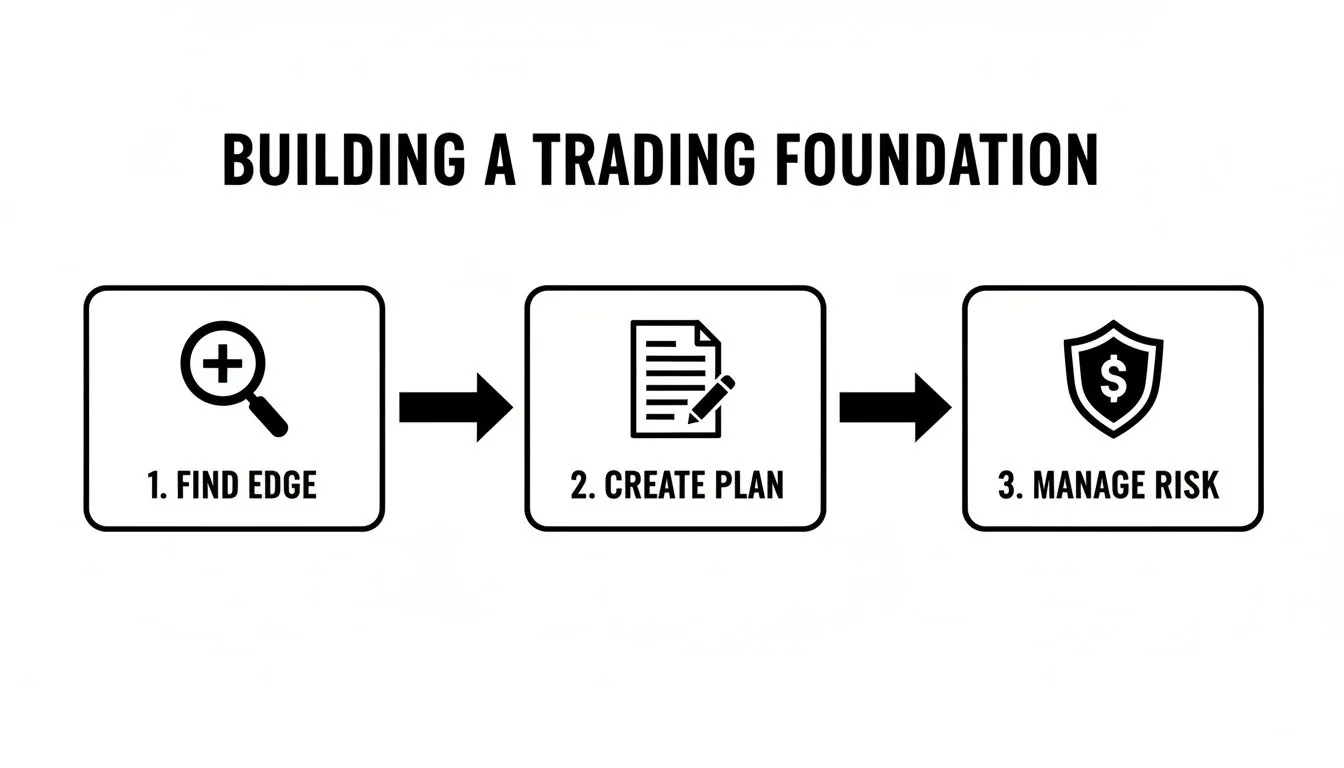
These three pillars—Edge, Plan, and Risk—are interconnected. An edge is useless without a plan to execute it, and a plan is worthless if poor risk management wipes out your account.
Step 1: Find Your Trading Edge
A trading edge is a specific, testable market condition that gives you a better-than-random chance of predicting the next move. It is not a vague concept like "buy low, sell high." An edge must be concrete and rooted in data.
Here are a few practical examples:
- A Trend-Following Edge: You notice that when the 50-period moving average (MA) is above the 200-period MA on the GBP/JPY 1-hour chart, the price tends to find support at the 50 MA before continuing higher. Your edge could be to buy on the first pullback to the 50 MA after a new high is made.
- A Mean-Reversion Edge: You observe that during the London session, the EUR/USD often spikes 20 pips beyond its previous day's high before reversing back toward the daily open. Your edge could be to fade (trade against) these moves with a tight stop-loss.
Your edge must also align with your personality. If you are patient, a swing trading strategy on the daily chart might suit you. If you prefer frequent action, a scalping strategy on the 5-minute chart may be a better fit.
Step 2: Create a Detailed Trading Plan
Once you have a potential edge, you must write it down in a detailed trading plan. This document is your rulebook and your best defense against emotional decisions. When the market is volatile and your money is on the line, your plan keeps you anchored to your strategy, not your feelings. It should be so clear that another trader could execute your strategy without asking questions.
A professional trading plan must include:
- Trading Goals: Be specific. "Generate 3% monthly return" or "Pass a prop firm challenge" are better than "make money."
- Market & Timeframe: Which specific instruments will you trade (e.g., "XAU/USD, NAS100 only")? What timeframes will you use (e.g., "4H for trend, 15M for entry")?
- Setup Conditions: What precise technical conditions must be met? (e.g., "Price must be above the 200 EMA, and RSI must cross above 30 from an oversold condition.")
- Entry Rules: How will you enter? (e.g., "Place a buy stop order 2 pips above the high of the bullish engulfing candle.")
- Stop Loss Rules: Where will your initial stop loss be? No exceptions. (e.g., "10 pips below the entry candle's low.")
- Take Profit Rules: How will you exit a profitable trade? (e.g., "At a 2:1 Reward-to-Risk ratio," or "Trail the stop loss below each new higher low.")
- Position Sizing: How much capital will you risk per trade? (e.g., "Fixed 0.5% of account balance per trade.")
Having this documented is a professional necessity. Building a foundation for profitable trading means treating it like a real business, and that includes understanding everything that affects your P&L, such as improving your tax position as a share trading business.
Mastering Risk to Survive and Profit
You can have the best strategy in the world, but it will fail if you don't manage risk. The number one reason traders lose money is not a bad strategy; it's poor risk management. This isn't the most exciting part of trading, but it is the only thing that will keep you in the game long enough to see your edge play out.
Your first job isn't to make money; it's to protect your capital so you can trade another day.
The Non-Negotiable 1% Risk Rule
This is a fundamental rule of professional trading: never risk more than 1% of your trading capital on a single trade. This is not a suggestion; it's a mathematical requirement for long-term survival. Every trader will experience a losing streak. Here's why this rule protects you:
- Risking 1%: After 10 consecutive losses, your account is down about 10%. To recover, you need an 11% gain, which is achievable.
- Risking 5%: After 10 consecutive losses, your account is down over 40%. You now need a massive 67% gain just to get back to breakeven.
For traders at prop firms like MyFundedCapital, this kind of rules-based approach is mandatory. To learn more about the numbers behind global trading, this Our World in Data visualization is worth exploring.
How to Calculate Your Position Size
Risking 1% means calculating your position size so that if your stop-loss is hit, the loss equals exactly 1% of your account balance.
Use this formula for every trade:
Position Size = (Account Balance x % Risk) / (Distance to Stop-Loss in Dollars)
Here's a concrete example:
- Account Balance: $10,000
- Risk per Trade: 1% ($100)
- Trade: Buy BTC/USD at $65,000 with a stop-loss at $64,500.
- Distance to Stop-Loss: $500 per BTC.
- Position Size Calculation: $100 / $500 = 0.20 BTC
This calculation ensures every trade has the same dollar risk, creating consistency in your results. To truly elevate your approach, consider adopting a structured system like the Australian Risk Management Framework to standardize your decision-making.
Respect Drawdown Limits Like a Pro
Professional traders and prop firms live by drawdown rules. These are hard limits on how much an account can lose—daily and overall—before trading is halted. Adopting these for your own trading builds professional discipline.
At MyFundedCapital, our rules are clear and designed to protect traders:
- 5% Daily Drawdown: Your account equity cannot drop more than 5% from the day's starting balance.
- 10% Maximum Drawdown: Your account equity can never fall more than 10% below your initial starting balance.
These limits act as circuit breakers, stopping a bad day from turning into a blown account. For a deeper dive, check out our complete guide on risk management in forex trading.
Prove It: How to Validate Your Strategy Before Risking Real Money
An idea for a strategy is worthless until you prove it works with data. This validation process is what separates wishful thinking from a professional, data-driven approach and builds the confidence needed to execute flawlessly.
Step 3: Backtest Your Strategy
Backtesting involves applying your trading rules to historical market data to see how they would have performed. Manual backtesting is incredibly valuable for building screen time and intuition.
Platforms like TradingView have a "Bar Replay" feature that lets you move through the market candle by candle, simulating a live environment. For a deeper dive, check out our guide on the best back-testing software.
Your backtesting process should follow these steps:
- Go back at least 1-2 years on your chosen chart.
- Use the Bar Replay function to advance the chart one candle at a time.
- Look for your setup based on the exact criteria in your trading plan.
- Log every single trade that meets your rules in a spreadsheet.
Track Your Data in a Spreadsheet
As you backtest, collect data on at least 100 trades to achieve a statistically relevant sample size. Your spreadsheet should track:
- Date & Time
- Entry & Exit Prices
- Initial Stop Loss
- Reward-to-Risk (R:R) Ratio (e.g., 2:1)
- Outcome: Win, Loss, or Break-Even
- P&L (in R-multiples): Log results as a multiple of your risk ("R"). A full win on a 2:1 trade is +2R. A full loss is -1R.
Tracking performance in R-multiples removes the emotion of dollar amounts and provides a clear picture of your strategy's expectancy. A system with a 55% win rate and an average 2:1 R:R is highly profitable.
The Psychology of Executing Your Plan Under Pressure
You can have a profitable, backtested strategy, but it's useless if you can't follow it under pressure. Discipline is not an innate trait; it's a skill you build through practical systems and habits.

Taming Common Trading Demons
Most trading mistakes stem from a few predictable psychological traps:
- Fear of Missing Out (FOMO): Chasing a price that has already moved, often leading to buying at the top.
- Revenge Trading: Jumping into another trade immediately after a loss to "get your money back," usually breaking all your rules.
- Prematurely Cutting Winners: Closing a trade for a small profit out of fear, which destroys your strategy's positive R:R edge.
Use a Checklist to Enforce Discipline
A pre-trade checklist is your best defense against emotional impulses. It’s a simple, non-negotiable list of criteria your setup must meet. If even one box isn't checked, you do not take the trade. Period.
Example Pre-Trade Checklist:
- Is the trade on an approved market (e.g., EUR/USD, XAU/USD)?
- Does the higher timeframe (H4) confirm the trend direction?
- Does the setup on the execution timeframe (M15) match my plan exactly?
- Is the R:R ratio at least 2:1?
- Have I calculated my position size for a 1% risk?
- Am I calm and focused, or am I feeling rushed/anxious?
This simple tool forces objective analysis and prevents costly emotional errors. This kind of structure is what allows traders to perform consistently, especially in a high-stakes setting like a MyFundedCapital challenge or on an Instant Funding account where rule adherence is everything.
FAQ: Your Questions on Profitable Trading
Here are straight answers to some of the most common questions aspiring traders ask. Disclaimer: This content is for educational purposes only and not financial advice. Trading involves substantial risk of loss.
How long does it realistically take to become profitable?
There is no fixed timeline. However, most traders who achieve consistency report spending 1 to 3 years in a dedicated learning phase. This involves building and backtesting a strategy, mastering risk management, and developing psychological discipline through demo and small live account trading. Expecting to make a profit in weeks is a gambler's mindset, not a business owner's.
What is a realistic monthly profit for a trader?
For a skilled retail trader, a realistic and sustainable goal is often in the 1% to 5% range per month. Returns are not guaranteed and will vary; some months will be flat or negative. For funded traders, even a modest 5% monthly gain on a $100,000 account can translate into a significant profit share, demonstrating how leverage amplifies consistent performance.
Can I learn to trade if I don’t have much money?
Yes. In fact, starting with a large amount of your own money is a common mistake. The modern path for an undercapitalized trader is to first build skill on a demo account. Once you have a proven, profitable strategy, you can enter a prop firm challenge for a small, often refundable fee to prove your skill. Passing an evaluation gives you access to significant trading capital (up to $500,000) without risking your own savings.
At MyFundedCapital, we provide the platform for skilled traders to get the funding they need to turn trading into a career. Stop letting account size limit your potential and start focusing on what truly matters: your performance.
Ready to prove your skills? Explore our funding programs and find the one that fits your trading style.
