

 AR
AR
 NL
NL
 EN
EN
 FR
FR
 DE
DE
 ES
ES
 IT
IT
 PL
PL
 SV
SV


Roughly 70% to 85% of retail forex accounts lose money. For an aspiring funded trader, that number matters twice. First, the market is already hard. Second, prop firm rules turn every mistake into a measurable breach risk.
Forex trading challenges are not limited to finding entries. The actual pressure shows up in consistency, drawdown control, execution quality, and decision-making under evaluation rules. That is why many traders who look fine on a demo chart struggle once they have daily loss limits, max drawdown thresholds, and profit targets hanging over every session.
Prop firm structures can cut both ways. They create pressure, but they also force discipline if the trader uses them correctly. A firm such as MyFundedCapital gives clear risk parameters and platform rules, which can help traders build habits that many retail accounts never enforce. The traders who last usually treat those rules as training wheels for professional behavior, not as obstacles to outsmart.
That mindset shift matters. A trader who wants funding needs more than market knowledge. They need a repeatable process, a disciplined trading mindset built for long-term performance, and enough operational awareness to avoid basic account and platform mistakes. Even account security matters, since a compromised login or phishing attempt can do real damage. This practical guide to social engineering explains the type of attack traders should know how to spot.
This article focuses on the problems that stop capable traders from getting funded and staying funded, then ties each one to a practical control, platform setting, or risk rule that can reduce the damage.
The Unspoken Truth About Forex Trading Challenges
Most traders don’t fail because they never found an entry pattern. They fail because the business of trading is harder than the chart itself.
A clean setup can still lose. A strong strategy can break down in noisy conditions. A disciplined trader can still get tripped up by execution issues, evaluation pressure, or poor risk controls. That’s why forex trading challenges need to be treated as operating problems, not just market problems.
Two realities matter.
First, retail traders face a structural disadvantage. The friction of spreads, slippage, timing mistakes, and overtrading adds up fast. Second, aspiring funded traders deal with another layer of pressure because they’re not only trying to trade well. They’re trying to perform inside rules.
Success in forex doesn’t come from eliminating stress. It comes from building routines that keep stress from taking control.
The traders who last usually do four things well:
- They manage themselves before they manage trades.
- They use simple strategies instead of chasing perfect indicators.
- They respect execution quality and platform constraints.
- They defend capital first and treat profits as a byproduct.
The Inner Game Overcoming Psychological Hurdles
Most blown accounts start with a mental mistake before they become a trading mistake. A trader feels urgency, anger, or the need to be right. Then the rule-breaking begins.
Research on trader behavior shows that over 90% of forex traders identify emotional control and strategic discipline as their primary obstacles, with common failure points including interfering with a plan and acting on fear or greed, as noted in this breakdown of trader challenges.

Fear shows up before the click
Fear doesn’t only mean panic after a loss. It often appears as hesitation, skipped entries, or chasing price after a move has already happened.
A common example is FOMO. Price breaks out, the trader missed the planned entry, and now buys late because the move “looks strong.” That trade usually has the worst location, the weakest stop placement, and the highest emotional load.
Another version is fear of taking the next valid setup after two losses. The plan says enter. The trader says, “I’ll wait for more confirmation.” Often that means they’re no longer trading a system. They’re trading their recent pain.
A practical fix is to reduce decisions before the trade.
Pre-trade checklist
- Market condition: Is this trending, ranging, or reacting to news?
- Setup quality: Does this match the exact pattern in the plan?
- Entry location: Am I entering where I planned, or am I chasing?
- Invalidation: Where is the trade clearly wrong?
- Risk: Is the position size small enough that I can accept the loss calmly?
If you can’t answer those five questions quickly and clearly, the trade probably isn’t ready.
Greed changes trade management
Greed isn’t only oversized risk. It also shows up when traders abandon a valid exit because they want “just a bit more.” A trade reaches target, momentum slows, and instead of following the plan, they hold and hope.
That’s how good trades turn into frustrating scratch trades or full losses.
For funded traders, greed gets amplified by evaluation pressure. When there’s a target on the account, traders start forcing progress. They overtrade slow sessions. They increase size after one winner. They stop treating risk as fixed and start treating it as negotiable.
Practical rule: If your risk changes because of emotion rather than a written plan, you’re no longer trading. You’re reacting.
One of the best ways to contain greed is to separate analysis from execution. Mark entries, stops, and exits before the order goes live. Once the trade is on, your job is to manage according to rules, not feelings.
Ego keeps traders in bad loops
Ego is the quiet account killer. It shows up as revenge trading, refusal to take a stop, or constant strategy switching because the trader can’t accept that losses are part of the job.
A typical pattern looks like this:
- Trader takes a planned loss.
- Trader feels the market “owes” them.
- Trader jumps into a lower-quality setup.
- Loss gets bigger.
- Trader abandons process completely.
The answer isn’t becoming emotionless. That’s not realistic. The answer is creating a recovery protocol.
Post-loss reset protocol
- Step away: Don’t re-enter immediately after a rule-based loss.
- Review the setup: Was the loss valid within the plan?
- Label the emotion: Frustration, urgency, embarrassment, anger.
- Downgrade activity: If focus is poor, move to observation mode instead of trading mode.
Funded trading adds a specific layer that many general forex articles miss. Evaluation accounts create performance pressure because every mistake feels measurable. That can be useful if you treat it like training. Clear rules force structure. They expose your weak habits faster than casual self-funded trading does.
If you want to tighten that side of your process, this piece on developing a trading mindset for consistent execution is worth reviewing alongside your journal.
There’s also a broader operational lesson here. Traders spend a lot of time protecting charts and very little time protecting themselves from manipulation, distraction, or avoidable security mistakes. If you trade online, use shared communities, or rely on alerts and account access across devices, this practical guide to social engineering is a useful reminder that risk management also includes digital behavior.
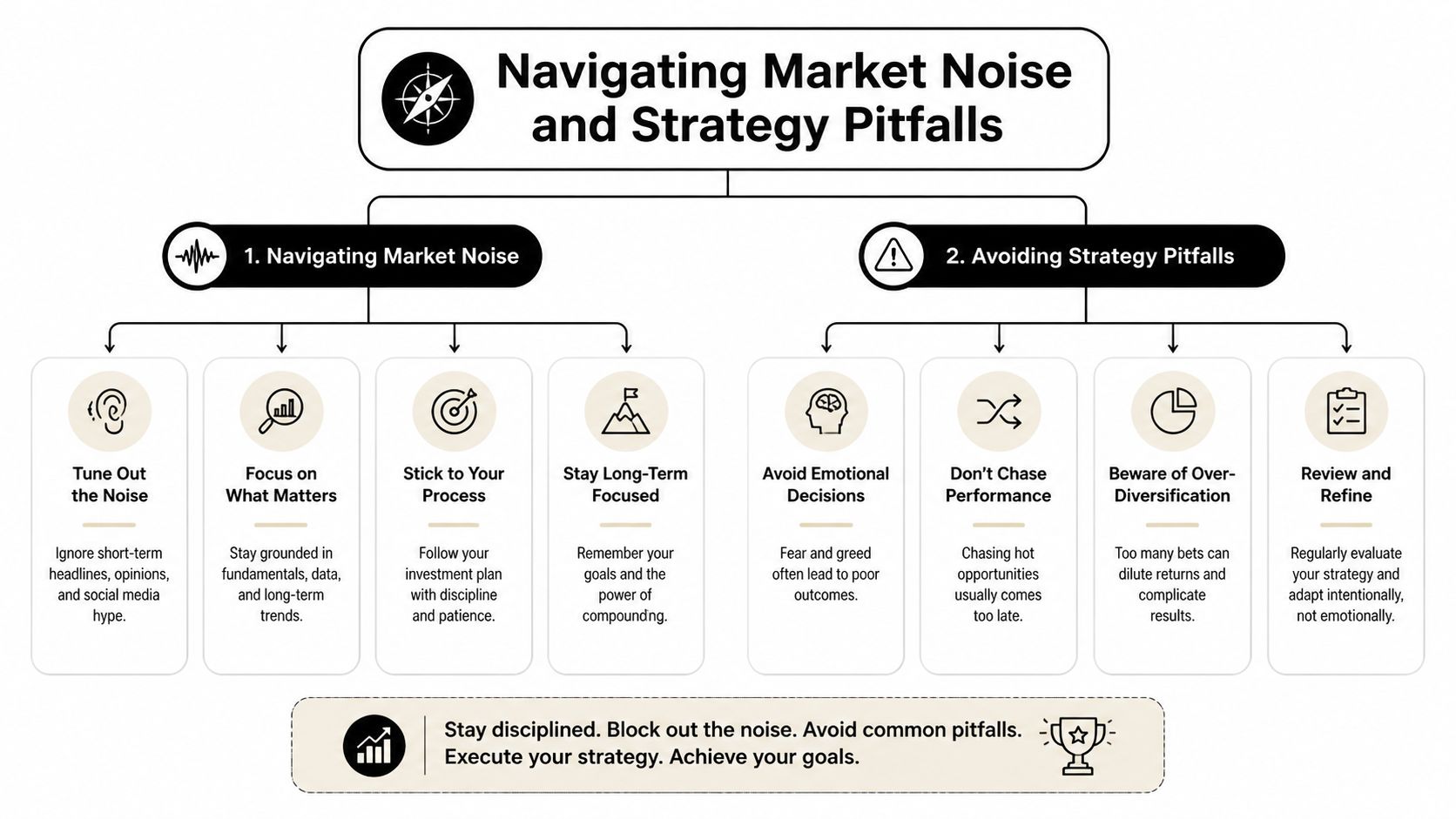
Navigating Market Noise and Strategy Pitfalls
A strategy can look brilliant in hindsight and still fail in live conditions. That usually happens for two reasons. The trader overfit the strategy to the past, or they trusted signals that weren’t strong enough for current conditions.
Overfitting creates fragile systems
Overfitting means building a strategy that matches historical data too perfectly. It’s like cutting a key for one exact lock and then expecting it to open every door on the street.
This is common with newer traders who keep adding filters until a backtest looks clean. One moving average filter becomes two. Then a session filter. Then a volatility rule. Then a candle condition. Eventually the strategy stops being dependable and becomes a customized explanation of old price action.
A simpler system often survives better because its logic is easier to repeat.
Signs your strategy may be overfit
- Too many conditions: You need a long checklist just to trigger a trade.
- No clear market logic: You can describe the rule, but not why it should work.
- Strong backtest, weak live execution: Results collapse once real decision-making begins.
- Constant tweaking: You change the rules after every bad week.
A better standard is durability. Ask whether the idea makes sense across different market conditions, not just whether it looked perfect on one chart sample.
For traders reviewing strategy decay, this article on whether forex trading strategies stop working over time gives a useful framework for thinking about adaptation without turning every losing streak into a full rebuild.
Indicators help, but they don’t lead
Many forex trading challenges come from treating indicators like prediction tools. They aren’t. They’re summaries of past price behavior.
According to this technical analysis guide focused on false signals, technical indicators are based on historical data and lag real-time market conditions, and they can produce false signals during high volatility. The same source notes that relying on indicators without fundamental context or strict risk management exposes traders to losses from whipsaw conditions.
That matters a lot during news-driven sessions. A moving average crossover may look valid on the chart, but if the market is reacting to a macro release, the signal may be late, weak, or completely irrelevant.
Use indicators for confirmation, not for permission.
A more grounded way to read the market
Instead of asking, “What does my indicator say?” ask a better sequence:
| Question | Why it matters |
|---|---|
| What is driving this pair today? | Context matters more than pattern recognition alone. |
| Is the market clean or noisy? | Choppy conditions reduce signal quality. |
| Is my setup aligned with the broader move? | Countertrend trades usually need tighter standards. |
| Where does the trade fail clearly? | If invalidation is fuzzy, the trade structure is weak. |
Algorithmic traders run into the same problem in code form. An EA can execute rules flawlessly and still lose if the rules are too dependent on lagging signals. That’s why strong system design usually includes filters for volatility, session behavior, and event risk instead of letting a single indicator trigger everything.
The strongest strategies usually look ordinary on paper. They’re understandable, repeatable, and hard to misuse. That’s a better target than trying to build a “smart” system that only works when the market behaves exactly like your backtest.
Conquering Execution Technology and Broker Risks
A trader can read the market well and still lose because the trade wasn’t executed the way they expected. This is one of the least discussed forex trading challenges, especially among newer traders who focus only on strategy.

Bad infrastructure distorts good decisions
Execution problems usually show up in three forms.
- Slippage: You click at one price and get filled at another.
- Latency: There’s a delay between decision and execution.
- Platform instability: Orders, chart data, or position management tools don’t behave consistently.
A neglected point in trading education is that platform quality directly affects outcomes. This discussion of trader struggles and infrastructure quality notes that suboptimal platforms with high latency, frequent slippage, and poor execution can sabotage even a winning strategy, yet many traders still don’t treat platform quality as a core selection factor.
That’s a mistake. Scalpers, intraday traders, and EA users feel this first, but swing traders aren’t immune either. A poor fill or unstable stop modification process can change the entire risk profile of a trade.
Compare your platform like a trader, not a marketer
A lot of traders choose platforms based on familiarity. That’s understandable, but it’s not enough.
What to compare before committing
- Order handling: Can you place, modify, and close trades quickly without friction?
- Chart workflow: Does the platform support your actual process, not just basic analysis?
- Strategy support: If you run EAs or copy trading, does the environment support that cleanly?
- Session stability: Does performance remain steady during active market hours?
- Rule visibility: Can you monitor drawdown and limits clearly while trading?
For traders evaluating funded environments, platform choice matters even more because the rules are tight. On that front, MFC’s FX platform options are relevant if you want to compare how DXtrade and cTrader fit manual, algorithmic, or copy-based workflows. The important point isn’t brand preference. It’s whether the platform supports precise execution under rule-based pressure.
Regulation can affect strategy design
There’s another technical problem many traders miss. Some strategies fail not because the market rejected them, but because the operating environment did.
The clearest example is the NFA FIFO rule for US-regulated forex brokers. According to OANDA’s explanation of how the NFA FIFO rule affects forex expert advisors, traders must close the oldest position first when managing trades in the same currency pair. That can conflict with the logic used by many EAs and scaling strategies, leading to rejected orders and broken execution flow.
A strategy isn’t complete until it fits the rules of the platform, broker, and jurisdiction where it will run.
Experienced traders think differently. They don’t ask only, “Does this setup work?” They also ask, “Can I execute it cleanly in the environment I’m using?”
The Money Game Why Risk Management Is Everything
Risk management is not a side skill.
It decides whether your strategy gets enough trades to show an edge, or dies during an ordinary losing stretch. I have seen traders with workable entries fail because they sized one trade like it had to pay for the week. A funded trader usually does not get that luxury. Prop firm rules turn poor risk control into an immediate consequence, which is frustrating, but also useful.

A professional approach starts with one simple truth. Trading is a business of controlling losses. Entries matter. Exits matter more. Position size has the final say, because even a good setup becomes dangerous when the size is wrong.
Aspiring funded traders run into a specific challenge here. They are not only managing market risk. They are managing rule risk. A decent trade taken too large can violate a daily drawdown limit before the setup has time to play out. That changes how trades should be selected, sized, and managed from the start.
A practical checklist that actually works
Complex risk models do not help if you abandon them under pressure. Use rules you can execute every day, in real time, without negotiation.
Core risk rules
- Keep per-trade risk small: Many traders use a fixed percentage model such as risking 1% to 2% of capital per trade. The exact number should fit your system and account rules.
- Use a stop-loss on every trade: If your invalidation is not defined, your risk is undefined.
- Set the trade before entering: Entry, stop, and target should all be known in advance.
- Watch total exposure: Multiple correlated positions can create one oversized bet.
- Lower size after instability: If you’re forcing trades or breaking rules, reduce risk before the account forces you to.
These rules look basic on paper. Under pressure, they separate traders who stay in the evaluation from traders who reset and start over.
Funded trading rules can correct bad habits fast
This is why structured evaluation models help some traders improve. Tight limits expose weak behavior early. If your method depends on adding to losers, taking revenge trades, or making back a red day in one position, the account rules shut that down before the damage gets larger.
A rule set such as a 5% daily loss limit and up to 10% maximum drawdown does more than restrict you. It gives you a hard operating boundary. For many self-funded traders, that boundary only appears after a painful mistake. In a prop environment, it is visible from day one, which makes discipline measurable.
Here’s the trade-off:
| Trading habit | What usually happens without limits | What a strict rule set forces |
|---|---|---|
| Overtrading after a loss | Trader keeps pressing to get back to even | Trader has to stop or reduce activity |
| Oversizing one setup | One trade can distort the whole month | Risk must stay controlled |
| Holding losers too long | Drawdown compounds before action is taken | Invalidation has to matter |
| Random recovery trading | Emotions dictate position size | Process takes priority |
The best funded traders do not fight these constraints. They build around them. That means smaller risk per idea, fewer correlated trades, and clear daily stop rules. It also means using platform features that support discipline, such as visible drawdown tracking, preset stop-loss orders, and position sizing tools that reduce manual mistakes.
The goal isn’t to avoid losses. The goal is to make sure no single day, trade, or impulse can put you out of business.
A lot of forex trading challenges trace back to this point. Accounts usually fail from ordinary strategies paired with poor risk control, not from some exotic market problem. For aspiring funded traders, prop firm structure can feel restrictive at first. Used properly, it becomes a training framework that forces professional behavior earlier than most traders would choose on their own.
Trading involves real risk of loss. This article is educational only and not financial advice.
Frequently Asked Questions About Trading Challenges
Why is forex trading so difficult for beginners
Because beginners usually underestimate how many skills have to work together at the same time. You need emotional control, a repeatable strategy, clean execution, and consistent risk management. If one of those breaks, the rest usually follow.
Are prop firm challenges harder than normal trading
They’re different. The pressure is more explicit because the rules are clear and the drawdown limits matter every day. That can feel harder at first, but it also exposes weak habits quickly. For disciplined traders, that structure can be useful training.
Do indicators still work in forex
They can help, but they shouldn’t be treated as standalone decision engines. Indicators summarize past price action, so they often lag current conditions. They work better as confirmation tools inside a broader framework that includes context, volatility, and risk controls.
What is the biggest mistake traders make
The most common damaging mistake is changing behavior under pressure. That includes chasing moves, moving stops, oversizing after a winner, revenge trading after a loss, or abandoning a tested plan because of short-term emotion. The solution is not more opinions. It’s tighter process.
Your Next Step to Becoming a Disciplined Trader
Forex trading challenges are real, and most of them don’t disappear with more screen time alone. Traders improve when they build systems around behavior, strategy selection, execution quality, and capital protection.
That’s also why funded trading appeals to serious traders. A structured environment forces you to confront weak habits early. If your process is solid, rules become manageable. If your process is sloppy, rules reveal the problem before more damage gets done.
Keep the standard simple. Trade less, define risk before entry, use tools that support execution, and stop expecting the market to reward emotion.
Trading involves risk of loss. Use this article as education, not financial advice.
If you want a structured environment to test your discipline, compare account models, and see how simulated funded programs work, take a look at MyFundedCapital. Review the challenge and instant funding options, check the platform fit for your style, and choose the setup that matches how you trade.
