

 AR
AR
 NL
NL
 EN
EN
 FR
FR
 DE
DE
 ES
ES
 IT
IT
 PL
PL
 SV
SV


A lot of traders reading this are in the same spot. You’ve got a small account, you want to grow it, and you’re trying to figure out whether to compound it, protect it, or use it as a stepping stone to something bigger.
The realistic answer is that how to grow a small trading account starts with discipline, not aggression. A small account can absolutely become useful, but usually not because you swing for home runs. It becomes useful because it proves you can trade well enough to handle larger capital later. Trading involves risk of loss, and this article is educational only, not financial advice.
The Foundation Mindset and Realistic Goals
Most small account traders fail before strategy even becomes the issue. They start with the wrong objective.
They want the account to change their life immediately. That pressure creates bad decisions, oversized positions, revenge trades, and constant system hopping. If you’re trying to force a small account to produce big-account income right now, you’re already leaning in the wrong direction.
A small account has a hard mathematical reality. Turning $500 into $1,000 requires a 100% gain, while turning $50,000 into $51,000 requires only a 2% gain, which is why small accounts demand far more consistency and why a 50% annual return is a more realistic planning number than explosive short-term expectations, as discussed in this TradingView analysis of the challenge of growing a small trading account.

Stop chasing income from a training account
A small account is best treated as a proof account.
That means the purpose isn’t “turn this into a fortune fast.” The purpose is to demonstrate that you can follow rules, manage risk, and execute a repeatable process without self-destructing when the account is under pressure. Traders who make that shift usually calm down immediately. Their decisions improve because every trade no longer carries emotional survival weight.
Your first milestone isn’t big money. It’s proving you can trade the same way on your best day and your worst day.
This changes how you measure progress. Instead of asking, “How much did I make this week?” ask, “Did I follow my plan on every trade I took?”
Use process goals instead of money goals
Money goals sound motivating, but they usually push traders into forcing setups. Process goals keep you grounded in what you can control.
Good process goals look like this:
- Execution goal: Take only trades that match your written setup.
- Risk goal: Keep risk fixed and unchanged after wins or losses.
- review goal: Journal every trade with entry, stop, exit, and reason.
- behavior goal: Skip all impulsive trades outside your trading window.
- consistency goal: Complete a block of trades with no rule violations.
Bad goals are almost always outcome-based:
- Weekly profit target: “I need to make a certain dollar amount this week.”
- Recovery target: “I need to earn back yesterday’s loss.”
- Account doubling obsession: “I need to grow this fast or it’s pointless.”
The market doesn’t care what you need. The only thing that matters is whether your decision quality stays stable.
What realistic goals actually look like
If you want to know how to grow a small trading account without blowing it up, set goals that build trading competence.
Try goals like these:
- Write one setup clearly. Entry, stop, invalidation, target.
- Execute a clean sample of trades. Enough to see whether you follow the plan.
- Review every loss for rule quality. Was it a bad trade or a good trade that lost?
- Track emotional mistakes. Fear, boredom, revenge, hesitation.
- Preserve capital first. If your account survives, you can improve. If it’s gone, the lesson gets expensive.
A trader who can follow rules with a small account is far more valuable than a trader who got lucky with one outsized week.
Think like an operator, not a gambler
Professionals don’t wake up asking whether today will make them rich. They ask whether today’s decisions fit the system.
That mindset matters more in a small account because every mistake feels bigger. One impulsive trade can do far more damage than it would in a larger account. When traders accept that fact, they stop trying to “win big” and start trying to stay consistent long enough for skill to matter.
Build Your Fortress Strict Risk and Position Sizing Rules
A small account only survives if risk is mechanical. If you decide size based on confidence, emotion, or the quality of your last trade, you’re gambling.
The cleanest framework is fixed fractional risk. Expert traders emphasize starting with a maximum 1% risk per trade, then only scaling after a 20% equity gain over 100+ trades with positive expectancy, because sequence risk is what wipes out 80% of aggressive accounts, as explained in this breakdown of small account risk methodology.
The rule that keeps you in the game
Most traders think they need better entries. Usually they need better damage control.
Practical rule: You can’t control profits, but you can always control your losses.
That means every trade starts with one question: How much am I willing to lose if this idea is wrong? Not how much can I make. Not how strong the setup looks. Not how badly I want a winner.
For most small-account traders, a good baseline is:
- Risk stays fixed: Use the same percentage of equity per trade.
- Stop loss is planned first: Size comes after the stop location, not before.
- No size increase after a win streak: Confidence isn’t a sizing model.
- No doubling after a loss: Recovery mode destroys accounts.
- No trade without predefined invalidation: If you can’t define the stop, you can’t define the risk.
A simple position sizing workflow
Use this order every time:
Choose the setup
Only trade the pattern you’ve defined in advance.Mark the stop loss
Put the stop where the trade idea is invalidated, not where the dollar loss feels comfortable.Calculate account risk
If the account is $1,000 and you risk 1%, your max loss is $10.Convert that risk into position size
Your size must fit the stop distance.Place the trade exactly as planned
No adjusting on the fly because the chart “looks strong.”
If you trade forex and need a refresher on the mechanics, this guide on what lot sizing means in practical terms is useful because it connects stop distance and size directly.
Sample Position Size Calculation ($1,000 Account)
| Parameter | Value |
|---|---|
| Account Balance | $1,000 |
| Risk Per Trade | 1% |
| Max Dollar Risk | $10 |
| Planned Stop Loss | Defined before entry |
| Position Size | Adjusted so stop-out equals $10 loss |
The table looks basic because the principle is basic. The market setup changes. The instrument changes. The stop distance changes. The allowed loss does not.
That’s the fortress.
Why traders still break this rule
They break it because small accounts create urgency. Traders think they need to speed up the process, so they over-size on a setup that “looks perfect.” Then a normal loss hits them harder than expected, and the emotional spiral starts.
Common ways this shows up:
- After a winner: “I’m seeing the market clearly, so I’ll press harder.”
- After a loser: “I’ll bump size and make it back on the next one.”
- During a slow week: “Nothing’s happening, so I need to force something.”
- Near a target: “One good trade gets me there.”
None of those are trading decisions. They’re emotional reactions.
How to scale risk without getting reckless
Scaling risk isn’t about bravery. It’s about evidence.
If your journal shows positive expectancy over a meaningful sample and your execution has stayed clean, then a modest increase can make sense. If your account growth came from one hot streak or one oversized winner, you haven’t earned the right to scale.
Use a checklist before any increase:
- Expectancy is positive: Your edge exists in the data, not just in memory.
- Rule adherence is stable: You’re not making money while breaking your own plan.
- Losses are controlled: Drawdown behavior matters as much as wins.
- Sizing is still formula-based: Every position can be explained in advance.
A small account doesn’t need dramatic risk. It needs repeatable risk. If you master that, growth becomes possible. If you ignore it, no strategy will save you.
Finding Your Edge Strategy Selection for Small Accounts
Most traders don’t have a strategy problem. They have a selection problem.
They pick methods that are too vague, too discretionary, or too complicated to execute consistently under pressure. A small account doesn’t give you room for that. You need one setup you can recognize quickly, define clearly, and repeat without improvising every step.

Win rate matters less than most traders think
A lot of beginners chase high win rate systems because losing feels bad. That’s understandable, but it often leads them into weak risk-reward structures where one bad trade wipes out several good ones.
A documented example showed an account growing from $3,000 to $50,000 in 57 days with only a 38% win rate, which worked because the trader had a strong win-to-loss ratio, not because they won often, according to this video analysis on win rate and risk-reward optimization.
A setup with a modest win rate can still work well if the average winner is large enough relative to the average loser.
That should change how you judge a strategy. Don’t ask only, “How often does it win?” Ask:
- Where is the invalidation?
- What is the average loss in R?
- What is the average win in R?
- Can I execute it the same way repeatedly?
- Does it fit my schedule and temperament?
Pick one setup you can explain in one paragraph
If you can’t clearly describe your strategy, you probably can’t execute it consistently.
A workable small-account strategy usually has:
- A specific market condition: trend continuation, range rejection, breakout retest.
- A defined trigger: structure break, pullback into a level, momentum confirmation.
- A clear stop location: beyond swing, structure, or volatility threshold.
- A target framework: fixed R multiple, next liquidity area, or partial plus runner.
- A filter: session, trend bias, or instrument selection.
The more moving parts you add, the easier it becomes to excuse bad trades. Simplicity doesn’t mean primitive. It means testable.
Avoid strategy hopping
Switching systems every time you hit a rough patch is one of the fastest ways to stay unprofitable. Every real edge has losing trades. Many have losing streaks. If you abandon the process before you gather enough evidence, you never find out whether the problem is the strategy or your execution.
That’s one reason some traders benefit from studying rule-based frameworks and even reviewing resources on Algorithmic Trading Strategies. Even if you trade manually, algorithmic thinking forces clarity. The rules must be concrete enough to test.
How to validate a setup without fooling yourself
Use a simple review structure:
- Screenshot every trade: Capture the chart at entry and exit.
- Label setup quality: A-grade, acceptable, or rule break.
- Track result in R: That keeps performance consistent across different sizes.
- Separate execution from outcome: A good trade can lose. A bad trade can win.
- Review clusters, not single trades: One trade proves nothing.
If you want to compare different approaches side by side, a practical starting point is this guide to the best trading strategy frameworks for different trader types. The value isn’t in copying a template blindly. It’s in seeing how clear rules make evaluation easier.
A small account grows from exploiting a modest edge with discipline. It does not grow because you found a magical pattern nobody else knows about.
The Daily Routine Trade Management and Journaling
Execution is where plans either become data or become excuses. Many traders spend most of their time looking for setups and very little time managing open trades properly or reviewing what they did.
That’s backwards. A clean daily routine matters more than endless chart time. The routine should reduce impulsive decisions, standardize management, and make it painfully obvious when you’ve broken your own rules.
Build a repeatable trade management routine
Trade management shouldn’t depend on your mood after entry. Decide the framework before you click buy or sell.
That usually means defining:
- Initial stop loss: The trade is wrong here.
- Initial target or target framework: Fixed R multiple or structure-based objective.
- Conditions for moving to breakeven: Only if your plan includes it.
- Conditions for partial profit: If you scale out, do it systematically.
- Conditions for manual exit: Invalid order flow, event risk, or end-of-session rule.
A lot of traders sabotage good setups by managing them emotionally. They cut winners early because they’re scared to give back unrealized profit. Then they widen stops on losers because they want the market to “come back.” That combination is poison for a small account.
If your management changes every time the trade starts moving, you don’t have management. You have improvisation.
What your journal should actually include
A journal is not a diary entry that says “felt decent, market choppy.” It should be operational.
At minimum, record these items for every trade:
- Instrument and session: What you traded and when.
- Setup name: The exact pattern or trigger.
- Entry, stop, and exit: Planned and actual.
- Reason for entry: One or two sentences, not a novel.
- Chart screenshot: Before and after if possible.
- Execution quality: Followed plan, partial deviation, full violation.
- Emotional note: Hesitation, overconfidence, boredom, revenge, fear.
Then review by category, not just by result. You want to know whether losses come from bad setups, poor management, or emotional interference.
Weekly review is where improvement happens
Daily journaling captures information. Weekly review turns it into correction.
Look for patterns like:
- Rule-breaking clusters: Are mistakes happening after losses or after wins?
- Time-of-day issues: Are you sloppy at a specific session?
- Management mistakes: Are you cutting winners too early?
- Setup drift: Are you entering before confirmation?
- Overtrading behavior: Are low-quality trades filling the gaps on slow days?
This process often shows that the issue isn’t edge. It’s impatience.
A smarter way to handle account growth
When a small account starts performing well, many traders become aggressive right when they should become more protective. One useful capital management idea is the paradoxical intervention approach: after doubling an account, such as $5k to $10k, withdraw 50%, reset to the original size, and repeat, which helps avoid the drawdowns that erase 90% of small accounts exposed to excessive risk, as described in this guide on process-focused account growth.
This works because it shifts your mindset away from screen P&L and toward realized progress. It also reduces the temptation to treat every growth phase like a chance to suddenly become aggressive.
A practical daily checklist
Use something simple enough that you’ll follow it:
Check market conditions
Is your setup even present today?Mark levels and invalidation
No levels, no trade.Calculate risk before entry
Never after.Manage the trade per plan
No emotional edits.Log the trade immediately
Memory gets cleaner in hindsight. Your journal shouldn’t.
The daily routine won’t feel exciting. That’s a good sign. Boring execution is usually what stable traders have in common.
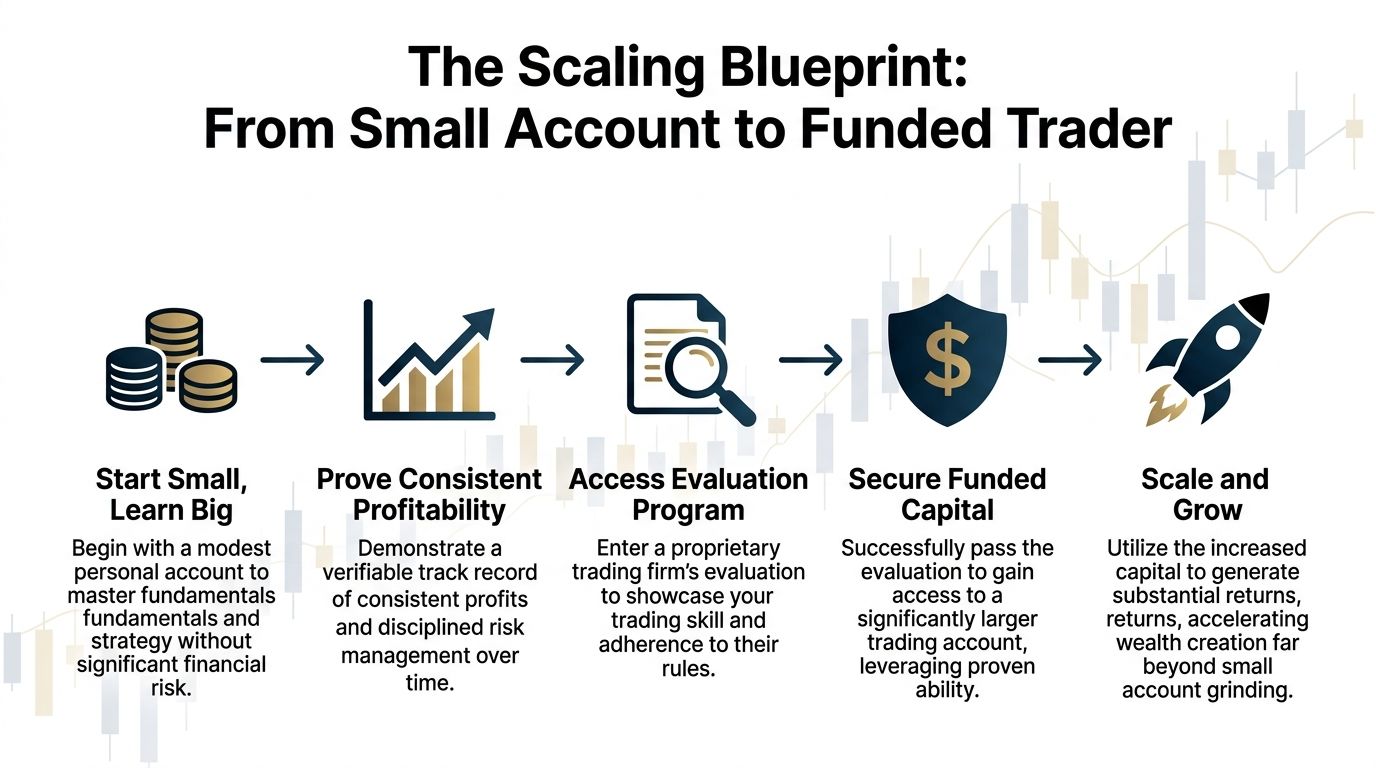
The Scaling Blueprint From Small Account to Funded Trader
Trying to compound a tiny account into a large personal trading stake is possible, but it’s slow, difficult, and emotionally demanding. The more efficient route for many traders is to use the small account for what it does best: proving consistency.
That changes the role of your personal account. It stops being the final destination and becomes the testing ground. If you can show disciplined execution on a small balance, you’ve built the one thing that matters most when you step into a funded evaluation. You’ve built evidence.
Why this path makes more sense
Most guides about how to grow a small trading account stop at compounding. That’s incomplete.
There’s a strong case for treating small-account trading as stage one, then moving into prop firm capital once your process is reliable. Data cited in this article on the importance of rules while growing a small account says 70% to 80% of challenge failures come from poor risk adaptation, not a lack of skill, and traders using a fixed 1% to 2% fractional risk model relative to the challenge size show 25% higher consistency, with access to $5K to $100K in simulated capital and scaling paths up to $500K.
That’s the overlooked point. Many traders don’t need a radically better strategy. They need to apply the same disciplined process to a larger capital base under rules they can respect.
The small account teaches control. The funded account rewards control.
What carries over from your small account
If you’ve trained correctly, the transition isn’t as dramatic as it looks.
The habits that transfer well are:
- Fixed risk per trade: You already know your max loss before entry.
- Hard respect for drawdown: You don’t let one bad session turn into a collapse.
- Selective trading: You wait for your setup instead of manufacturing action.
- Journal-based review: You know how to diagnose mistakes quickly.
- Calm execution: You aren’t changing size because of emotion.
These are the same traits that make a trader survive challenge rules and funded account conditions.
What usually breaks traders in evaluations
The problem usually isn’t technical analysis. It’s behavioral pressure.
A trader who was patient in a small account often becomes reckless when they see access to larger buying power. Suddenly they overtrade, widen stops, force setups, or try to finish the challenge too quickly. That’s not a strategy issue. It’s a risk adaptation issue.
The best way to avoid that is to treat the evaluation exactly like your training account:
- Same setup selection
- Same risk logic
- Same maximum daily exposure
- Same review routine
- Same refusal to chase
If you want a practical overview of the process, this guide on how to get a funded trading account lays out the evaluation path in plain language.
The real blueprint
A realistic scaling path looks like this:
Use a small personal account to prove process
Focus on clean execution, not dramatic returns.Build a verifiable record
Journal, screenshots, repeatable stats, rule adherence.Move into a prop evaluation
Apply the same risk framework to a larger simulated account.Trade funded capital with the same discipline
Don’t “upgrade” into reckless behavior just because the numbers are larger.
This approach is often more capital-efficient than trying to grind a micro account into life-changing size. It respects the reality of compounding while giving skilled traders a route to scale sooner.
Frequently Asked Questions About Small Account Growth
Can I grow a small trading account with day trading, swing trading, or algos?
Yes, but the method has to match your temperament and your rules. Day trading gives you more repetition and faster feedback, but it also creates more chances to overtrade. Swing trading reduces screen time and may suit traders with jobs, but you still need clear stop placement and patience. Algo traders have an advantage if their rules are explicit and tested, but they can still fail if they deploy systems they don’t understand.
The style matters less than whether you can execute it consistently.
How long does it take to grow a small trading account?
Longer than most traders want. That’s the honest answer.
The issue isn’t whether fast growth is possible. It’s whether fast growth is repeatable without destroying the account. The traders who last usually think in terms of trade samples, rule consistency, and account survival. If you focus only on speed, you’ll usually increase risk before you’ve earned the right to.
Should I add more money to my small account or keep compounding it?
That depends on your situation, but adding capital won’t fix bad execution. If your process is sloppy, a larger account just lets you make bigger mistakes.
A better question is this: have you proven you can follow your system through wins, losses, and drawdown? If not, stay focused on process. If yes, then adding capital or moving toward funded capital may make more sense than trying to force dramatic compounding from a tiny base.
What should I do if I hit a plateau?
Don’t respond by changing everything. A plateau usually means one of three things: your edge is fine but variance is normal, your execution quality has slipped, or you’re taking trades outside your best conditions.
Go back to your journal and review only three things:
- Rule adherence
- Trade location and timing
- Management errors
If you’re an active trader in taxable accounts, it’s also smart to understand how trading activity affects taxes. For example, the 30 day wash sale rule is worth reviewing so you don’t create avoidable reporting issues while rotating in and out of similar positions.
Trading involves risk of loss. Stay realistic, stay mechanical, and treat plateaus as review periods, not as a signal to become reckless.
If you’re ready to move beyond grinding a tiny account and want a structured way to prove your consistency, explore the funding programs at MyFundedCapital. Compare the available account types, review the rules carefully, and choose the path that fits your strategy, whether that’s instant funding or a challenge model.
