

 AR
AR
 NL
NL
 EN
EN
 FR
FR
 DE
DE
 ES
ES
 IT
IT
 PL
PL
 SV
SV

You've probably opened a chart after the New York close, seen price sitting inside a tight box, and wondered whether the Asian session is dead time or the best part of the day to plan your next trade. The answer depends on the pair, the clock, and the rules you're trading under. For funded traders, that matters even more because a quiet session can protect your drawdown, or grind it away one small stop at a time.
Why the Asian Session Matters in Your Daily Routine
If you've ever checked USD/JPY at 2 a.m. EST, or logged in after New York and seen London still respecting the Asian range, you already know why this window matters. The Asian forex session is usually mapped to Tokyo, but in practice it is a layered Sydney-to-Tokyo liquidity block, and that distinction changes how you read the day.
The global FX day runs around the clock, but the Asian window is the opening stretch of the weekly cycle. Forex is open 24 hours a day, 5 days a week, and retail platforms generally begin the week on Sunday at 5:00 PM ET / EST-equivalent and close it on Friday at 5:00 PM ET (FXOpenHours). For traders trying to understand asian session forex time est, that weekly frame is the one that keeps broker labels, rollover timing, and chart behavior in the same conversation.

Where Asia sits in the 24-hour FX day
The day divides into three major blocks. Asia opens first, London expands the range later, and New York often adds the final push or reversal. That is why the Asian high and low matter so much, they often become the reference points for the rest of the day.
For funded traders, that matters in a very practical way. A quiet Asian range can help protect a 5% daily loss cap because price often moves in smaller steps, but the same quiet can also tempt you into taking low-quality entries that waste risk before London has even started. If your firm allows only limited room for error, the session is less about excitement and more about deciding whether your edge is present.
If you want a clean way to use the window, start with three questions:
- Am I trading for range or expansion? Asia usually gives you the range.
- Is my pair active in this window? JPY, AUD, and NZD pairs usually are.
- Do I need the trade right now, or can I wait for London? For many U.S.-based traders, waiting is the better decision.
A charting and scheduling layer can help here if you are tracking several pairs and session notes at the same time. A practical example is RizeTrade forex trading tools, which can sit alongside your own routine if you already use alerts and session notes. For broader timing context, the Sunday open guide at when forex opens on Sunday for New York traders can also help you line up your broker clock with the weekly reset.
Practical rule: if you don't know whether Asia is building a range or setting up a later break, treat it as information first and a trade second.
Asian Session Forex Time EST and the DST Shift
For New York-based traders, the cleanest starting point is the Tokyo-based Asian session. It is commonly described as running from about 7:00 PM to 4:00 AM EST, which maps to 12:00 AM to 9:00 AM UTC and 9:00 AM to 6:00 PM JST (Defcofx). When U.S. daylight saving time is in effect, that window shifts to about 8:00 PM to 5:00 AM EDT, because EST is UTC-5 in winter and UTC-4 in summer.
The confusion starts because the Asian window includes more than just Tokyo. Sydney often opens earlier, around 5:00 PM EST, so the session is better understood as a layered Sydney-Tokyo liquidity period rather than a single market bell (Forex.com glossary). That detail matters when you compare broker charts, because some platforms label the same hour differently depending on server time and weekly rollover.
Quick conversion table for New York traders
| City | EST (UTC-5) | EDT (UTC-4) | Local |
|---|---|---|---|
| Tokyo | 7:00 PM to 4:00 AM EST | 8:00 PM to 5:00 AM EDT | 9:00 AM to 6:00 PM JST |
| Sydney | 5:00 PM EST open, layered ahead of Tokyo | 6:00 PM EDT open, layered ahead of Tokyo | Local open depends on Australia's clock cycle |
A broker can also show a weekly reset that looks off by an hour if you compare it to your New York clock. Anchor your view to UTC first, then translate into EST or EDT after you have identified the market center.
If the clock feels inconsistent, the problem usually is not the market, it is the time zone label.
For traders who align charts with the weekly cycle, this Sunday open guide helps connect the weekly rollover to a broker clock.
How Volatile and Liquid the Asian Session Is
Calling Asia “boring” misses what makes it useful. The Asian session is usually the lowest-volatility major FX session, with thinner participation, fewer major releases, and more range-building than trend expansion (Investopedia). For funded traders, that often means fewer clean breakout chances and more time spent waiting for price to earn its move.
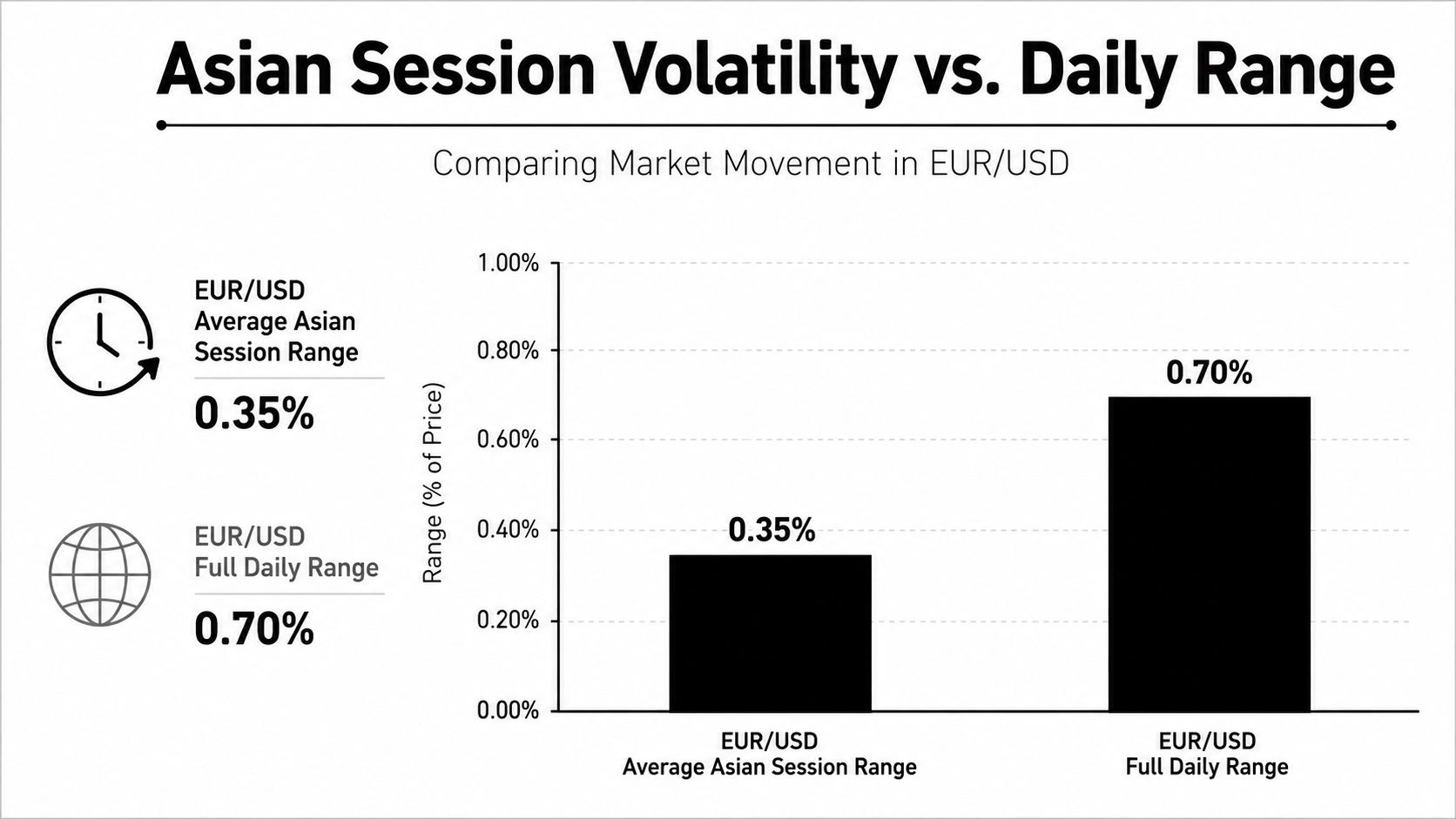
One market education rule of thumb says EUR/USD often moves only 30 to 40% of its full daily range during Asian hours, and broader EUR/USD volatility can be 2 to 3 times lower than in London (Investopedia). That kind of compression matters on a funded account. If your daily loss cap is tight, quieter conditions can help you avoid oversizing into noise, but they can also tempt you to force a trade that has not earned follow-through yet.
What that means on a live chart
On a live chart, the Asian window often looks compressed because fewer institutional desks are active and fewer macro releases hit the tape. A setup that looks obvious at midnight can still stall for hours. The move is often there, but it tends to unfold more slowly and with more hesitation than a London impulse.
London remains the most active session, with about 38% of daily forex trading volume, while Asia is often cited as the third-largest global FX session and sometimes estimated at roughly 20 to 21% of daily volume (Investopedia). Japanese trading hours alone are sometimes estimated at 6 to 8% of global daily activity, which explains why the Tokyo window matters without dominating the whole day (Investopedia).
For a funded trader, that trade-off is practical. Lower volatility can frustrate breakout hunters, but it also suits traders who want cleaner execution, smaller ranges, and more controlled exposure. If you trade the Asian session, the task is to match size and expectation to the session's pace. If your plan needs expansion, patience matters more than prediction. If your plan is range work, the session can fit well, provided you respect the slower tape and keep your risk tight.
For a broader pair framework, best forex currency pairs to trade gives a useful starting point for matching session behavior to the right market.
Best Currency Pairs to Trade During Asian Hours
Start with the pairs that have something to do during this window. JPY pairs, AUD pairs, and NZD pairs are the core group because Tokyo flow, regional news, and Asia-Pacific data are most relevant there (Investopedia). That's also why USD/JPY and EUR/JPY stay on many watchlists when the rest of the market is still quiet.
Pairs that usually fit the session
- JPY pairs: USD/JPY, EUR/JPY, GBP/JPY. These often react best to Japanese institutional flow and Tokyo-driven positioning.
- AUD and NZD pairs: AUD/USD, NZD/USD, AUD/NZD. These can respond to Australia and New Zealand releases, especially when regional data hits.
- Special case pairs: USD/CNH. China-related flow can create moves that don't look like classic Tokyo momentum.
- Metals: XAUUSD can also react during Asia, but its behavior depends heavily on broader risk sentiment and event timing.
A simple screening rule helps. If the pair needs London or New York participation to move cleanly, it's usually not the best Asian-session vehicle. That's why many USD majors, including EUR/USD and GBP/USD, often suit later hours better, especially if your style depends on expansion rather than range work.
Trading filter: choose the pair first, then choose the session. Don't force a London-style breakout plan onto a Tokyo-range chart.
If you want a broader pair framework for comparison, this currency-pair guide is a useful reference point. The key idea is simple, pair choice should match the session's liquidity profile, not your hope for movement.
How to choose in practice
Use this quick checklist:
- Check the calendar first. Look for Japan, Australia, New Zealand, and China releases.
- Match the pair to the session. Use JPY, AUD, NZD, or regional pairs when Asia is active.
- Decide on your target behavior. If you want a tight range, Asia fits. If you want expansion, wait for overlap.
Trading the Asian Session Inside Funded Account Rules
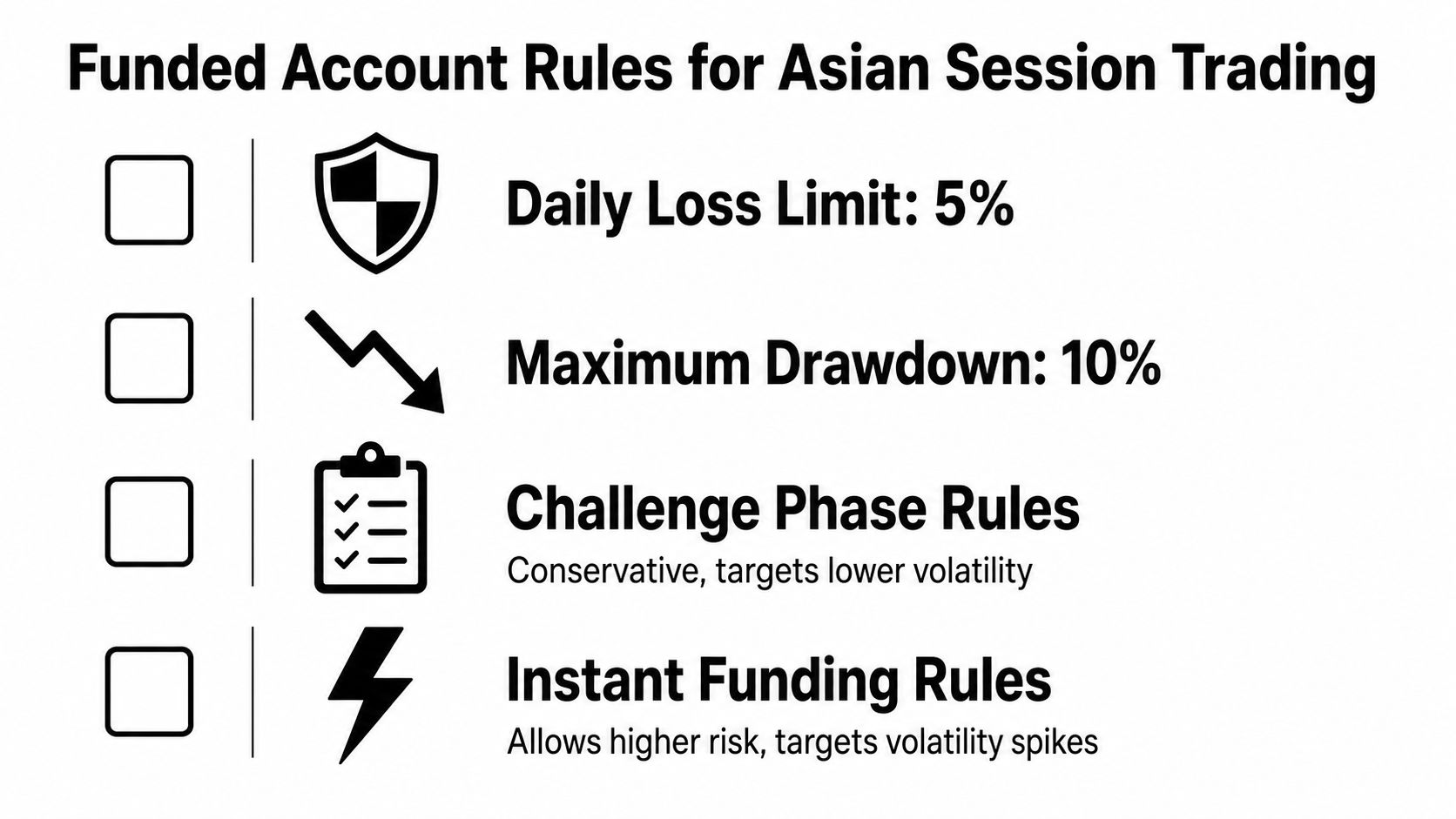
Funded traders don't get points for being awake during weak liquidity. They get paid for respecting the risk frame, and Asia can either help or hurt that effort. With a 5% daily loss limit and up to 10% maximum drawdown, even a handful of small losses can become a problem if you oversize a quiet session.
That's the hidden issue. A trade that risks too much in a low-volatility window may not feel aggressive, but several stop-outs in a row can stack up. On a funded evaluation, that kind of drift is often more dangerous than one obvious mistake.
What to respect and what to ignore
News flow matters, but not every headline deserves attention. The Asian session is where BoJ, RBA, China PMI, and RBNZ releases can matter, while random noise around thin liquidity can trap impatient traders. If your strategy doesn't have a reason to engage, skipping the session is a valid decision.
The prop-firm context matters too. Challenge phase rules usually reward a more conservative pace, while Instant Funding traders may accept more flexibility, but the same daily and overall loss limits still shape behavior. Optional add-ons like news trading and weekend holding change the boundaries further, so you should know those settings before pressing buy or sell.
A funded-account checklist
- Keep size smaller: Asia rarely needs full-size risk.
- Use tighter time-based stops: If the move doesn't start on time, exit.
- Avoid revenge entries: Thin liquidity can turn one loss into three.
- Pre-plan event risk: BoJ, RBA, China, and RBNZ can move the market fast.
- Know your add-ons: News trading and weekend holding change the rule set.
If you want a neutral comparison of session behavior and account discipline, this forex session overview makes the broader trade-off clear. The lesson is the same, low volatility is not a flaw if your job is to protect equity.
Session Overlaps and Where Asia Hands Off to London
Asia works best when you know where it ends. The most useful handoffs are Sydney-Tokyo, Tokyo-London, and London-New York, because that's where liquidity changes shape and the chart stops behaving like a single-session market.
The Tokyo-London handoff is the one most traders care about. Asian ranges often resolve there, and the first real directional move of the global day often starts as Europe comes in. If you've drawn the Asian high and low on EUR/JPY or AUD/USD, this is usually the moment when those levels get tested or broken.
How to read the handoff
Use the Asian range like a map, not a prediction.
- If price respects the range: you may get a fade or mean-reversion setup.
- If price breaks with follow-through: London may be taking over.
- If price spikes and snaps back: the break may have been liquidity only.
That's why some U.S.-based traders set alerts instead of placing full trades during this overlap. The late-Tokyo, early-London window can happen while they're still asleep or just starting the day, so alerts are often the better tool than forcing a screen-time schedule.
The Asian high and low are not magic levels. They're reference points for deciding whether Europe is expanding the day or rejecting it.
For a tighter clock on the London side of that handoff, this London session time guide helps connect the overlap to your own routine. Once you know the handoff, you stop treating Asia as isolated noise and start reading it as the setup for what comes next.
Should You Trade the Asian Session, and How
Trade Asia if your style fits calm price action. That usually means mean-reversion, range scalps, JPY/AUD/NZD news reactions, or preparation for a later London setup. Don't force it if you're trying to catch a clean breakout in a pair that normally sleeps through the window.
The best use of the session often isn't to earn your whole day. It's to gather structure, manage risk, and maybe take one clean trade if the setup is obvious. If the chart is slow and you're tired, skipping it is often the higher-quality decision.
Simple trading habits that fit Asia
- Reduce position size: Let the market prove itself before you commit.
- Use time-based exits: If nothing develops, get out.
- Trade the right pairs: Stick closer to JPY, AUD, NZD, or regional flow.
- Pre-load London plans: Mark the Asian range so you're ready for expansion later.
That approach fits funded trading well because it respects both the session profile and the account rules. If you can protect your daily limit in Asia, you're usually in better shape for the more active windows later in the week. If you'd rather avoid the low-volatility hours altogether, that's fine too, discipline matters more than being active.
Asian Session Time and Pair Questions Answered
If you want a deeper software and platform angle for session timing, you can also browse Anaxer's developer blog, especially if you're comparing tools that help with alerts, calendars, or workflow.
Why do Asian session times vary between sources?
Because some sources center Tokyo and others include Sydney's earlier activity. That's why you'll see ranges like 7:00 PM to 4:00 AM EST or slightly wider windows that emphasize layered liquidity. The market is the same, the labeling isn't.
Is USD/JPY worth trading during the Asian session?
Often, yes, if your plan is built for thinner liquidity and tighter ranges. USD/JPY is one of the pairs most tied to Tokyo flow and Japanese institutional activity, so it usually makes more sense here than many other USD majors.
How does daylight saving time affect the clock?
The U.S. shifts from EST, UTC-5 to EDT, UTC-4, so the Asian window moves by one hour on your New York chart. That's why the same Tokyo open can look like 7:00 PM EST in winter and 8:00 PM EDT in summer.
How far does price usually move in Asia compared with London?
Asia is commonly the quieter session, and one market rule of thumb says EUR/USD may move only 30 to 40% of its full daily range during Asian hours (Investopedia). That's usually enough for range setups, but not always enough for a breakout plan.
MyFundedCapital gives disciplined traders a place to apply this kind of session logic inside clear risk rules, including 5% daily loss and 10% max drawdown limits. If you want to trade the Asian session with a plan, compare account types and learn how MyFundedCapital fits your style, whether you prefer conservative challenge trading or immediate funding with tighter process control.
