

 AR
AR
 NL
NL
 EN
EN
 FR
FR
 DE
DE
 ES
ES
 IT
IT
 PL
PL
 SV
SV

Most traders ask, “What's the best forex trading book?” The better question is, “Which book helps me trade inside hard risk limits without blowing a challenge or a funded account?” That gap matters, because a lot of book lists still lean toward broad beginner education instead of the day-to-day reality of drawdown control, rule compliance, and repeatable execution.
The good news is that forex education still has a durable core. IG's ranking of top forex trading books puts John J. Murphy's Technical Analysis of the Financial Markets first and Mark Douglas's Trading in the Zone second, with long-standing staples like The Alchemy of Finance, Market Wizards, and Kathy Lien's Day Trading and Swing Trading the Currency Market also high on the list, which shows how concentrated and stable the canon really is (IG's forex book ranking). This guide narrows that bigger shelf down to seven forex trading books that are useful in live conditions, especially if you're trying to pass evaluation rules and boost reading comprehension so the material turns into decisions instead of trivia.
1. The Art of Currency Trading
If you only buy one modern FX-specific book, Brent Donnelly's The Art of Currency Trading is one of the few that reads like it came from someone who's had to make decisions with actual market pressure on the screen.
It's useful because it doesn't trap you in one camp. You're not forced into pure macro, pure technicals, or pure psychology. Donnelly blends them into a workable routine, which is exactly what funded traders need. Most challenge failures don't come from lacking a setup. They come from forcing trades when conditions don't fit the setup.
Why it works for prop-style trading
This book is strong on preparation, trade framing, and what I'd call “context discipline.” That matters more than a flashy pattern library. In a funded environment, your edge has to survive bad timing, spread expansion, and the temptation to oversize after a losing day.
Practical rule: If a book helps you say “no trade” more often, it's probably more valuable than a book that gives you ten more entries.
Donnelly's approach also fits traders who need structure without becoming fully systematic. You can build a pre-session process around it, then connect that process to your own risk management in forex trading.
Best use case
- Best for discretionary traders: You already understand charts but want a more professional decision framework.
- Best for day and swing traders: The material maps well to active FX trading without feeling like a beginner manual.
- Best for review work: It gives you language for post-trade analysis, not just entries.
What doesn't work as well is automation depth. If you want code-ready models or deep quantitative architecture, this isn't that book.
Still, for real-market judgment, it's one of the most practical forex trading books on this list. It teaches how pros think through trades before they click, and that's more valuable than memorizing another setup you won't follow under pressure.
2. Day Trading and Swing Trading the Currency Market, 3rd ed.
Kathy Lien's Day Trading and Swing Trading the Currency Market has stayed relevant for a reason. It gives active traders concrete material to test. That alone separates it from a lot of forex trading books that spend pages explaining the market without telling you what to do with that information.
The biggest strength here is that Lien treats currencies like currencies, not just lines on a chart. That matters because FX isn't an isolated retail game. The New York Fed notes that average daily FX turnover rose from about $1.5 trillion in 1998 to $7.5 trillion in 2022, the U.S. dollar was on one side of 88% of all FX transactions in 2022, the euro was involved in about 30%, and London plus New York accounted for 57% of global volume (New York Fed FX market evolution). That's why books that focus on pair behavior, session overlap, and macro catalysts age better than books built around generic pattern-chasing.
Where this book earns its place
Lien gives traders a menu of setups and drivers that can be adapted, filtered, or rejected after testing. That's the right way to use the book. Not as a script. As a research starting point.
A junior trader can read it and immediately start separating:
- Pairs with cleaner response to data
- Sessions where movement is more tradeable
- Technical setups that need a catalyst versus setups that stand alone
A setup that ignores session, pair character, and news context usually looks better in a screenshot than in a live account.
Trade-offs to know
This is not a “set and forget” recommendation. Some examples come from an older market environment, so you need to validate anything you use on current charts.
That said, this is still one of the better forex trading books for traders who want rules they can test. If your goal is to build a challenge-ready playbook, Lien gives you more usable raw material than most popular beginner titles.
3. Naked Forex
Walter Peters and Alex Nekritin's Naked Forex is the book I'd hand to a trader whose chart is buried under indicators and whose decisions keep getting slower.
The appeal is simple. Fewer variables. Cleaner execution. Less excuse-making.
For funded-account trading, that matters. Rule-based risk limits punish hesitation almost as much as they punish recklessness. If your process takes too long, you'll either miss the trade or chase it late. Price-action traders often do better when the chart gives them a short list of decisions instead of a dashboard.
Why simplicity helps under risk rules
This book focuses on patterns, support and resistance, and trade management around visible price behavior. That makes it easier to build a repeatable routine around a small number of pairs. It also pairs naturally with a focused price action trading strategy if you want to keep your approach lean.
Here's where Naked Forex is strongest:
- Clear visual logic: You can usually explain the trade in one sentence.
- Tighter routine fit: It supports specialization instead of random pair-hopping.
- Lower cognitive load: You're less likely to override your plan because three indicators disagree.
Where traders misuse it
The common mistake is treating “naked” as “context-free.” Price action works better when you know where you are in the session and what event risk is on deck. Clean charts don't remove the need for judgment.
Good use: Pick two patterns, one session, and a small watchlist.
Bad use: Trade every rejection wick you see because the chart looks simple.
Advanced traders may eventually want more depth on macro drivers and broader market structure. That's the limitation. But for traders who need discipline, clarity, and fewer moving parts, this is one of the more operational forex trading books you can buy.
4. Beat the Forex Dealer
Agustín Silvani's Beat the Forex Dealer isn't the prettiest book on the shelf, but it covers something many traders learn only after paying for it. Execution matters. A lot.
That's why I rate this book higher than most generic “strategy” books for intermediate traders. It explains why a good idea can still produce a bad trade if you enter in the wrong window, place stops in obvious spots, or ignore what thin liquidity does to price behavior.
The practical value
Many retail traders think they have a strategy problem when they really have a market mechanics problem. Silvani helps fix that. He spends time on dealing practices, liquidity conditions, big-figure levels, crosses, and the ugly parts of FX execution that don't show up in polished social media charts.
What I like most is the survival value. If you trade around opens, handovers, or lower-liquidity periods, this book makes you more skeptical in the right way.
- Stops need location logic: Not just technical logic.
- Timing changes quality: The same setup behaves differently in different liquidity windows.
- Broker fills are part of the trade: Your plan isn't complete until execution is considered.
Who should read it now
This book is especially useful for traders who keep saying, “My stop got clipped and then price moved my way.” Sometimes that's bad luck. Sometimes your placement was too obvious for the conditions.
Some examples are dated, and you'll need to translate the principles to your current broker and platform. But the underlying lesson holds. If you ignore execution, your backtest and your live results drift apart fast.
This is one of the more underrated forex trading books because it teaches defense. Funded traders need that. Preserving the account is part of the job.
5. FX Options and Smile Risk
Antonio Castagna's FX Options and Smile Risk is the most specialized book here. It's also the easiest one to buy for the wrong reason.
If you only trade spot FX and don't care about volatility structure, this probably isn't your next read. It's dense, quantitative, and aimed at traders who want to understand how volatility is priced and managed, not just where EUR/USD might bounce on a chart.
Why it still matters for some FX traders
A lot of spot traders underestimate how much options-related thinking can improve their market awareness. Even if you're not pricing exotics, understanding volatility, hedging logic, and smile behavior helps around event risk and overnight exposure.
BestBrokers reports that global forex turnover reached $9.6 trillion in April 2025, up 28% from $7.5 trillion in April 2022 (BestBrokers forex market statistics). In a market that large, books that teach process and measurable risk have lasting value because intuition alone won't carry you far.
Read this only if you need it
This book earns a spot on the list because some traders do need to move past spot-only thinking.
You should consider it if:
- You trade around major event risk: You want better awareness of volatility conditions.
- You monitor options markets: You need stronger context for how pricing pressure can shape spot behavior.
- You have quantitative background: You're comfortable with model-heavy material.
You should skip it for now if your current problem is basic execution, discipline, or overtrading.
This isn't an “edge in a weekend” book. It's a specialist text. Read it when your trading questions have become more technical than tactical.
For the right reader, though, it's one of the few forex trading books that opens the door to how professionals think about volatility risk, not just directional bias.
6. Trading in the Zone
Mark Douglas's Trading in the Zone is still the psychology book most traders eventually circle back to.
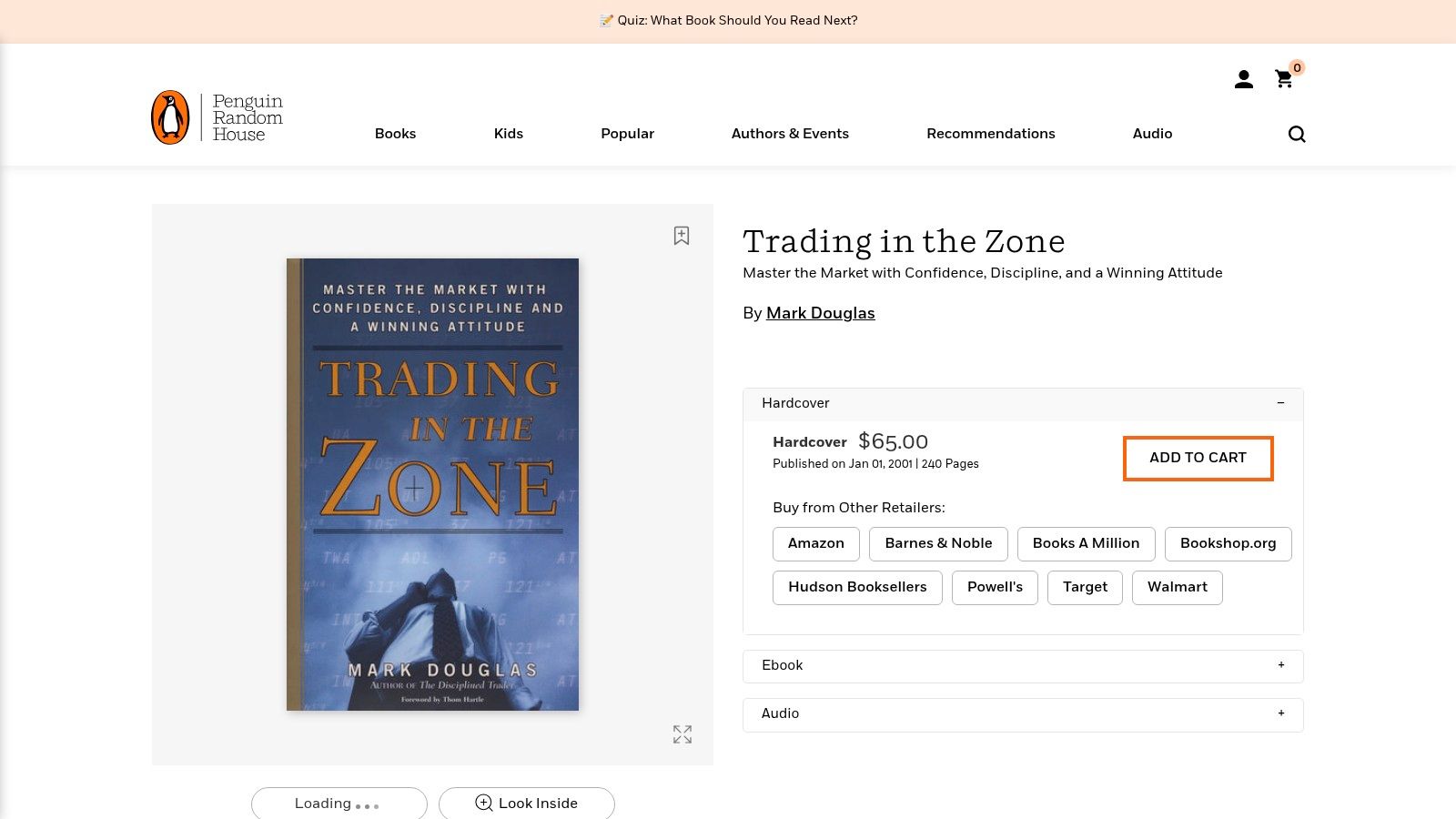
There's a reason it stays near the top of major lists. As noted earlier, IG ranks it second among the best-known forex trading books. That staying power matters. Investing.com also emphasizes that reading forex books gives beginners a structured foundation in fundamentals, strategies, and risk management, but the gap in many mainstream lists is that they still don't directly answer the funded trader's question: which book helps under strict drawdown rules (Investing.com guide to forex trading books)? Douglas comes closer than most because he teaches the mental side of consistency.
Why funded traders need this book
If you've ever done any of these, you need it:
- moved a stop because you “knew” price would come back
- doubled down after a loss
- skipped a valid trade because the last one lost
- took a marginal trade because you wanted to finish the day green
Douglas doesn't give entries. He gives a framework for accepting uncertainty without falling apart. That matters in challenge conditions where emotional mistakes often break the account before strategy quality does.
A lot of traders pair this well with focused work on developing a trading mindset for consistent execution.
What it won't do
It won't build your edge for you. That's the trade-off.
If you don't already have a workable method, this book can feel profound while your chart stays messy. Use it as a complement to a concrete strategy, not as a substitute for one. But once a trader has a method, few books do more to stabilize execution.
7. Market Wizards
Jack D. Schwager's Market Wizards is not a forex manual. That's exactly why it belongs here.
The best lesson in this book is that strong traders don't all look the same. Some are discretionary. Some are systematic. Some are macro-driven. Some are brutally selective. What ties them together is process, risk control, and the ability to keep operating through uncertainty.
Why I still recommend it
Many newer traders read one strategy book and assume they need to copy that style exactly. Market Wizards breaks that habit. It shows that there are multiple valid ways to win, but there are very few valid ways to ignore risk.
That's especially useful if you're trading under prop-style constraints. Rule limits force clarity. You need to know what kind of trader you are, what conditions you handle well, and what behavior gets you in trouble.
The common thread in good trading isn't personality. It's disciplined risk behavior repeated for a long time.
Best takeaway for a challenge account
Read this book with a notebook, not as inspiration entertainment.
Write down:
- Which trader mindset fits you
- How often top traders talk about defense
- What they avoid, not just what they trade
- Where patience shows up as an edge
The downside is obvious. This isn't a step-by-step forex playbook. If you want pair-specific setups, read Lien or Donnelly first.
But if you want durable principles you can carry across FX, indices, commodities, or any other instrument set, this is one of the most valuable books in trading. It teaches judgment by example, and that ages well.
7-Book Forex Trading Comparison
| Title | Implementation (🔄) | Resource requirements (⚡) | Expected outcomes (📊) | Ideal use cases (💡) | Key advantages (⭐) |
|---|---|---|---|---|---|
| The Art of Currency Trading (Brent Donnelly) | Moderate, process-driven discretionary workflows 🔄 | Moderate, live market practice, basic data feed ⚡ | Structured trade plans; improved news/correlation execution ⭐⭐⭐⭐ 📊 | Experienced day/swing traders building professional routines 💡 | Real-market examples, integrated psychology & sizing ⭐⭐⭐⭐ |
| Day Trading and Swing Trading the Currency Market (Kathy Lien) | Moderate, rule-based, backtestable setups 🔄 | Moderate, historical data, backtesting tools, optional automation ⚡ | Tradable setups ready for backtest/automation ⭐⭐⭐⭐ 📊 | Active day/swing traders seeking systematized strategies 💡 | Dozens of defined setups; technical + fundamental blend ⭐⭐⭐⭐ |
| Naked Forex (Walter Peters, Alex Nekritin) | Low–Moderate, price-action only, simple rules 🔄 | Low, charting tools and practice time ⚡ | Cleaner entries/exits; reduced indicator noise ⭐⭐⭐ 📊 | Traders favoring simplicity and focused pair specialization 💡 | Easy to operationalize; discipline-focused routines ⭐⭐⭐ |
| Beat the Forex Dealer (Agustín Silvani) | Low, conceptual and tactical awareness 🔄 | Low, broker review, market observation ⚡ | Better execution awareness; fewer stop/price surprises ⭐⭐⭐ 📊 | Retail traders concerned with execution and liquidity quirks 💡 | Insider view of microstructure and execution pitfalls ⭐⭐⭐ |
| FX Options and Smile Risk (Antonio Castagna) | High, model- and math-heavy implementation 🔄 | High, quantitative background, volatility data, pricing tools ⚡ | Professional-level pricing/hedging of smiles and exotics ⭐⭐⭐⭐📊 | Options traders, market-makers, volatility risk managers 💡 | Concrete tools for volatility surface construction & hedging ⭐⭐⭐⭐ |
| Trading in the Zone (Mark Douglas) | Low, conceptual shift requiring practice 🔄 | Low, time for mindset work and journaling ⚡ | Improved emotional control and consistency ⭐⭐⭐⭐ 📊 | Traders needing psychological edge, funded-account participants 💡 | Durable framework for probabilistic thinking and risk acceptance ⭐⭐⭐⭐ |
| Market Wizards (Jack D. Schwager) | Low, principle-driven, interview format 🔄 | Low, reading time and reflection ⚡ | Broadened risk/process perspective; strategy inspiration ⭐⭐⭐ 📊 | Traders seeking cross-style lessons and longevity principles 💡 | Diverse, candid trader insights on risk and process ⭐⭐⭐ |
From Knowledge to an Actionable Edge
Reading forex trading books helps, but only if the book changes what you do before, during, and after a trade. If it just gives you more highlights and more screenshots, it won't improve your account. The useful books are the ones that sharpen selection, tighten risk, and reduce emotional mistakes.
A practical way to use this list is to match the book to your actual weakness. If you overtrade, start with Trading in the Zone. If your chart is cluttered and inconsistent, start with Naked Forex. If you need a real FX framework, start with The Art of Currency Trading or Kathy Lien's book. If execution keeps hurting you, Beat the Forex Dealer is more urgent than another strategy title.
Don't try to extract everything at once. Take one idea from one book and run it through your process. Test it on historical charts. Then test it in replay or demo conditions. Then decide whether it improves your trading inside your own limits. That sequence matters. Reading without testing creates false confidence, and false confidence is expensive in a funded environment.
The broader backdrop also explains why these books still matter. FX remains the largest financial market by trading volume, and the educational core around it has stayed unusually stable over time, as noted earlier. That's not because trading hasn't changed. It's because the basics that matter most still hold up. Risk control, probability, execution quality, psychological discipline, and market context remain the difference between a trader who survives and one who resets.
If you're trading toward a prop challenge or managing a funded account, judge every book by one question: does this help me follow a plan under pressure? If the answer is no, it may still be interesting, but it's not essential.
Trading involves substantial risk of loss and isn't suitable for everyone. This content is educational only and not financial advice.
If you're ready to turn study into a funded trading plan, explore MyFundedCapital and compare its Instant Funding, 1-Step, and 2-Step options. The key isn't reading more for the sake of it. It's applying the right ideas inside clear risk rules, then proving you can execute them consistently.
