

 AR
AR
 NL
NL
 EN
EN
 FR
FR
 DE
DE
 ES
ES
 IT
IT
 PL
PL
 SV
SV

Most advice about day trading in options focuses on entries. That's backward. Most traders don't fail because they guessed direction wrong once. They fail because theta decay, spreads, slippage, and bad sizing punish even decent reads.
If you want a real shot, treat options like a high-friction instrument, not a lottery ticket offering outsized potential. Day trading in options can work for a small minority of skilled traders, but only if execution, product selection, and risk controls are tighter than most beginners expect.
The Unfiltered Truth About Day Trading Options
The popular version of day trading in options sounds simple. Buy a call if price looks strong. Buy a put if price looks weak. Sell fast, stack gains, repeat.
That version leaves out the part that destroys accounts.
One large-data analysis discussed in a market review found that over 75% of options trades lose money, with losses worsened by transaction costs and bid-ask spreads, especially in same-day and 0DTE contracts, as noted in this discussion of options trading friction. That's the part most guides skip.

What new traders usually get wrong
Most blowups come from a short list of mistakes:
- They buy cheap contracts, not good contracts. Cheap premium often means weak responsiveness, ugly spreads, or too little time.
- They ignore the cost stack. Even a correct directional trade can lose if the move isn't fast enough.
- They oversize 0DTE trades. Small option prices create the illusion of controlled risk. The actual exposure can still be severe.
- They trade bad market conditions. Choppy intraday action shreds long premium.
Practical rule: If the underlying doesn't move cleanly and quickly enough, the option buyer pays for being early, being late, and sometimes even being right.
There's also a legal reality behind the hype. When traders are sold reckless options ideas or misled about risks, they sometimes need legal review rather than another strategy video. In those situations, resources like Scott Paul Schlett recovery options can help people understand what recovery paths may exist after investment-related losses.
What actually matters
A serious options day trader thinks in this order:
- Is the underlying liquid and moving with intent?
- Can this contract respond fast enough without an ugly spread?
- Does the setup justify the premium decay I'm accepting?
- Will one bad trade damage my week?
If you can't answer those questions before entry, you're not trading a setup. You're renting gamma and hoping.
Decoding the Engine Room of Options
If you're day trading in options, you're not trading price alone. You're trading a contract whose value changes based on several moving parts at once. New traders usually focus on direction and ignore the engine underneath the trade.
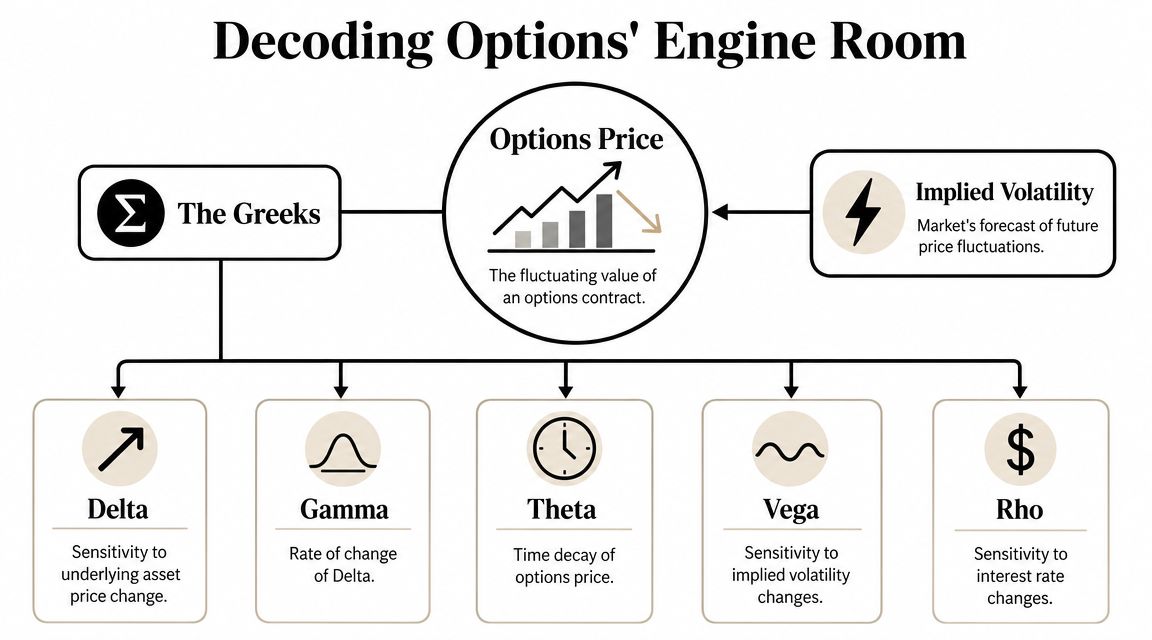
That engine is the Greeks and implied volatility.
Read the dashboard, not just the chart
Think of the option chain like a control panel.
- Delta is your speedometer. It tells you how sensitive the option is to a move in the underlying.
- Gamma is acceleration. It tells you how fast delta itself can change.
- Theta is the running cost of time. Hold too long and time decay keeps taking payment.
- Vega is volatility sensitivity. If implied volatility shifts, the option price can change even when price action doesn't help much.
- Rho matters far less for most intraday traders, so it usually stays in the background.
These aren't academic details. They tell you what kind of contract you're buying.
A contract with mild delta and low gamma can behave like a slow truck. A near-expiration contract with aggressive gamma can behave like a race bike on wet pavement. Both can be useful. Both can also be dangerous in the wrong hands.
Why strike and expiration matter more than beginners think
For an options day trade to work, the underlying move has to be large enough to overcome multiplied risk and time decay, which means the key advantage is not just direction but choosing expirations and strikes where the move can beat theta and trading costs, as explained in Nasdaq's guide to day trading options.
That single point explains why many traders keep “calling the move” and still lose.
A few practical examples:
- Too far out of the money and the option may stay sluggish while the stock moves.
- Too close to expiration and gamma may be exciting, but theta becomes a tax collector.
- Wide spreads can turn a decent setup into a weak trade before it starts.
Don't ask, “Will the stock go up?” Ask, “Will it go up far enough, fast enough, for this contract?”
A simple contract selection routine
Use a repeatable filter before every trade:
| Check | What you want | What to avoid |
|---|---|---|
| Underlying liquidity | Heavy intraday volume and clean price movement | Thin names with jumpy candles |
| Option spread | Tight bid-ask spread | Contracts with obvious fill risk |
| Expiration | Enough time for the setup to play out intraday | Expirations that decay too aggressively for the expected move |
| Strike placement | Responsive but still tradable | Strikes chosen only because premium looks cheap |
Most traders would improve quickly if they stopped hunting for the cheapest premium and started matching the contract to the setup.
Common Intraday Options Trading Strategies
A usable strategy in day trading in options is a process you can repeat under pressure. It isn't a screenshot of a winner. It isn't a one-indicator signal. And it definitely isn't “buy the breakout because social media says momentum is here.”
The better intraday setups use layered confirmation.
Breakout trades with confirmation
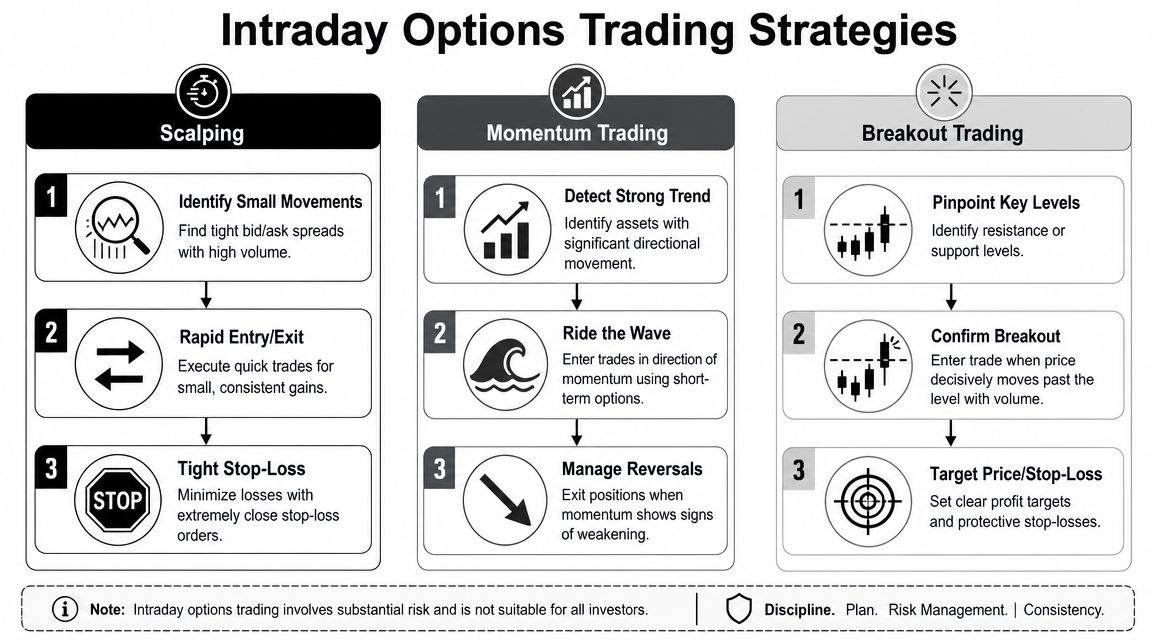
Breakouts are popular because they're easy to see. Most of them fail because traders enter the first push into resistance without checking whether buyers are committed.
A stronger process combines a trend tool with confirmation. Strike Money notes that effective options day-trading setups usually combine multiple indicators, and that VWAP is especially useful as a dynamic support and resistance benchmark backed by volume in its overview of options trading indicators.
A practical breakout checklist looks like this:
- Trend filter first. Use a moving average, MACD, or ADX to define direction.
- VWAP confirmation second. If price is reclaiming or holding above VWAP on a long setup, that matters.
- Volume expansion third. A breakout without volume often leaves option buyers holding premium that starts decaying immediately.
- Contract selection last. Pick the option only after the chart setup qualifies.
This order matters. Too many traders reverse it and start with the contract.
Momentum continuation trades
Momentum trades work best when the underlying already has clean directional intent. The goal isn't to predict a reversal. It's to ride the continuation while the path is still obvious.
Common signs the setup is healthier:
- Higher highs and higher lows for calls, or the reverse for puts
- Repeated respect for VWAP or another trend reference
- Pullbacks that are shallow rather than impulsive
- Fast tape and active participation
What kills momentum options trades is hesitation in the underlying. Once the stock starts grinding sideways, the option holder begins donating to theta.
A good momentum trade feels obvious on the chart and efficient in the option chain. If either one looks messy, skip it.
Reversal trades near key levels
Reversals are harder than breakouts and easier to misuse. Most traders call a reversal too early and buy options while price is still trending against them.
A better reversal setup usually needs:
- A known support or resistance area.
- Failure to continue through that area.
- Some form of momentum loss, such as weaker pushes or a reclaim of VWAP.
- Enough room back into the range to justify the premium.
Discipline matters. If you're buying puts after a sharp drop into support, you may be late. If you're buying calls before sellers lose control, you're early. Both mistakes cost money.
When not to trade at all
Many underlyings don't offer a good intraday options environment. If the stock is choppy, the chain is thin, or the spread is ugly, buying short-dated premium becomes self-sabotage.
Avoid the trade when:
- The underlying lacks range
- Price keeps crossing back and forth with no trend
- The contract spread is wide relative to expected move
- You only want the trade because the premium “looks affordable”
Some days the best options trade is no options trade.
The Unbreakable Rules of Risk and Money Management
Most traders think risk management protects profits. It doesn't. It protects your ability to stay in the game long enough to become competent.
That distinction matters because day trading in options punishes loose behavior faster than most markets do.
Research summarized in a market review found that roughly 97% of day traders lose money net of costs on any given day, and that active traders also underperform market indexes over time in that analysis of day trading outcomes. If the baseline odds are that bad, then risk management isn't a side topic. It is the job.
The rules that actually keep you alive
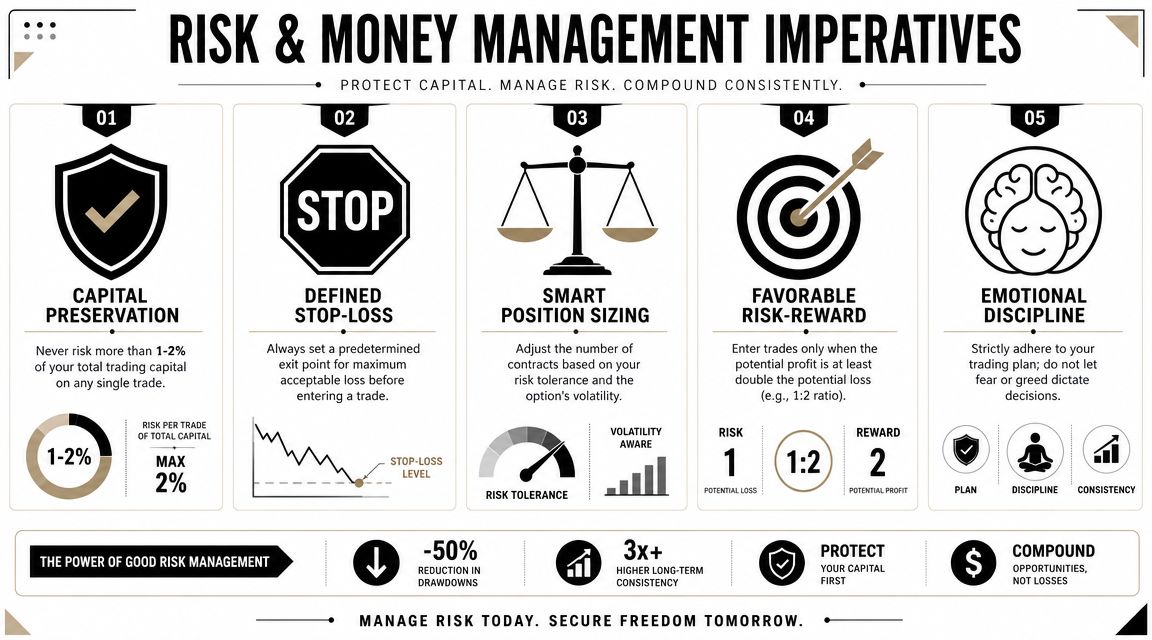
Use rules that remove decision-making after entry.
- Pre-define the loss before you click buy. If you need to “see how it trades first,” the position is too discretionary.
- Size by account damage, not conviction. Great-looking setups still fail.
- Set a daily stop. One sloppy morning should not become a revenge-trading afternoon.
- Cut exposure when conditions deteriorate. If spreads widen or price action gets noisy, your edge is shrinking in real time.
A lot of traders say they have a stop. What they have is a level where they begin negotiating with themselves.
Think in account survival terms
Many self-funded traders get trapped by sizing a trade based on how much premium they can afford instead of how much drawdown their plan can absorb.
Use a simple framework:
| Risk layer | Hard question |
|---|---|
| Per trade | If this loses immediately, is the damage routine or emotional? |
| Per day | Can I stop after a bad sequence without trying to win it back? |
| Per week | Would a normal rough patch force me to reduce size or quit? |
If you don't have written answers, your sizing is probably too large.
For traders who want a cleaner framework for planning exits and targets, this guide on how to calculate risk-reward ratio is useful because it forces you to quantify the trade before money is on the line.
Non-negotiable: Your first risk model should assume you're wrong more often than you want to admit.
Stops on options need extra discipline
Options stop-losses aren't the same as stock stops. The contract can move sharply because of the underlying, spread shifts, or changing urgency near expiration. That means you can't rely on hope or visual comfort.
Many experienced traders anchor the stop to the underlying chart level, then translate that into an option exit plan. That reduces the chance of getting shaken out by random contract noise while still respecting the actual setup failure point.
If you can't define where the underlying invalidates the trade, you don't have a trade. You have an opinion.
Trade Execution and Platform Essentials
Execution is where a decent options trader either protects edge or leaks it away. The setup can be good and the trade can still be poor if the fill is bad.
Order type matters
A few practical rules go a long way:
- Limit orders are usually the default for options. They help control entry and exit price in a market where spreads matter.
- Market orders are dangerous in fast or thin contracts. They can turn urgency into unnecessary slippage.
- Stop-limit orders can help with structure, but they need careful use because price can move through them without filling.
The goal isn't to be fancy. The goal is to avoid donating edge on entry.
Read the chain like an execution tool
When scanning an options chain, focus on tradability before narrative.
Look for:
- Tight bid-ask spreads
- Consistent activity across nearby strikes
- Contracts that respond cleanly when the underlying moves
- A platform that updates quickly and routes orders reliably
If your platform lags, your chart and chain stop being one decision environment. They become two different realities.
For traders comparing software and routing quality, these best trading platforms for day traders are worth reviewing because platform speed, order controls, and chart workflow matter much more in options than is often realized.
What to expect from your platform
A usable setup for active options trading should support:
| Platform need | Why it matters |
|---|---|
| Fast quotes | Delayed pricing ruins timing |
| Clean chain view | You need to compare strikes fast |
| Flexible order entry | Bracketed and controlled orders reduce mistakes |
| Stable execution | Bad routing magnifies spread costs |
Fancy features don't compensate for poor fills. Traders often learn that lesson after paying for it repeatedly.
Mindset Discipline and Compliance Notes
The technical side of day trading in options is hard. The mental side is what makes most traders break their own plan.
FOMO usually shows up when price is already extended and the trader feels late. Revenge trading shows up after a stop-out, when the trader wants emotional repair more than a valid entry. Options make both problems worse because their inherent amplification creates urgency.
The mental traps that blow up good setups
A few patterns repeat constantly:
- Chasing candles. Traders buy after the move expands, which leaves little room for the contract to continue paying.
- Averaging into losers. In options, that often means adding into decay, not just into a drawdown.
- Forcing trades after a miss. Missing one clean setup often triggers three low-quality ones.
- Treating losses as personal. That usually leads to oversized “comeback” trades.
One practical fix is to reduce mental clutter before the session starts. Some traders use routines like pre-market checklists, short breaks away from screens, and nutrition support to stay sharper during high-focus windows. If concentration is a genuine issue, resources on solutions for cognitive energy gaps may be worth reviewing as part of a broader performance routine.
The trader who needs action will always find a reason to click. The trader who protects capital can wait.
The compliance side most people ignore
Under FINRA rules, a pattern day trader is someone who makes 4 or more day trades within 5 business days in a margin account when those trades are more than 6% of total trades, and such traders must maintain at least $25,000 in account equity, according to FINRA's day trading rule overview.
That matters because options are included in the same day-trade framework.
For undercapitalized traders, that structure creates a practical barrier. A prop-style model changes the discipline requirement rather than removing it. Instead of a high account minimum, the pressure usually comes from daily loss limits, maximum drawdown rules, and stricter consistency demands. MyFundedCapital is one example of that model. It evaluates traders in a simulated environment with defined loss limits rather than relying on the retail PDT barrier.
Retail rules punish limited capital. Prop rules punish poor risk behavior. Neither one forgives indiscipline.
Should You Day Trade Options in a Prop Firm Account
A prop account can help if your real problem is capital efficiency. It can hurt if your real problem is unstable execution or oversized risk.
Options traders need to judge fit realistically. Fast contracts and tight drawdown rules can be a rough combination.
Prop Firm Suitability Checklist for Options Day Traders
| Evaluation Criteria | Key Question for Options Traders | Ideal Scenario |
|---|---|---|
| Instrument access | Can you trade the products and underlyings your setup requires? | Your exact market and style are supported |
| Daily loss structure | Can one normal losing sequence stay inside the daily cap? | Your routine drawdown leaves clear buffer |
| Maximum drawdown | Does your strategy have enough room to survive variance? | Normal strategy swings fit comfortably |
| Execution quality | Are fills, quote updates, and order controls good enough for short-duration trades? | Clean routing and stable platform behavior |
| Rule compatibility | Are there restrictions on overnight holds, news windows, or trade style? | Rules match your actual process |
| Psychological fit | Will tighter rules improve discipline or trigger forced trading? | Rules reinforce patience, not panic |
When a prop account makes sense
A prop structure can fit if:
- You already have a rules-based setup
- You know your average losing streak behavior
- You can trade smaller and cleaner under hard limits
- You don't rely on random hero trades to make the month
If you're exploring that route, compare the available structure carefully through this option trading prop firm overview.
When it probably doesn't
It's probably a bad fit if you:
- Need wide intraday swings to stay in trades
- Regularly move stops
- Depend on 0DTE impulse entries
- Haven't tested whether your strategy survives tight drawdown rules
A prop account doesn't fix a weak process. It exposes it faster.
Frequently Asked Questions and Your Next Steps
Can I day trade 0DTE options with a prop firm?
Yes, but only with caution. The attraction is obvious. Fast contracts, fast payoff potential, same-day closure. The problem is that the same speed works against you. A small execution mistake, a spread issue, or a stalled move can push the trade offside quickly.
0DTE trading only makes sense when your strategy is built specifically for that pace and you can follow it without improvising.
What's a realistic profit target for day trading in options?
A better question is whether your process is risk-defined. Professionals usually think in terms of controlled downside, repeatable execution, and whether the expected reward justifies the planned loss.
If you chase a dollar target first, you'll often force trades that aren't there.
Is it better to day trade options on stocks or indices?
For many traders, liquid index-related products are easier to manage because they often provide cleaner participation and tighter execution conditions than random single-name options. Individual stock options can move harder, but they also carry more event risk and more opportunities for erratic behavior.
The right answer depends less on what's exciting and more on where your execution stays consistent.
What should I do before risking more capital?
Build a short review loop:
- Track every trade by setup type
- Review whether the underlying moved enough to justify the contract
- Flag spread and slippage problems separately from bad reads
- Cut the setups that look good on charts but fail in real fills
That process is boring. It's also where progress happens.
Day trading in options demands skill, restraint, and respect for risk. This article is educational only and not financial advice. Trading involves a real risk of loss, and most traders never get far because they underestimate the cost structure and overestimate their discipline.
If you've built a rules-based process and want to apply it inside a structured evaluation model, review the funding paths at MyFundedCapital. Compare the account types, study the risk limits, and start a challenge only if your strategy can operate cleanly within them.
