

 AR
AR
 NL
NL
 EN
EN
 DE
DE
 ES
ES
 IT
IT
 PL
PL
 SV
SV
 PT
PT

You can trade well and still fail a funded evaluation. That's the part many traders don't expect at first, because the market rewards a clean setup, but prop firms reward clean setups inside a rule set. If you've ever looked at your own chart and thought, “I'm profitable, so why am I still stuck?”, this guide is for you.
Are You a Good Trader Lacking Capital
A lot of traders reach the same wall. They can read price action, hold their nerve, and execute a plan, but their account size is too small to turn that skill into meaningful income. That's where funded trader plus programs enter the picture, because they're built for traders who need more capital without risking their own large account.
The catch is simple. A prop firm doesn't just ask, “Can you make money?” It asks, “Can you make money without breaking our limits?” That's a different skill. A trader who is good on a personal account can still struggle if they size too aggressively, ignore daily risk, or let one emotional trade ruin the week.
Practical rule: treat prop firm trading like a job interview, not a personal account. You're not trying to impress anyone with one big day, you're trying to prove you can be consistent.
For traders in forex, indices, crypto, or commodities, the opportunity is real, but so is the discipline requirement. You're not buying freedom from risk. You're stepping into a system where risk control becomes part of the test, and the firm wants to see whether you can stay inside the guardrails long enough to earn a payout.
What Are Funded Trader Programs Really
A funded trader program is a screening system for traders who want access to a firm's capital. The trader supplies the skill, the firm supplies the account, and both sides rely on strict rules to decide whether the relationship works. If you already know how to read a chart, the harder part is proving you can do it without breaking the program's limits.

That structure matters because the goal is not only to find entries and exits. It is to show that your decision-making stays controlled when the account is under pressure. In MyFundedCapital's description, the setup uses a simulated execution model with real-market quotes rather than broker-routed live capital, and independent review coverage describes it as not backed by any broker, with payouts based on simulated trading activity under the program terms (firmfunded review). In practice, that means the firm's internal risk rules shape whether trades count, so drawdown limits and daily loss rules are part of the job, not fine print you can ignore.
A trader who understands that shift starts trading differently. The question becomes whether your method still works when every position has to fit inside a risk framework, not just whether your analysis was correct. A clean setup can still fail if the sizing is too large or if one emotional decision breaks the evaluation.
The psychology changes as well. On a personal account, traders often focus on finding the next opportunity. In a funded program, the priority is to protect the account first and let valid setups come to you. That is why some traders improve only after they stop trying to trade every move and start acting like a rule-compliant operator.
The same idea shows up in systems design. A well-built peer-to-peer OTC trading platform development project depends on rules, matching logic, and risk controls before scale can work properly. Funded trading is similar. The platform can only function if the process is disciplined enough to survive the conditions it creates.
For a clear explanation of the company's setup, the most direct place to start is the firm's own how it works page. It lays out the program structure in one place, which helps because prop firms can look similar at first while differing in evaluation style, funding path, and rule design.
The Evaluation Gauntlet Proving Your Skill
A trader can be sharp on analysis and still fail a prop evaluation for the simplest reason, the account was not handled like a rule-based test. The entry path is where that shift becomes visible. MyFundedCapital offers Instant Funding, a 1-Step Challenge, and a 2-Step Challenge, and each path changes how much room you have to make mistakes before the firm decides whether you belong in the funded group (PropFirm201 review).
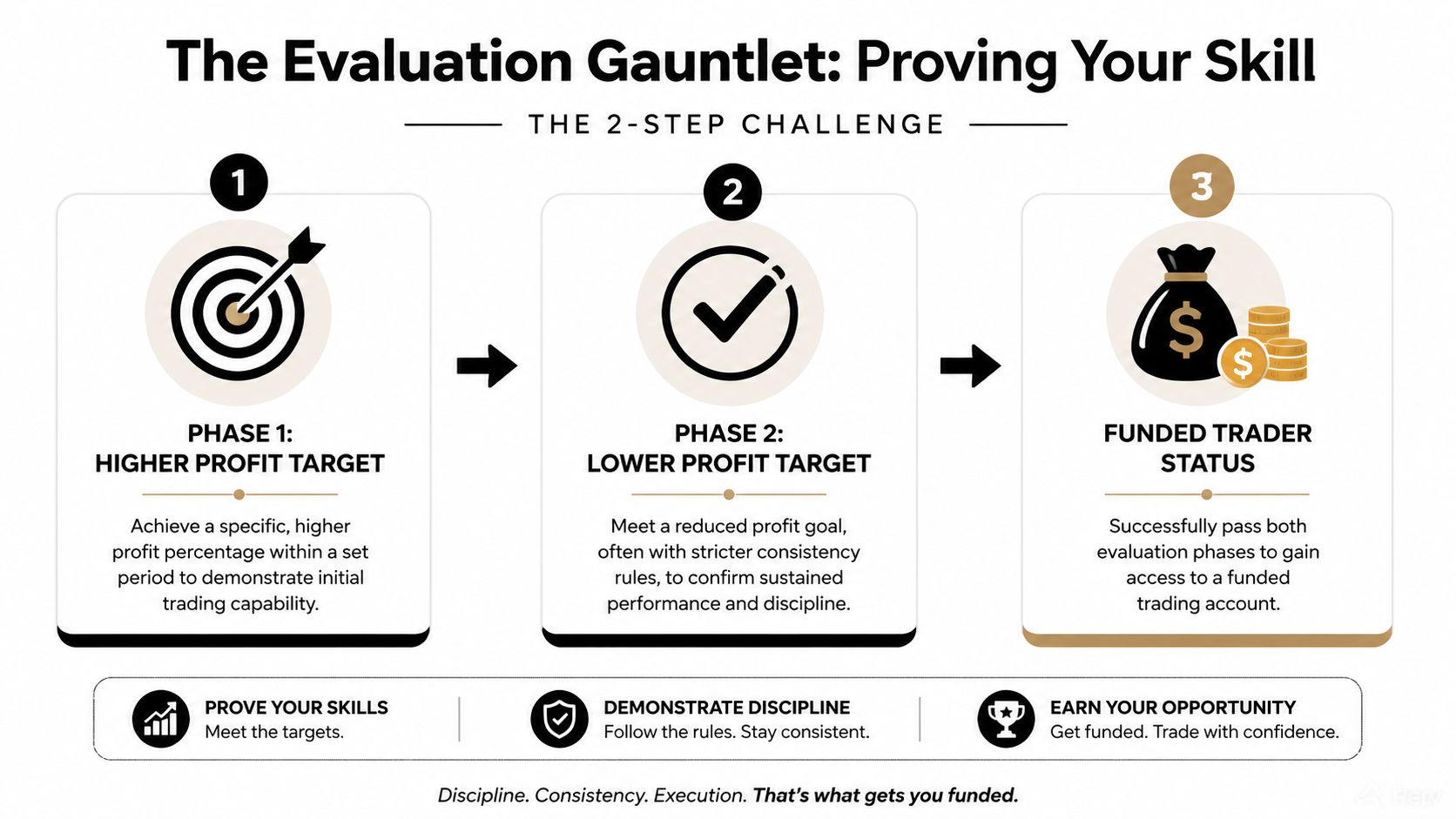
2-Step Challenge
A two-step model checks whether your process holds up more than once. The first phase usually asks for the stronger push, then the second phase asks whether you can keep the same discipline after the first hurdle is behind you. That matters because one good run can come from favorable conditions, but a funded trader has to survive different market moods without changing character.
It also changes your mindset. If you trade a two-step evaluation like a lottery ticket, every position gets oversized and every loss feels like a setback to recover fast. If you treat it like an audit of your execution, each trade becomes evidence of whether you can stay inside the risk box while still finding valid entries.
1-Step Challenge
A one-step structure removes one layer of waiting and one layer of pressure. You still need to respect the rules, but there is less room for confusion because the test is shorter and the path to funding is clearer. Traders with a strict risk plan often prefer it because they can focus on execution instead of pacing themselves through two separate phases.
That does not make it easier in every sense. A shorter evaluation can punish impatience, since there is less time to dig out of a bad sequence or recover from an early mistake. The main question becomes whether your setup selection and position sizing are already tight enough to hold under a single, direct test.
Instant Funding
Instant funding changes the trade-off again. You skip the challenge and start right away, but the account usually demands tighter control from day one because the firm is taking on more exposure immediately. The appeal is obvious, access is faster. The pressure is also real, because there is no warm-up phase to let you learn the rules through trial and error.
Choosing the path that fits your trading
The right choice depends on how you trade, not on which option sounds easiest. A trader who needs time to prove consistency may fit better in a challenge path, while a trader who already executes cleanly and wants speed may prefer Instant Funding. If you want the rule details in one place, MyFundedCapital's trading rules explain how the account boundaries shape each path.
MyFundedCapital is useful as an example because it gives traders multiple funding routes instead of forcing every style into one setup (MyFundedCapital). The primary test is psychological as much as strategic. You are not only trying to be a good trader, you are trying to be a trader who can stay profitable inside a framework that punishes careless risk.
Navigating the Key Rules of Prop Trading
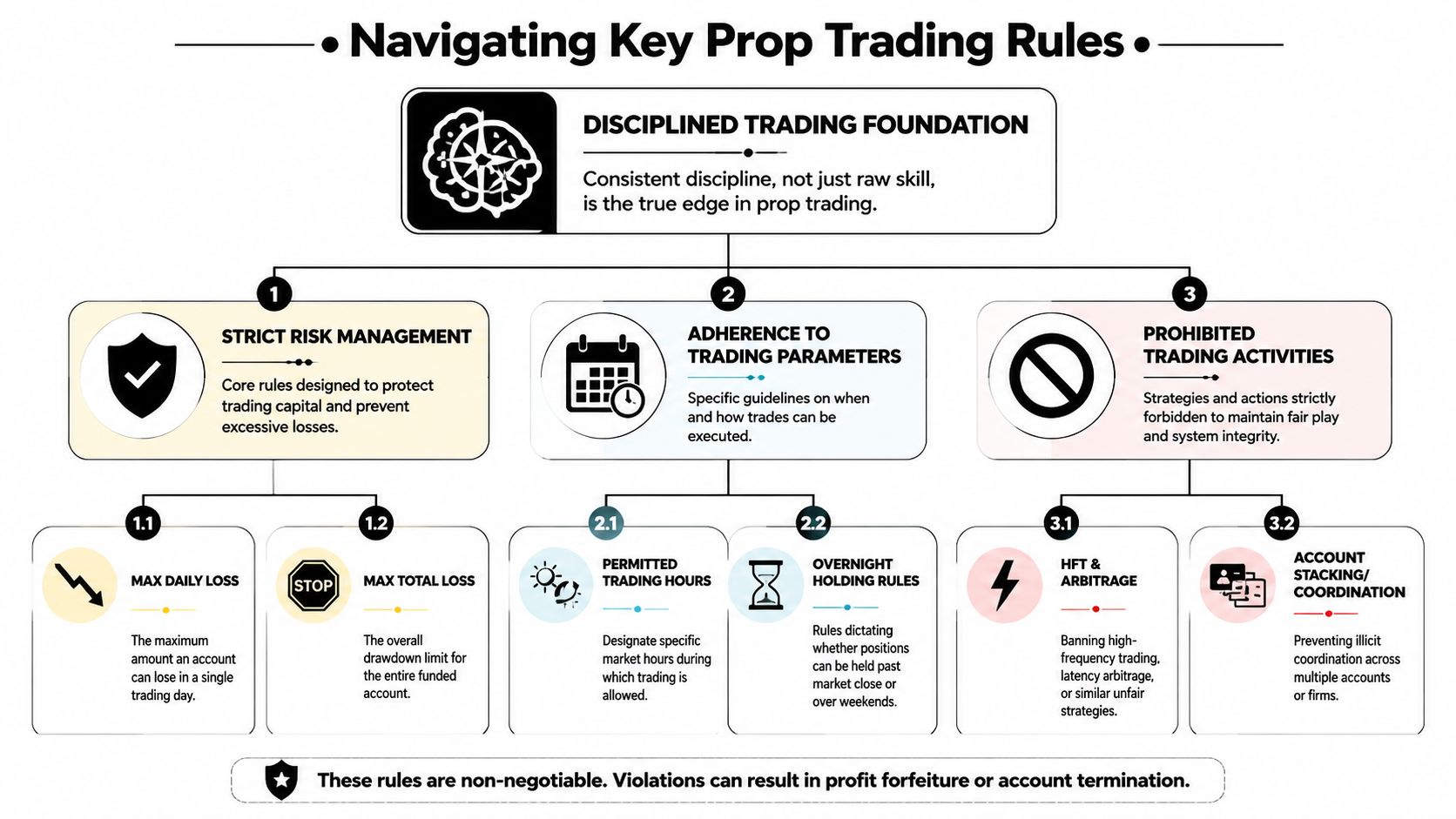
Most traders fail evaluations for a boring reason. They focus on profit targets and ignore the rules that protect the account. The firm does not care whether you “almost” got the move right. It cares whether your trading stayed inside the limits that keep the risk model intact.
Risk limits first
The biggest rules are the ones that cap losses. A daily loss limit sets the most you can lose in a single day, while a maximum drawdown sets the overall loss ceiling for the account. Those rules exist because the firm is protecting its simulated risk structure, not rewarding traders for taking wide swings.
Why consistency matters
Consistency rules are where many profitable traders get trapped. Public review content for Funded Trading Plus notes a 35% consistency rule in challenge phases and 50% in the funded stage, alongside explicit profit targets, drawdown limits, and the maximum trading multiplier set at 1:30 in most programs (FXEmpire review). The lesson isn't that profit is bad. It's that a smooth equity curve is often more valuable to a prop firm than a jagged one.
What changes in your trading
If you normally size up when you're confident, you may need to stop doing that. A personal account can survive a few uneven bursts of profit. A prop account can punish that style if one oversized session creates inconsistency or breaks a limit. That's why traders have to become rule-compliant traders, not just good market readers.
Internal rule details are worth reviewing before you place a trade, especially if you're mapping your setup to a specific firm's structure. MyFundedCapital's own trading rules page is where those guardrails are laid out in plain terms.
Bottom line: the prop firm's job is to see whether your edge survives the rules. If your strategy only works when you ignore the rules, it isn't prop-friendly.
The Money Side Fees Payouts and Profit Splits
A funded trader account has a simple money flow, but the tradeoff is easy to misunderstand if you focus only on the upside. You usually pay for an evaluation or an instant access route first, and that fee is the cost of trying to qualify. After that, the key question is how profit gets divided and how often you can take money out.

How the split works
The split is usually straightforward. If the account makes a profit, the firm keeps its share and the trader keeps the rest under the program terms. The practical lesson is simple, the bigger the account and the cleaner the execution, the more useful that split becomes.
That is why traders need to think like account operators, not just market readers. A strategy that looks fine on a personal account can still fail in a funded setting if the trader ignores the payout rules, the drawdown rules, or the rhythm needed to stay eligible.
Why account size changes the conversation
Account size changes the math and the pressure. A small funded account can help a trader prove consistency, but a larger account can make the same strategy more meaningful if it is controlled well.
MyFundedCapital offers several funding paths and publishes a structure that includes different account sizes, along with weekly or bi-weekly payout support depending on the plan. That matters because the payout cadence affects how traders plan exits, protect open profit, and decide when a trade is worth holding. A short-term trader may want faster access to payouts, while a slower swing trader may care more about how the firm handles timing and eligibility rules.
Payout timing and planning
Payout timing changes how you manage risk. If a firm pays weekly or bi-weekly, you can plan in shorter cycles and avoid treating one trade as if it has to solve everything. That usually helps traders protect gains instead of forcing low-quality setups near the end of a run.
Review the firm's payouts page before you assume the withdrawal process will feel like a normal broker account. The wording on timing, eligibility, and processing matters more than any marketing claim. A trader who understands those details is less likely to break a rule right when the account starts producing.
The money side rewards patience and discipline. Your job is to earn the right to keep trading the account, then take a clean payout under the program rules.
Choosing a Program and Avoiding Red Flags
A trader can be profitable and still pick the wrong prop firm. That usually happens when the firm's rules are unclear, the payout process is fuzzy, or the account structure does not match the trader's style. The first filter is simple. If you cannot tell exactly what breaks the account, the firm is asking you to trade blind.
Use a short checklist before you pay for any program.
- Clear rules: confirm the firm spells out drawdown, daily loss, payout terms, and challenge structure in plain language.
- Visible payout process: look for a documented payout path, not vague claims about fast cash.
- No broker pressure: be cautious if the firm pushes you toward a specific broker arrangement without a clear reason.
- Responsive support: test whether the support team answers practical questions directly.
- Realistic expectations: avoid any firm that suggests trading is easy or nearly risk-free.
These checks matter because prop trading changes the job. In a personal account, the main question is whether your strategy makes money. In a funded account, the question becomes whether you can make money while staying inside the firm's rules. That shift sounds small, but it changes how you size positions, place stops, and decide whether to hold a trade.
MyFundedCapital is one example of a setup that shows the mechanics instead of hiding them. It presents multiple funding paths, a defined simulated environment, and a published program structure. That does not remove trading risk, and it does not guarantee results, but it does give a trader more to evaluate before paying a fee.
Trading always involves risk of loss, even in a funded program. If you understand that upfront, you will make better choices about sizing, pacing, and which account type fits your style.
Funded Trader Program FAQs
Do I need to be a great trader to pass a prop evaluation
You need to be a disciplined trader first. A strong edge helps, but firms usually care more about whether you can protect capital, respect limits, and avoid emotional mistakes.
Why do traders fail even when they're profitable
Because profit alone isn't enough. A trader can make money and still fail by breaching drawdown, losing too much in one day, or running an uneven equity curve that violates consistency rules.
Is Instant Funding easier than a challenge
It's easier to start, not necessarily easier to manage. You skip the evaluation phase, but the account often comes with tighter risk control because the firm is exposing capital immediately.
What should I check before choosing a firm
Look for clear rules, a real payout process, and a structure that fits your trading style. If you're not sure whether your strategy is prop-friendly, compare the challenge path, the instant route, and the account rules side by side before paying any fee.
If you're serious about trading with structure instead of guesswork, review the account types, check the rules, and compare the funding paths at MyFundedCapital. Then choose the setup that fits your discipline, not just your optimism.
