

 AR
AR
 NL
NL
 EN
EN
 FR
FR
 DE
DE
 IT
IT
 PL
PL
 SV
SV
 PT
PT

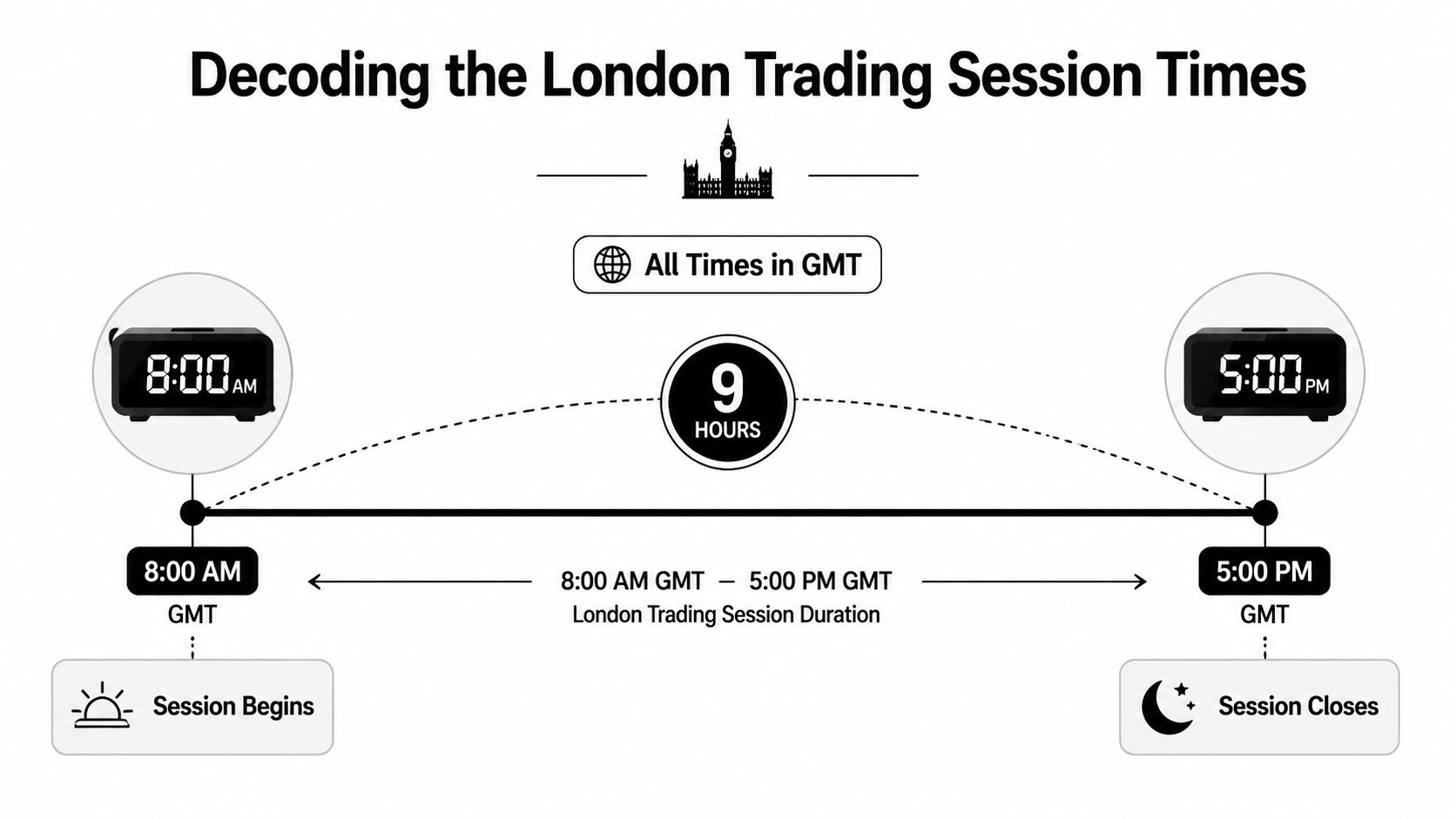
The London trading session runs from 8:00 AM to 5:00 PM GMT. The part that trips traders up is that British Summer Time shifts London to 7:00 AM to 4:00 PM GMT in summer, and the most important window is the London-New York overlap from 1:00 PM to 5:00 PM GMT when both centers are active.
If you're trying to pass a prop challenge or protect a funded account, getting london trading session time wrong isn't a small detail. A one-hour timing mistake can put you into the wrong volatility regime, the wrong spread conditions, and the wrong side of your daily loss limit. This guide gives you the practical schedule, the trade-offs, and the risk framework that matter when real rules are in play.
Decoding the London Trading Session Times
Most traders need one clean answer first. Use 8:00 AM to 5:00 PM GMT as the standard London session schedule.
The complication is British Summer Time (BST). When the UK shifts clocks forward, London effectively trades on a 7:00 AM to 4:00 PM GMT schedule. If you trade with fixed charts, fixed alerts, or an EA that assumes London always opens at the same GMT hour, mistakes often arise.
The time that matters most
For day traders, the open matters more than the close.
Why? Because order flow changes quickly around the start of London. European desks come online, liquidity improves, and price often stops drifting and starts moving with intent. If you want a broader view of how trading hours connect across the week, this guide on what time forex opens on Sunday helps put London into the full market cycle.
Practical rule: Keep two recurring reminders in your calendar, one for standard GMT months and one for BST months. Don't rely on memory.
Simple time conversion table
Use this as a working reference for london trading session time:
| Location | Standard London session | During UK summer shift |
|---|---|---|
| London | 8:00 AM to 5:00 PM GMT | 7:00 AM to 4:00 PM GMT |
| New York | 3:00 AM to 12:00 PM EST | shifts with seasonal clock differences |
| Tokyo | convert from GMT on your platform clock | check your platform during DST weeks |
| Sydney | convert from GMT on your platform clock | check your platform during DST weeks |
The safest habit isn't memorizing every city conversion. It's checking your trading platform clock against London time every Sunday before the week begins.
How to track it without guessing
Use a three-part routine:
- Check the UK clock change first: London session timing changes around the UK seasonal shift, not your local routine.
- Match platform time to GMT: Your broker server time and your chart time may not be the same thing.
- Re-test alerts and EAs: Anything built around session opens needs a timing check during transition weeks.
What doesn't work is assuming every online session box indicator stays correct year-round. Many don't.
Why the London Session Dominates Forex Trading
London matters because the biggest players are active there, and price reflects it. The session accounts for about 35% to 40% of total daily global forex volume, and London handles over 43% of global turnover according to the 2022 BIS data cited by Titan FX's London session overview.

That's the structural reason. The trading reason is simpler. During London hours, many pairs become easier to trade because the market is more active and execution is usually cleaner than in quieter parts of the day.
What liquidity feels like on your chart
Newer traders hear "liquidity" and treat it like a textbook word. On the screen, it usually means:
- Tighter spreads: You give away less edge on entry and exit.
- Cleaner fills: Slippage tends to be less painful in normal conditions.
- More reliable reactions: Levels break or hold with more participation behind them.
That doesn't mean every move is clean. London also punishes hesitation. Fake breaks still happen, especially around obvious Asian session highs and lows.
What volatility changes for a funded trader
Volatility creates opportunity, but it also compresses decision time.
A self-funded trader can sometimes get away with loose execution and call it "learning." A funded trader usually can't. If you're operating under firm rules, high-speed conditions expose every weakness fast: late entries, oversized positions, moving stops, revenge trades.
London is where bad discipline shows up faster, not where discipline stops mattering.
A lot of traders make the same mistake here. They choose the London session because they want movement, then they bring a low-volatility risk model into a high-volatility window. That mismatch is why good setups still end in bad account management.
What works and what doesn't
What tends to work during London:
- Focused watchlists: A few instruments with a reason to move.
- Pre-session planning: Levels mapped before the open.
- Defined invalidation: Hard stop placement before entry.
What usually doesn't:
- Watching too many pairs: You end up reacting instead of reading.
- Chasing first candles blindly: Early momentum and good opportunity aren't the same thing.
- Using the same size all day: London often requires smaller size for the same risk.
The Golden Hours The London-New York Overlap
If the London open is the setup phase, the overlap is the main event. The London-New York overlap runs from 1:00 PM to 5:00 PM GMT, and it generates 50% to 60% of intraday forex volatility according to Dukascopy's forex market hours analysis.

That same window can push EUR/USD ATR to 80 to 120 pips, versus 40 pips in solo sessions, with pip movement amplifying by up to 2.5x in the overlap in the same source. For a day trader, that changes everything. Targets can hit faster, but so can stops.
Why this window behaves differently
Two things happen at once.
London liquidity is still present, and New York order flow joins it. That combination tends to create the fastest expansions of the day, especially when U.S. data or policy-related headlines land during the window.
This is why overlap trading often suits traders who like momentum, continuation, and strong intraday reaction. It usually doesn't suit traders who need a slow market to think through every candle.
The real trade-off
The overlap gives you more movement. It also gives you less room for execution mistakes.
Here's the practical comparison:
| Period | Typical character | Best fit |
|---|---|---|
| London open | Fresh directional push, breakout risk, fast repricing | Traders who prepare levels before the bell |
| Mid-session London | More selective movement, less impulse | Traders who wait for cleaner confirmation |
| London-New York overlap | Strongest combined liquidity and sharpest reactions | Traders who can execute quickly and stay within plan |
If you're late in the overlap, you're usually not "joining momentum." You're often buying after expansion or selling after flush.
How junior traders should approach it
Start by picking one overlap model, not five.
For example:
- Breakout continuation: Price clears a session level, retests, then runs.
- Trend pullback: A strong morning move retraces into a structure zone.
- News reaction only after stabilization: Let the first violent move print, then decide if structure supports continuation.
What fails most often is mixing styles inside the same four-hour block. A trader tries to fade one move, chase the next, then scalp noise in between. The overlap doesn't forgive that kind of indecision.
Best Instruments to Trade During the London Session
A London watchlist should be small and intentional. You don't need more charts. You need instruments that respond to European and UK flow.
Top instruments for the London session
| Instrument | Type | Key Characteristic |
|---|---|---|
| EUR/USD | Major | Deep liquidity and steady institutional participation during European hours |
| GBP/USD | Major | Sensitive to UK data and often more reactive around London open |
| USD/JPY | Major | Useful during the transition from Asia into Europe and later during overlap |
| EUR/GBP | Cross | Direct exposure to European and UK relative strength |
| GBP/JPY | Cross | Can move sharply when London momentum meets yen-related positioning |
| EUR/JPY | Cross | Often active when European flow builds on earlier Tokyo structure |
| FTSE 100 | Index | Reflects UK market participation and can align with broader London risk tone |
How to choose instead of guessing
Not every active instrument fits every trader.
If you're newer, start with EUR/USD or GBP/USD. They usually give cleaner structure than more aggressive crosses. If you already handle volatility well, GBP/JPY and EUR/JPY can offer stronger movement, but they punish poor entries faster.
A simple selection framework:
- Pick majors if you value cleaner execution: They tend to be easier for process-driven traders.
- Pick crosses if you understand session-specific catalysts: They often move well, but they can become erratic quickly.
- Add an index only if you already trade one market well: Don't split focus just because the instrument is available.
What usually works by time of day
During the earlier London phase, traders often focus on euro and pound instruments because they respond directly to European participation. Later, as New York joins, USD-related pairs can become more decisive.
One practical note on tools: if you trade across forex, indices, and automated systems, platforms and firm rules matter as much as the instrument list. MyFundedCapital supports simulated trading across forex, indices, crypto, and commodities on DXtrade and cTrader, which matters if your London session process includes manual execution, EAs, or copy setups.
The main mistake here is building a watchlist based on excitement. Build it around repeatability.
Actionable Trading Strategies for the London Session
You don't need a complicated playbook for london trading session time. You need one or two setups you can execute the same way every week.
According to OANDA's review of forex trading timing, breakouts often occur after 8:00 AM GMT when UK GDP or ECB announcements can trigger 50 to 100 pip moves within 30 minutes, and pre-open accumulation from 6:30 to 8:00 AM GMT can build momentum for those moves. That's why pre-London context matters.
If you need a broader framework for lower-timeframe execution, this guide to a scalping strategy in forex is a useful companion.
London open breakout
Goal: Catch the first clean expansion after the open.
Best fit: Traders who can do prep work before the session starts.
Best timeframe: Lower intraday charts for execution, higher intraday charts for structure.
Process:
- Mark the Asian session high, low, and any obvious consolidation.
- Check whether price built pressure during the pre-London window.
- Wait for the first real break with follow-through. Don't trade every wick through a level.
- If price breaks and immediately snaps back into range, leave it alone.
Exit logic matters as much as entry. If the move extends quickly, partials make sense. If the breakout stalls, don't turn a scalp into a hold and hope.
Execution note: The best breakout isn't the earliest one. It's the one that still looks valid after the first burst of noise.
Overlap trend continuation
This setup works when London has already established direction and New York adds fuel rather than reversing it.
Look for:
- A clear morning trend: Not a choppy back-and-forth session.
- A controlled pullback: Price retraces instead of collapsing.
- A reclaim or continuation trigger: Structure should support another leg.
This tends to work better than forcing fresh trades in the middle of nowhere. If the market has already shown its hand, the overlap can offer a cleaner second chance than the London open itself.
News trading with restraint
News can create the biggest move of the day, but it can also create the fastest rule violation on a funded account.
A practical approach is simple:
- Trade after the first reaction settles: Let price show whether it accepts or rejects the move.
- Reduce size around scheduled releases: Fast conditions can invalidate normal stops.
- Skip events you don't understand: There will always be another session.
What doesn't work is treating every headline spike like a gift. Fast markets reward preparation, not impulse.
Risk Management for Funded Traders in the London Session
For funded traders, risk management isn't the boring part of the process. It's the part that decides whether you stay in the game long enough for your edge to matter.
The hidden issue with london trading session time is DST drift. When the UK shifts to BST (7 AM to 4 PM GMT), the New York overlap shortens by an hour, and traders who miss that change can end up trading the wrong window and pushing into avoidable losses, including breaches of a prop firm's 5% daily drawdown limit, as explained by AvaTrade's trading sessions guide.
If you need a deeper framework for building that discipline, these forex risk management strategies are worth reviewing before you size up.
The professional model
Funded trading rules force clarity. A flat 5% daily loss limit and up to 10% maximum drawdown mean you can't trade London the way many retail traders do.
That means:
- Hard stops only: Mental stops don't belong in fast session trading.
- Size by stop distance, not confidence: A wider stop requires smaller size.
- One bad trade doesn't get a revenge trade: London volatility compounds emotional mistakes.
A practical daily framework
Use a simple session risk checklist before the open:
| Check | Why it matters |
|---|---|
| Session time confirmed | Prevents DST-related timing errors |
| Economic calendar reviewed | Reduces avoidable news exposure |
| Primary instrument chosen | Stops random chart hopping |
| Max loss for the session defined | Keeps daily damage contained |
| Walk-away condition set | Prevents overtrading after a win or loss |
Small size with clean execution beats aggressive size with a perfect thesis you can't survive.
What junior funded traders usually get wrong
They focus on passing instead of surviving.
That mindset creates bad habits fast. They double down after a stop. They widen risk because "London is moving." They hold losers through scheduled volatility. None of that is a strategy. It's pressure leaking into execution.
What tends to work better is boring and repeatable:
- Stop trading after a clear loss threshold.
- Scale down after an emotional trade.
- End the session when market conditions no longer match the plan.
Trading involves risk of loss. On a funded account, that risk is managed first or the opportunity disappears.
Essential Tools and Frequently Asked Questions
Good London trading starts before the open. The tools are basic, but skipping them creates avoidable mistakes.
The short tool stack
Keep these open every trading day:
- A timezone converter: Use it to verify London time against your local clock, especially around seasonal shifts.
- An economic calendar: Check UK, eurozone, and U.S. releases before placing your first order.
- A session marker on chart: It helps, but only if you verify its clock settings.
- A trade journal: Review whether your best trades come from the open, the overlap, or the quieter period in between.
One more useful reference is this set of Frequently asked questions from TradeTally. It's helpful when you're comparing practical prop-trading issues like execution rules, setup expectations, and process questions that come up outside pure chart analysis.
FAQ
Is the pre-London period worth watching
Yes. An emerging pattern is the rise of pre-London volume between 6:30 and 8:00 AM GMT, driven by algorithmic activity, which creates early opportunity before the official open according to Dominion Markets' trading sessions article. That doesn't mean you should trade it every day. It means you should pay attention to whether price is building pressure before London opens.
Should beginners trade the open or the overlap
Usually the open is easier to study, and the overlap is harder to execute. The open gives you a cleaner routine around session highs, lows, and pre-market buildup. The overlap moves faster and punishes hesitation more aggressively.
Can you trade the London session from outside Europe
Yes, but your local schedule matters. If London opens in the middle of your sleep cycle, forcing it can hurt decision quality. Many traders do better choosing one repeatable slice of the session rather than trying to trade every active hour.
What if I miss the first move
Then you miss it. That's better than inventing a late entry. London offers enough opportunity over time that you don't need to force a trade after the market has already expanded.
Trading is educational work, not financial advice, and there's always risk of loss.
If you want to apply this framework inside a prop environment, explore the funding options at MyFundedCapital. Compare the account types, review the risk parameters, and choose a challenge model that fits the way you trade the London session.
