

 AR
AR
 NL
NL
 EN
EN
 FR
FR
 DE
DE
 PT
PT
 IT
IT
 PL
PL
 SV
SV

You've watched the videos, joined the Discord servers, and probably tested more than one strategy. Yet your results still swing between small wins and frustrating losses, and finding a mentor who offers practical guidance instead of marketing promises feels harder than it should. This guide shows where legitimate mentorship opportunities for traders appear, how to vet them, and how to build a relationship that improves decision-making without outsourcing your responsibility.
Why Most Traders Struggle to Find Real Mentorship
A trader can spend months collecting information without building a repeatable process. One week brings a profitable breakout setup, the next brings a new indicator, and a losing streak sends the trader back to YouTube for another explanation. The education market is crowded, but the trader still lacks someone who can review a journal, challenge weak assumptions, and identify whether the problem is strategy, execution, or risk control.
That distinction matters. Information is widely available, while accountable feedback is scarce. A public community may answer a question, but it usually won't follow your trades over time or notice that you move stops after entry. A course may explain market structure, but it may not show how the instructor handles uncertainty, missed entries, or a string of losses.
Mentoring has become a mainstream corporate development practice. Estimates place organizational mentoring adoption between 56% and 71%, and 98% of Fortune 500 companies operate mentoring programs, including every Fortune 50 company, according to mentoring adoption data from Mentorloop. Yet only about 37% of professionals report having a mentor, which shows the gap between an organization offering mentorship and an individual receiving useful access.
Availability isn't the same as access
Trading communities often favor people who already know how to participate. A beginner who asks broad questions may receive generic answers, while an intermediate trader with a clear journal and defined problem attracts more serious attention. Remote and rural traders face another barrier. Recent workplace data reports that 39% of remote employees had a workplace mentor compared with 56% of in-office peers, making location and proximity relevant to access in the remote-work mentorship research.
Timing also changes the value of a mentor. Someone learning order execution needs different support from a trader preparing for a prop-firm evaluation. A career changer needs a different conversation from an experienced trader refining a system. MentorCruise reports participation from 116,000+ mentees and 4,000+ mentors across 173 countries, with a median milestone time of 3 months, which the platform says is 2.4 times faster than self-study in its mentorship statistics. That doesn't promise a trading result, but it illustrates why targeted feedback can shorten a learning loop.
Practical rule: Don't search for “a mentor” in the abstract. Search for someone who can address your current bottleneck, in a format you can sustain.
Access also varies by identity and life stage. Canadian research found that 44% of respondents didn't recall having a mentor between ages 6 and 18, while 62% of those who had at least one mentor still wanted mentorship but couldn't access it at the right time in The Mentoring Gap.pdf). Traders shouldn't interpret a failed search as a lack of interest or ability. Often, the missing piece is a structured route to the right person.
For a useful business perspective on how to evaluate the value of guidance rather than treating mentorship as a vague benefit, review this resource on finding mentor ROI in M&A. The same discipline applies to trading. Define the decision or behavior you want to improve before you pay for access.
Where to Search for Mentorship Opportunities
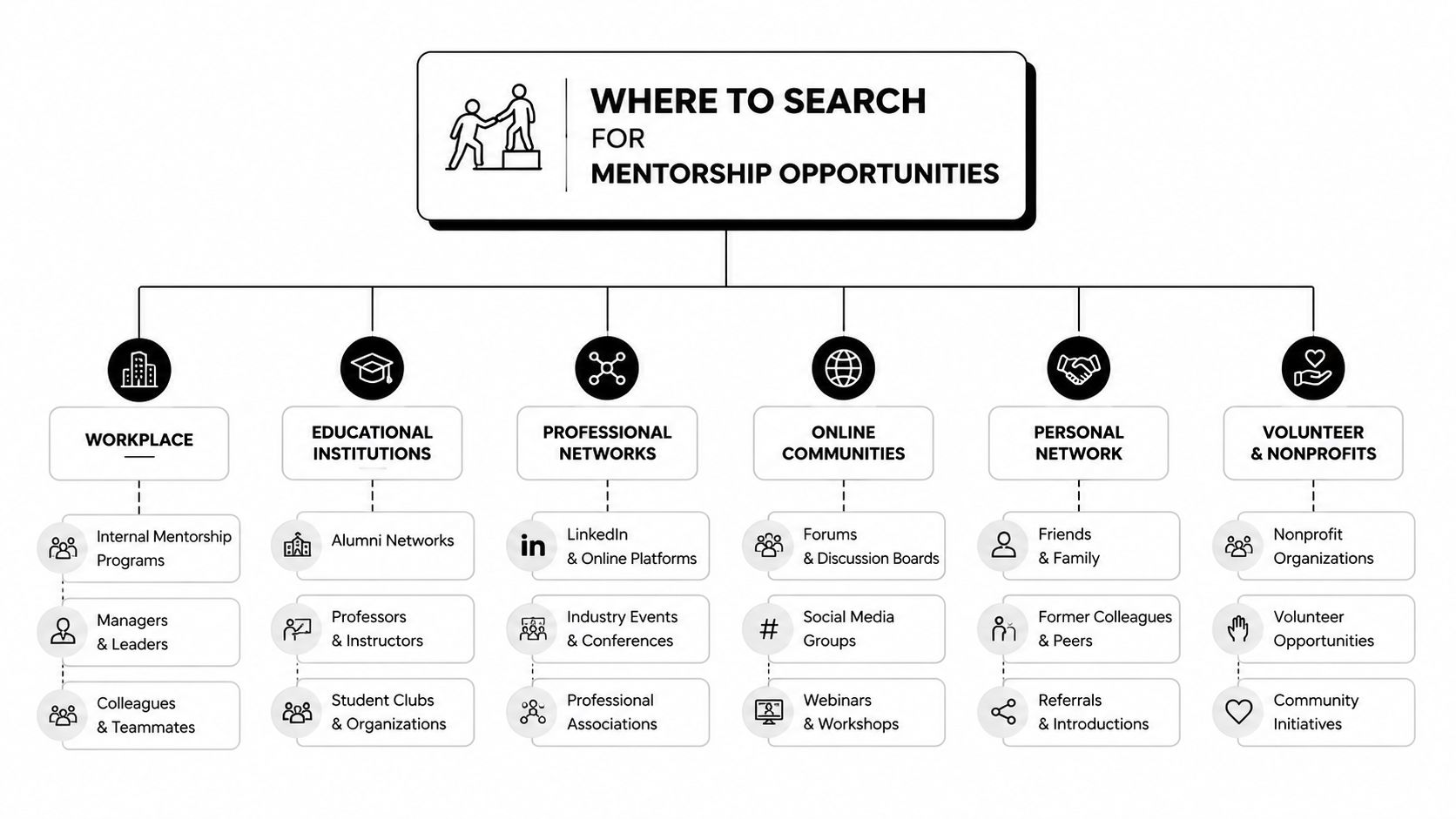
Start with places where the mentor's behavior can be observed before you request direct guidance. A person who explains risk clearly in a public discussion gives you more evidence than someone who posts only winning screenshots.
Begin with communities, but watch the culture
Trading Discord servers, forums, and study groups can create informal mentorship opportunities. Look for active moderation, searchable discussions, members who explain both entry logic and invalidation, and a culture that discourages revenge trading. Avoid rooms built around constant alerts, urgency, or status displays. A mentor who only tells you what to buy or sell isn't teaching a transferable process.
Peer communities outside trading can also help you understand how serious professionals exchange feedback. For example, these peer groups for CFOs demonstrate the value of structured professional networks, even though their subject matter differs from retail trading. The transferable lesson is simple: useful communities create repeated conversations, clear norms, and accountability.
Check prop-firm ecosystems carefully
A prop firm can expose traders to educational material, onboarding guidance, risk discussions, and peer interaction. Treat those features as a supplement, not a substitute for independent research. Before joining, read the rules directly and confirm how daily loss, maximum drawdown, news trading, weekend holding, copy trading, and payout conditions work.
A firm's community becomes more useful when traders discuss process rather than celebrate isolated payouts. You can also look for peer-learning spaces such as Traders Helping Traders and assess whether the conversations help members interpret rules and manage behavior.
Use platforms and events as screening channels
Dedicated mentorship platforms let you compare profiles, specialties, availability, and pricing. Industry events, webinars, and trading workshops let you hear a mentor explain a concept before you commit. In both cases, ask whether the person reviews journals, teaches risk management, and provides feedback between sessions.
Prioritize your search in this order:
- Observed expertise: Study public explanations and look for consistent reasoning.
- Relevant experience: Match the mentor to your market, timeframe, and development stage.
- Clear structure: Confirm what happens during sessions and between them.
- Verifiable expectations: Reject vague promises and undefined outcomes.
- Accessible format: Choose a schedule and communication method you'll consistently use.
The best starting point isn't necessarily the largest community. It's the environment where you can observe standards, ask precise questions, and build trust gradually.
How to Vet a Trading Mentor and Spot Red Flags
A legitimate mentor doesn't need to promise profits. They should be able to explain how they define risk, what invalidates a setup, how they review mistakes, and why a strategy may stop working in different market conditions. Their teaching should make you more independent, not more dependent on alerts.
Ask questions that expose the process
Before paying or sharing detailed account information, ask:
- What will you review? A serious mentor can describe journal reviews, replay sessions, trade plans, or execution audits.
- How do you measure progress? Look for process measures such as rule adherence, quality of preparation, and consistency of risk decisions.
- What happens during a losing period? The answer should include reduced exposure, review, and preservation of capital, not pressure to trade harder.
- What restrictions apply? Confirm whether the mentor promotes a broker, signals, affiliate products, or a particular prop firm.
- Can I test the format? A short introductory call or clearly defined trial gives you evidence about fit.
Prop-firm rules make risk literacy especially important. One guide describes typical daily caps around 5% to 10% and maximum drawdown commonly around 10% to 20% in its explanation of prop-firm drawdown rules. A mentor who can't explain how those limits interact with open positions, floating losses, and server-time resets shouldn't be guiding you through an evaluation.
| Green Flags | Red Flags |
|---|---|
| Process first: Explains preparation, execution, and review. | Guaranteed outcomes: Promises profits or a pass. |
| Risk transparency: Defines loss limits and position sizing. | Lifestyle marketing: Uses luxury imagery instead of evidence. |
| Independent thinking: Encourages your own journal and decisions. | Signal dependence: Requires constant copying or paid alerts. |
| Clear terms: States schedule, scope, fees, and cancellation rules. | Pressure tactics: Demands immediate payment or claims scarcity. |
| Balanced evidence: Discusses losses and limitations. | Selective proof: Shows wins without context or risk details. |
Verify before you commit
Check whether the mentor's public claims are internally consistent. Ask for a sample lesson, anonymized review format, or explanation of a losing trade. You don't need private financial records, and you shouldn't accept screenshots as complete proof.
Read the firm's rules yourself when the mentor discusses prop trading. This guide to whether a prop firm is legitimate can help frame the questions, but no article replaces your own review of current terms.
Trading involves a real risk of loss. A mentor can improve your process, but they can't remove market uncertainty or guarantee that you'll qualify for funding.
How to Reach Out and Structure the Mentorship
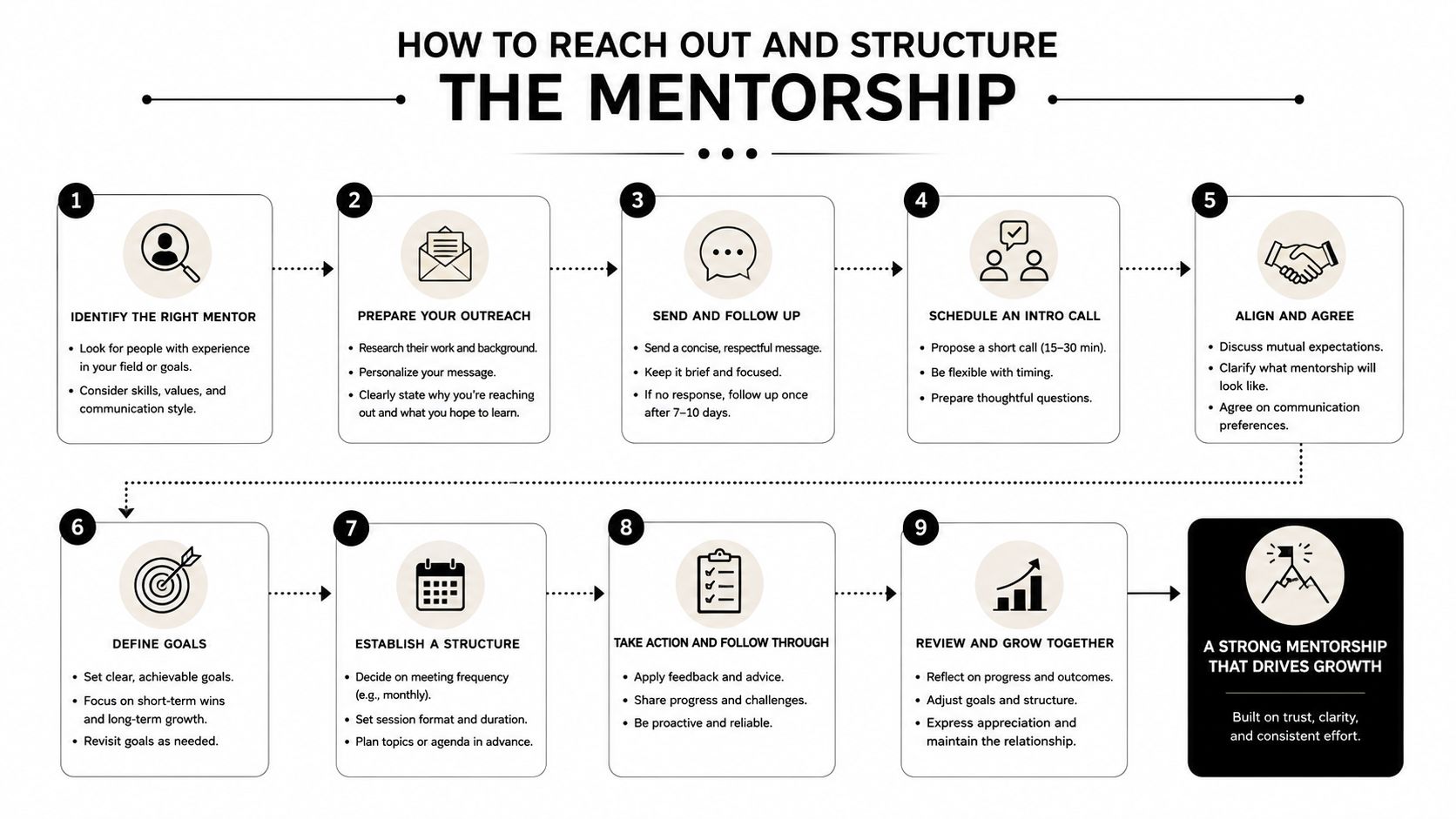
Good outreach is short, specific, and easy to answer. A mentor doesn't need your entire trading history in the first message. They need enough context to decide whether your problem matches their experience.
Use a structure like this:
Subject: Feedback on execution and risk discipline
Hi [Name], I trade [market and style] and have been keeping a journal. My main issue is [specific behavior], especially when [market condition]. I'm looking for feedback on my process rather than signals. Do you offer a short introductory call, and what format and fee structure do you use?
Replace broad goals with observable targets. “Become profitable” is too vague for a mentorship agreement. “Complete a pre-trade plan for every session,” “stop moving protective exits,” or “review a fixed sample of trades each week” gives both people something concrete to assess.
Agree on the operating terms
Write down the basics before the first substantive session:
- Objective: Define the behavior or decision-making issue you want to improve.
- Cadence: Choose a schedule that leaves time to apply feedback.
- Format: Decide between video calls, written reviews, screen sharing, or a community channel.
- Compensation: Confirm whether the arrangement is free, paid, subscription-based, or included with another service.
- Boundaries: State that the mentor provides education, not personal financial advice or guaranteed signals.
- Review point: Set a date to assess whether the relationship is useful.
Prepare for every meeting with a trade journal, marked-up charts, and three questions. Don't send dozens of screenshots without context. Select examples that reveal a repeated decision error, then explain what you thought at the time.
Between sessions, complete the agreed work and record what changed. If the mentor keeps giving general motivation instead of analyzing your stated problem, ask for a more specific review. If the format still doesn't improve after an honest adjustment, end it professionally and search for a better fit.
Comparing Mentorship Formats for Traders
No single format works for every trader. One-on-one support offers depth but can be expensive and dependent on one person's availability. Communities are accessible and varied, but the quality of feedback changes from member to member. The right choice depends on whether you need diagnosis, repetition, accountability, or exposure to different approaches.
| Format | Best For | Typical Cost | Feedback Depth |
|---|---|---|---|
| One-on-one mentorship | Traders with a defined bottleneck and enough preparation to use individual feedback. | Paid, sometimes premium. | High, when the mentor reviews your actual process. |
| Group coaching | Traders who benefit from a curriculum, shared questions, and scheduled accountability. | Usually lower per person than private coaching. | Moderate, with limited individual attention. |
| Community-based learning | Beginners building vocabulary, routines, and peer support. | Free or membership-based. | Uneven, depending on moderation and member expertise. |
| Prop-firm-embedded mentorship | Traders learning to operate within explicit evaluation and funded-account rules. | May be included or connected to a program. | Ranges from general onboarding to structured feedback. |
Match the format to the problem
A beginner who can't explain position sizing may need a structured group or carefully moderated community before paying for private coaching. An intermediate trader who understands the basics but repeatedly violates a daily loss rule may gain more from one-on-one journal review.
Group coaching also offers a useful test of a mentor's teaching quality. If the instructor answers the same question in several ways, explains trade-offs, and invites participants to reason independently, the group format can deliver strong value. If every session becomes a stream of entries and exits, it trains dependence.
Community learning works best when you contribute as well as consume. Share a clear trade plan, ask for critique, and compare responses. Don't treat the loudest member as the most skilled member.
For prop-firm-embedded programs, read the rules before judging the education. A mentor may be excellent at market analysis but unfamiliar with the specific account mechanics that control your evaluation. Format matters less than whether feedback addresses your actual constraint.
You can combine formats without joining everything. Use a community for broad discussion, a structured course for foundations, and limited private review for one recurring issue. More access won't fix poor execution if you don't complete the work between conversations.
Leveraging MyFundedCapital for Mentorship Opportunities
MyFundedCapital offers a community setting, 24/7 multilingual support, and trading education alongside its proprietary trading activities. Its Discord community and onboarding support can create practical learning moments, especially when traders use questions about account rules, platform behavior, and execution as prompts to improve their process.
The evaluation structure can also serve as a checklist for disciplined preparation. The core mechanics commonly involve a profit target of 5% to 10%, maximum drawdown of 5% to 10%, daily loss limits of 3% to 5%, and minimum trading-day requirements that commonly range from 0 to 4, though some programs require as many as 40 days, according to this guide to prop-trading rules. Verify the current terms before trading because rules determine how you should size positions, handle news, and manage open exposure.

Use the platform as a place to ask precise questions, compare your journal with peer feedback, and turn risk parameters into daily habits. The Boot Camps and Programs resources can provide another structured path, but you still need to evaluate whether the material matches your experience and goals.
Mentorship won't make a weak plan safe, and a funding evaluation isn't a substitute for practice. Trading involves risk of loss, and this article is educational content, not financial advice. Choose a format that encourages independent decisions, document your work, and treat every rule as part of your trading system.
MyFundedCapital offers funding programs, account options, platform access, community interaction, and support for traders who want a structured environment for developing discipline. Visit MyFundedCapital to compare account types, review the current rules, and decide whether starting a challenge fits your preparation.
