

 AR
AR
 NL
NL
 EN
EN
 FR
FR
 ES
ES
 IT
IT
 PL
PL
 SV
SV
 PT
PT

About 90% of retail algorithmic traders fail to beat a simple buy-and-hold S&P 500 benchmark in their first year, according to a 2026 retail algorithmic trading analysis. That result reframes how to algorithmic trading: the hard part isn't writing an entry rule, it's proving that the system can survive costs, changing conditions, platform limitations, and prop-firm risk rules.
What Algorithmic Trading Actually Involves in 2026
A backtest can produce an attractive equity curve while hiding the conditions that destroy a live strategy. Perfect fills, stable spreads, delayed signals, excessive borrowing, and rules that only work on one historical period create a false sense of security. In practice, algorithmic trading is an operational loop, not a code file that runs unattended.
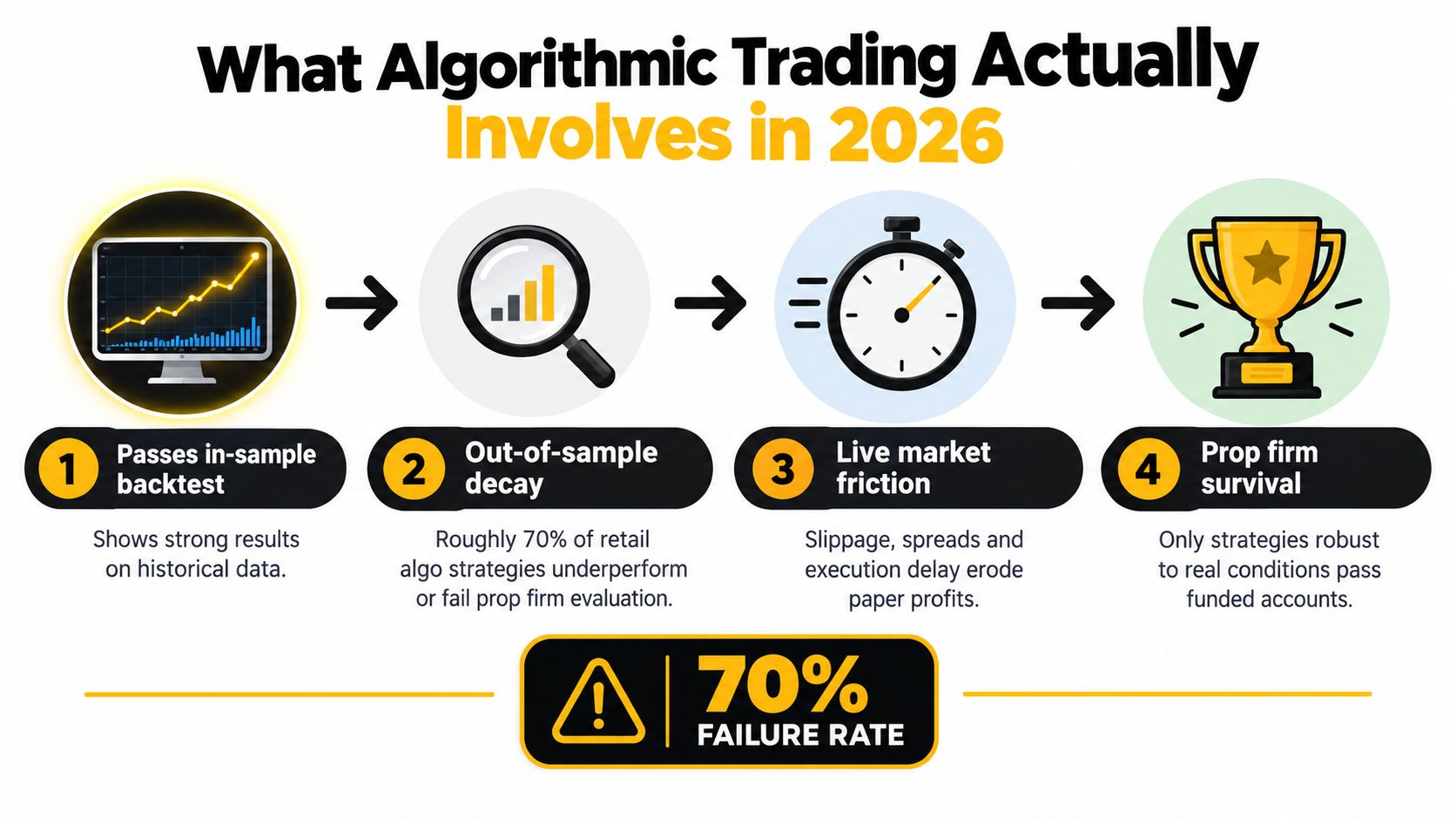
The workflow has five gates:
- Research defines the market, timeframe, signal logic, and reason the strategy might have an edge.
- Backtesting measures the idea against historical data while including trading friction.
- Walk-forward validation tests whether the rules work on sequential data the model hasn't seen.
- Risk encoding converts account limits into software conditions, rather than leaving them to judgment.
- Live execution measures fills, rejected orders, slippage, outages, and actual behavior on cTrader or DXtrade.
Each stage gates the next. If research is vague, optimization becomes curve-fitting. If the backtest assumes instant fills, walk-forward results inherit unrealistic assumptions. If risk rules aren't encoded, a profitable signal can still fail an evaluation through oversized positions or trading after a loss limit has been reached.
A recent crypto study used historical backtesting, exchange-based paper trading, and real-money trading as separate stages, with distinct training, validation, and testing windows. That separation is designed to reduce overfitting and regime leakage, two problems that commonly make historical performance look stronger than live performance. The same study also highlights survivorship bias, look-ahead bias, transaction costs, and slippage as recurring implementation failures. See the study's full methodology before treating any backtest as evidence.
Practical rule: A strategy isn't ready because it made money historically. It's ready when you understand why it made money, how much execution friction it can absorb, and when it must stop trading.
Many traders also underestimate the monitoring layer. A useful external resource for observing market context is this whale activity monitoring service, particularly when a strategy trades crypto or reacts to unusually large flows. It won't validate a strategy for you, but it can add context to a monitoring process that already tracks volatility, liquidity, and news risk.
Picking Your Stack and Platforms
The right stack depends on the strategy's timeframe, the prop firm's supported platforms, your coding ability, and how much operational complexity you can maintain. A fast system that needs specialized infrastructure isn't automatically better than a slower, simpler strategy. If the holding period is measured in hours or days, reliability and rule enforcement usually matter more than shaving small amounts of execution time.
Three practical routes
cTrader cBots are a natural choice for traders comfortable with C#. The strategy runs close to the trading environment and can be easier to supervise than a collection of external scripts. Native platform integration reduces the number of moving parts, which helps with order synchronization, position tracking, and recovery after a restart. The trade-off is language commitment. A Python researcher may need to rewrite indicators, data handling, and execution logic before deployment.
DXtrade automation suits traders who already use browser-based workflows, TradingView alerts, REST or FIX connectivity, or a Python research stack. It can support a more modular architecture, with research, signal generation, and execution separated into services. That flexibility comes with integration work. Authentication, order-state reconciliation, retries, duplicate-order prevention, and connection monitoring all become your responsibility.
Python on a VPS offers the broadest research ecosystem. Libraries such as backtesting.py and vectorbt can make experimentation efficient, while broker endpoints allow custom execution services. However, Python doesn't create an edge by itself. Hosting, package updates, logs, process supervision, and reconciliation add failure points that a native cBot may avoid.
| Stack | Latency | Monthly Cost | Prop Firm Fit |
|---|---|---|---|
| cTrader cBot | Usually suitable for intraday and swing systems | Platform and hosting costs vary | Strong when the firm supports cTrader and C# automation |
| DXtrade API or bridge | Depends on REST, FIX, bridge, and hosting route | Integration and hosting costs vary | Suitable when the firm's API and automation rules permit the design |
| Python with broker endpoints | Depends on VPS location, broker route, and software design | VPS, data, and maintenance costs vary | Flexible, but requires careful compliance and order-state control |
Before committing, read the firm's current terms and platform documentation. Automation permission isn't the same as unrestricted automation permission. Restrictions may apply to copying, latency-sensitive behavior, third-party signals, or how multiple accounts are synchronized. A guide to algorithmic trading software can help you identify the platform and strategy questions to resolve before building the deployment layer.
Regulation adds another layer. In India, recent guidance and exchange implementation standards have introduced requirements involving broker approval, order tags, provider registration, and access controls. The coverage of changing retail algo rules in India is a useful reminder that deployment constraints vary by venue and jurisdiction. Coding skill doesn't replace compliance engineering.
Designing a Backtest That Resembles Reality
A credible backtest answers a narrow question: what might this rule set have done under assumptions that resemble actual execution? It doesn't prove future profitability. The result is only as useful as the data, timing model, cost model, and validation design behind it.
Consider a simple 20-period and 50-period moving-average crossover on EURUSD H1. The strategy calculates both averages from completed candles. When the faster average crosses the slower average at bar close, the system records the signal and submits an order at the next bar's available price. Executing at the same timestamp as the signal would introduce look-ahead bias, because the completed bar's information wasn't available until it closed.
Model the costs you actually pay
Minute or hourly bars can hide the spread conditions around major market opens and sudden volatility. Where possible, use tick-grade data and record the bid and ask separately. The backtest should account for:
- Spread: Apply the actual bid-ask relationship instead of assuming a mid-price fill.
- Slippage: Test a range of adverse execution outcomes rather than using a perfect fill.
- Commission: Enter the broker's real round-turn commission instead of setting commission to zero.
- Partial fills: Consider whether the order size and market liquidity make a complete fill realistic.
- Stops: Treat a triggered stop as an order exposed to the market, not as a guaranteed fill at the stop price.
A stop order can become a market order when triggered. During a gap, halt, or thin-liquidity period, the fill can be materially worse than the stop level. Execution-friction guidance for backtesting specifically warns against assuming instant fills and recommends modeling spread, slippage, commission, position limits, and stop-loss behavior.
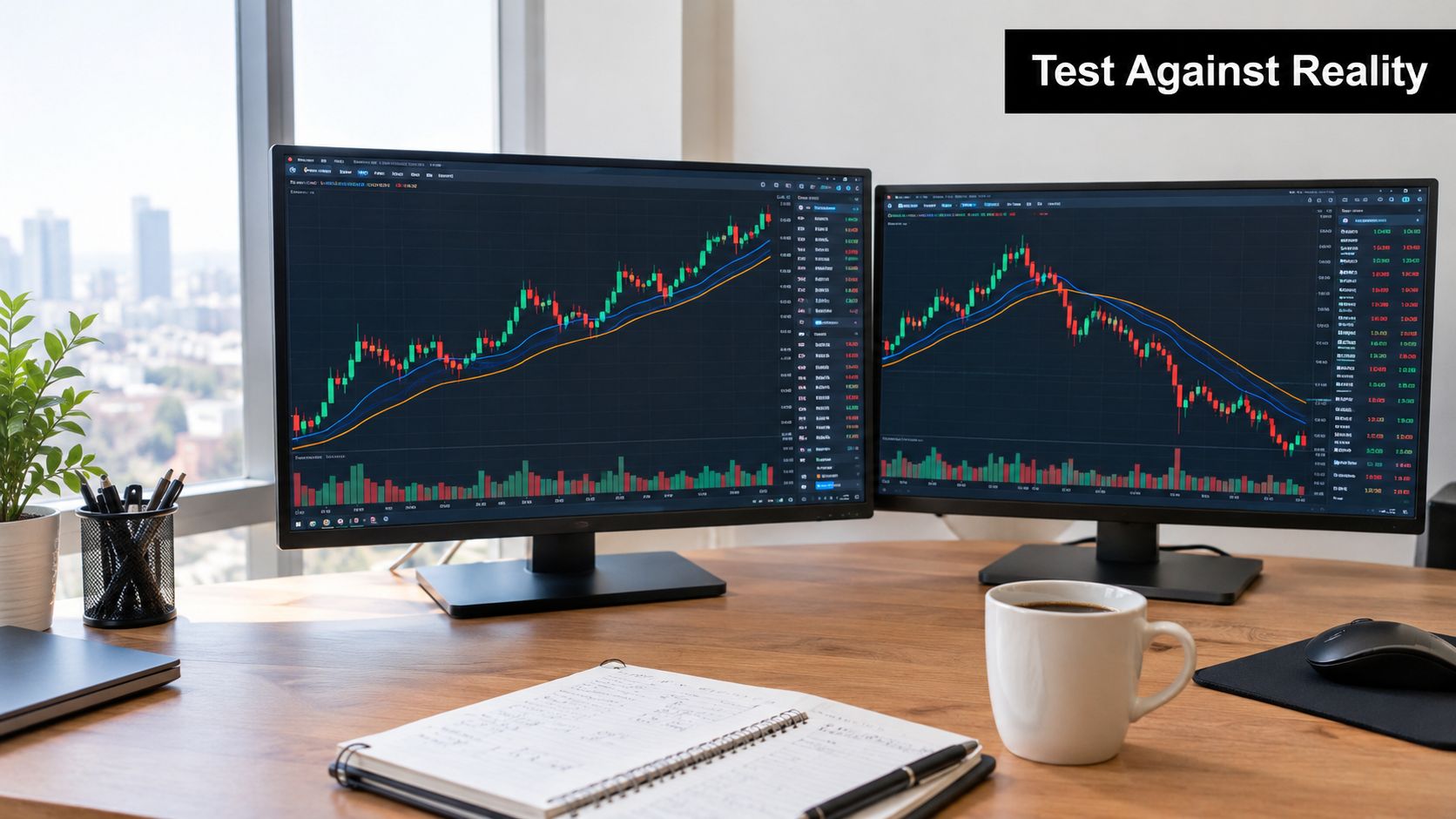
Don't judge the crossover by return alone. Save the full trade list and review maximum drawdown, profit factor, trade count, average trade, exposure, losing streaks, and performance by session. A smooth curve based on very few trades tells you little. Test whether the result survives reasonable changes to the moving-average periods, entry timing, spread assumptions, and stop placement.
A practical backtesting guide is useful for organizing those assumptions, but the responsibility remains with the trader. If removing unrealistic fills turns a profitable system into a marginal one, that isn't a software problem. It is information about the strategy's execution sensitivity.
Validating With Walk-Forward and Forward Testing
A single in-sample backtest can reward a strategy for remembering the past. Walk-forward analysis asks whether the strategy continues to work when its parameters are applied to the next unseen market segment.
The basic process is sequential:
- Train or optimize the moving-average system on a historical in-sample window.
- Freeze the parameters and run the strategy on the next out-of-sample window.
- Move the window forward.
- Repeat the process and stitch only the out-of-sample results into one equity curve.
- Compare the combined path with a relevant benchmark and the original in-sample results.
You can use anchored windows, where the training period grows, or unanchored windows, where the length stays constant and the oldest data drops away. The choice should reflect how quickly the market's behavior changes and how often you intend to retune the system. The critical rule is that the strategy must not use information from the future test slice while making decisions.
Measure decay, not just profit
Log the out-of-sample Sharpe ratio, profit factor, maximum drawdown, trade count, exposure, and cost per trade. Compare those metrics with the in-sample record. A strategy that loses much of its quality outside the training data is likely overfit, even if the composite equity curve remains positive.
Python tools such as backtesting.py and vectorbt can automate rolling tests, but they won't protect you from a flawed data split. Write the split logic explicitly, save each run's parameters, and preserve the raw outputs. Reproducibility matters when you later change the cost model or investigate a suspicious result.
The next gate is forward testing on a demo account. Keep the rules fixed and record the timestamp of every signal, order submission, fill, rejection, spread observation, and slippage result. Compare live-demo behavior with the walk-forward expectation before putting evaluation capital at risk. A curve simulator for trading results can help you examine path dependency, but it can't substitute for real order behavior.
The useful question isn't “did the model make money?” It is “did the live system behave like the tested system when conditions became inconvenient?”
Forward testing also exposes operational faults. A bot may calculate a signal correctly but submit duplicate orders after reconnecting. It may fail to detect a manually closed position, trade an instrument with a different contract specification, or continue opening trades after an account-level limit has been reached. Those are deployment defects, not strategy variance.
Encoding Risk Rules for Prop Firm Survival
A profitable signal can fail an evaluation if the risk layer doesn't understand the account's rules. Treat the rulebook as a software specification. Every limit needs a data source, a trigger condition, an action, and a recovery state.
For an account with a flat 5% daily loss limit and up to 10% maximum drawdown, calculate risk from current equity and open profit or loss, not from the original balance alone. Check the conditions on every meaningful account update and every tick where the platform provides that data. A bar-close check can arrive too late during a fast move.
Build the controls before the entries
Position sizing should reference current equity, stop distance, instrument value, and the permitted loss budget. A fixed lot size can be conservative in one account state and reckless in another. The risk-management guidance for systematic trading describes the common practice of limiting individual trade risk to 1% to 2% of total capital, while also emphasizing a defined drawdown budget and automatic pauses for review.
Add controls that operate independently of the signal:
- Daily circuit breaker: Disable new entries after the daily loss threshold is reached.
- Drawdown kill switch: Flatten or block trading when the maximum account drawdown is approached.
- Open-trade cap: Limit simultaneous positions so correlated signals can't multiply exposure.
- Session filter: Prevent entries during periods your testing doesn't support.
- News control: Flatten or pause around high-impact events when the account rules and strategy require it.
- Restart protection: Reconcile existing positions before the bot submits anything after a restart.
- Audit logging: Save equity, open P&L, order state, rule state, and timestamps to a durable log.
| MFC Rule | Risk Function | Trigger Frequency | Action on Breach |
|---|---|---|---|
| 5% daily loss limit | Calculate daily loss from the defined daily baseline and current equity | Every tick or account update | Close positions where required and disable new entries |
| Up to 10% maximum drawdown | Compare current equity with the permitted drawdown reference | Every tick or account update | Stop the strategy and prevent further orders |
| Position risk cap | Size volume from equity, stop distance, and instrument value | Before every order | Reject or resize an oversized order |
| Trading-condition restrictions | Check news, sessions, holding rules, and permitted instruments | Before entry and at session events | Block, close, or preserve trades according to the account terms |
| Order-state integrity | Reconcile local state with platform state | On startup and after connection recovery | Halt until positions and orders match |
A local script shouldn't be the only line of defense where a platform-level control is available. A crashed VPS can't enforce a rule it isn't running. Test the kill switch by simulating disconnections, rejected orders, fast price movement, and partial execution.
Choosing Between cTrader and DXtrade for Execution
Platform choice should follow the strategy's holding period and execution needs. It shouldn't be made because one interface looks more familiar.
cTrader generally offers a more integrated route for C# cBots. Traders can keep signal logic, position management, and execution monitoring within a single ecosystem. That simplicity can reduce reconciliation work, especially for systems that trade directly from completed bars and don't need a separate research server.
DXtrade is more attractive when the workflow already depends on TradingView alerts, Python services, REST connectivity, or FIX. It fits a trader who wants to separate data processing from order routing and deploy components on a managed server. The cost is architectural complexity. A bridge or API integration must handle authentication, retries, duplicate messages, rejected orders, stale prices, and position synchronization.
Compare the execution path
| Feature | cTrader | DXtrade |
|---|---|---|
| Main automation route | Native cBots and platform APIs | REST, FIX, bridges, and compatible automation services |
| Typical coding preference | C# | Broader integration options, including Python-based workflows |
| Deployment style | More platform-centered | More modular and service-oriented |
| Monitoring requirement | Platform and cBot logs | Platform logs plus API, bridge, and server logs |
| Main strength | Lower integration friction for supported cBots | Flexibility for external research and execution services |
| Main risk | Strategy is tied more closely to the platform ecosystem | More components can fail or drift out of sync |
| Best fit | Intraday or swing systems that value simplicity | Traders with an existing cloud, API, or multi-tool workflow |
Don't confuse a low displayed spread with a guaranteed low trading cost. Execution risk includes spreads, liquidity, partial fills, rejected orders, and delays, all of which can change a trade's outcome. Algo-trading risk guidance also emphasizes the importance of data acquisition, order routing, and controls that respond to volatility or anomalies.
Run the same strategy on both platforms only if the comparison is meaningful. Use identical signal timestamps, instrument specifications, stop logic, and cost assumptions. Then compare fill quality and operational errors, not just headline returns. The platform that produces the cleaner, more reliable implementation is usually the better choice for a prop-firm evaluation.
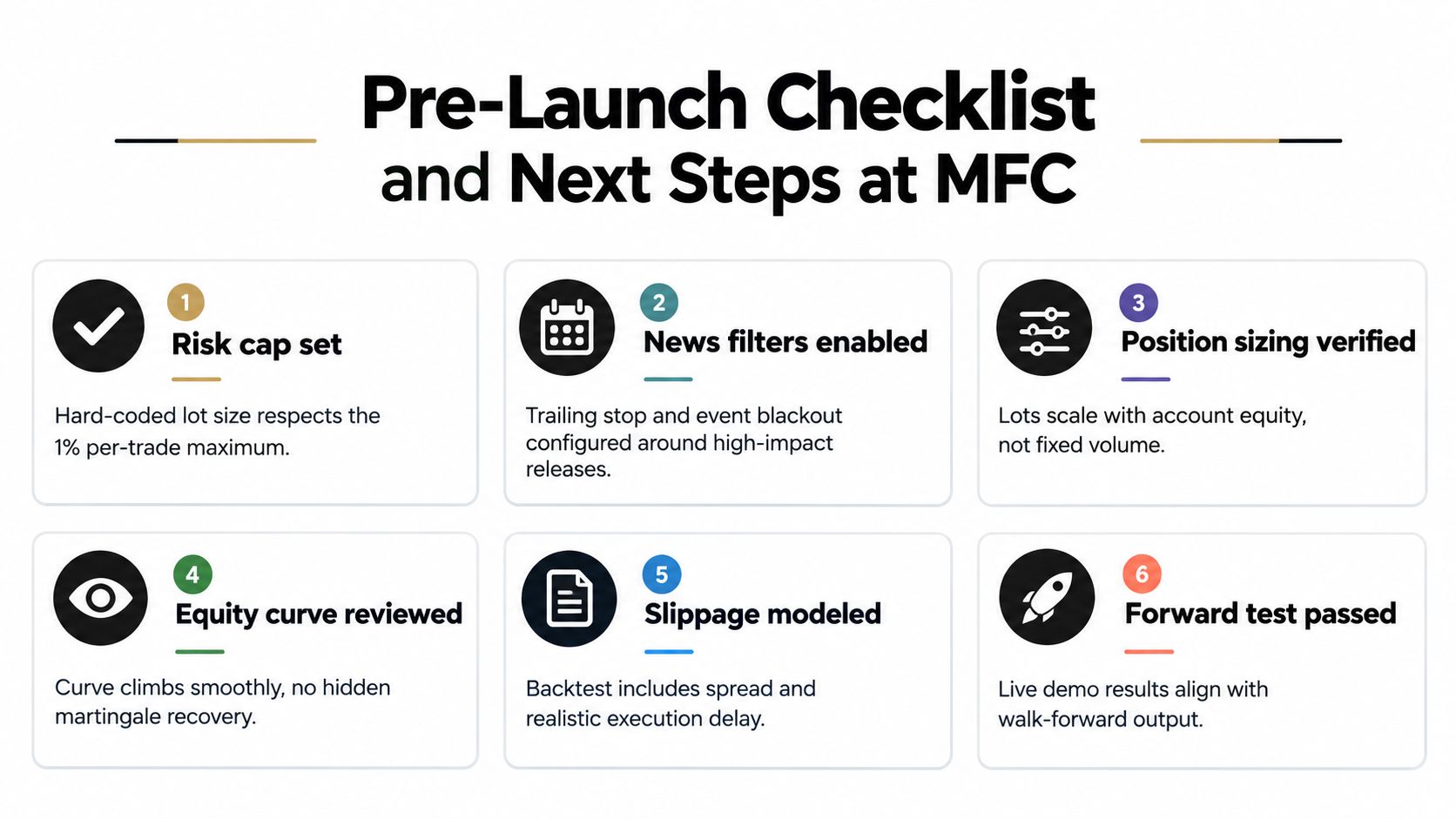
Pre-Launch Checklist and Next Steps at MFC
Most evaluation failures don't require an exotic market event. They come from ordinary defects: a fixed lot size, a news filter that wasn't enabled, a reset bug after a stop-out, or a bot that keeps trading after the account has reached its loss boundary.
Use a pre-launch review that another person can reproduce. Start with the account terms, then trace each rule into code, platform settings, logs, and an actual test. If you can't point to the exact function that blocks a prohibited trade, the control isn't finished.
The release checklist
- Risk cap set: Confirm that per-trade sizing respects the chosen loss budget and uses current equity.
- News filters enabled: Test the event blackout, flattening behavior, and restart behavior around scheduled releases.
- Position sizing verified: Change equity and stop distance in a simulation, then confirm that volume changes as intended.
- Equity curve reviewed: Look for hidden martingale recovery, sudden exposure changes, and unusually smooth behavior.
- Slippage modeled: Re-run the backtest with adverse spread and fill assumptions.
- Forward test passed: Compare demo fills, rejection handling, and realized slippage with walk-forward expectations.
- Rule mapping completed: Document daily loss, drawdown, holding, instrument, and automation restrictions.
- Recovery tested: Disconnect the bot, restart it, and verify that it reconciles positions before sending orders.
- Logging confirmed: Export enough information to reconstruct every decision and rule state.
Stress testing should include shuffled trade sequences, altered costs, parameter perturbations, and different market regimes. Monte Carlo analysis is useful when it tests the path of losses and gains rather than decorating a backtest with a confidence label. A strategy that only survives one favorable order of trades can breach a trailing limit even when its long-run statistics look acceptable.
Watch for specific evaluation traps:
- Rollover exposure: Spreads and liquidity can change when the trading day changes.
- News chasing: A system can enter during a volatility spike because the signal arrives after the move.
- Revenge automation: A recovery rule can increase size after a loss without understanding the account limit.
- Correlation stacking: Separate signals can all express the same currency or index exposure.
- Silent failure: The bot can stop sending orders while the dashboard still shows it as connected.
The right next step depends on evidence. Traders with a battle-tested system may consider an Instant Funding route for immediate live-style trading. Traders still validating their edge may prefer a 1-Step or 2-Step Challenge, where the evaluation process forces a review of execution and discipline before scaling.
The allocation is not the edge. It magnifies whatever is already present, including poor sizing and unreliable execution. Trading involves a risk of loss, and this article is educational content, not financial advice. Review the current account terms, platform permissions, and risk limits before deploying automation.
MyFundedCapital offers simulated-capital trading accounts with Instant Funding and Challenge routes, supporting algorithmic strategies on its available platforms when they comply with the firm's rules. Visit MyFundedCapital to compare account types, review the current automation conditions, and choose whether to start a challenge or investigate an Instant Funding option.
