

 AR
AR
 NL
NL
 EN
EN
 FR
FR
 DE
DE
 ES
ES
 IT
IT
 PL
PL
 SV
SV


Understanding how to manage risk is critical for survival in forex trading, and it all starts with lot size. A lot size is the standardized quantity of currency you trade, and getting it right directly controls your potential profit and loss on every position. This guide will give you practical, step-by-step instructions on how to calculate and use lot sizes to protect your capital.
What Exactly Is a Lot Size in Forex?
In the forex market, a lot is the standard unit used to measure the size, or volume, of your trade. Think of it like buying eggs—you can buy a dozen, a half-dozen, or a single egg. Each is a pre-defined quantity. Forex works the same way, with trades placed in standardized amounts called lots.
This standardization brings order to currency trading, allowing for clear calculation of risk and reward. The lot size you choose has a direct impact on your trading: the bigger the lot, the more money each pip movement is worth, which magnifies both your wins and your losses.
Why Lot Size Is a Trader’s Most Important Tool
Mastering lot size is more important than finding a complex trading strategy. It is the primary tool for controlling your risk exposure on any given trade. A common mistake for new traders is to focus only on entry signals while ignoring position size, which often leads to unexpected and significant losses.
Correctly sizing your lot allows you to:
- Manage Risk Precisely: Decide exactly how much of your account you are willing to risk on a single trade.
- Stay Consistent: A disciplined approach to choosing your lot size removes emotion from risk management and makes it a repeatable process.
- Trade Within Your Means: Ensure your trade size is appropriate for your account balance, preventing you from over-leveraging and blowing up your capital.
The core principle is simple: your lot size, not your entry or exit point, ultimately determines how much you stand to win or lose. Getting this right is fundamental to long-term survival in trading.
Trading always involves a substantial risk of loss and is not suitable for every investor. The educational content provided here is not financial advice.
A Practical Breakdown of Standard, Mini, and Micro Lots
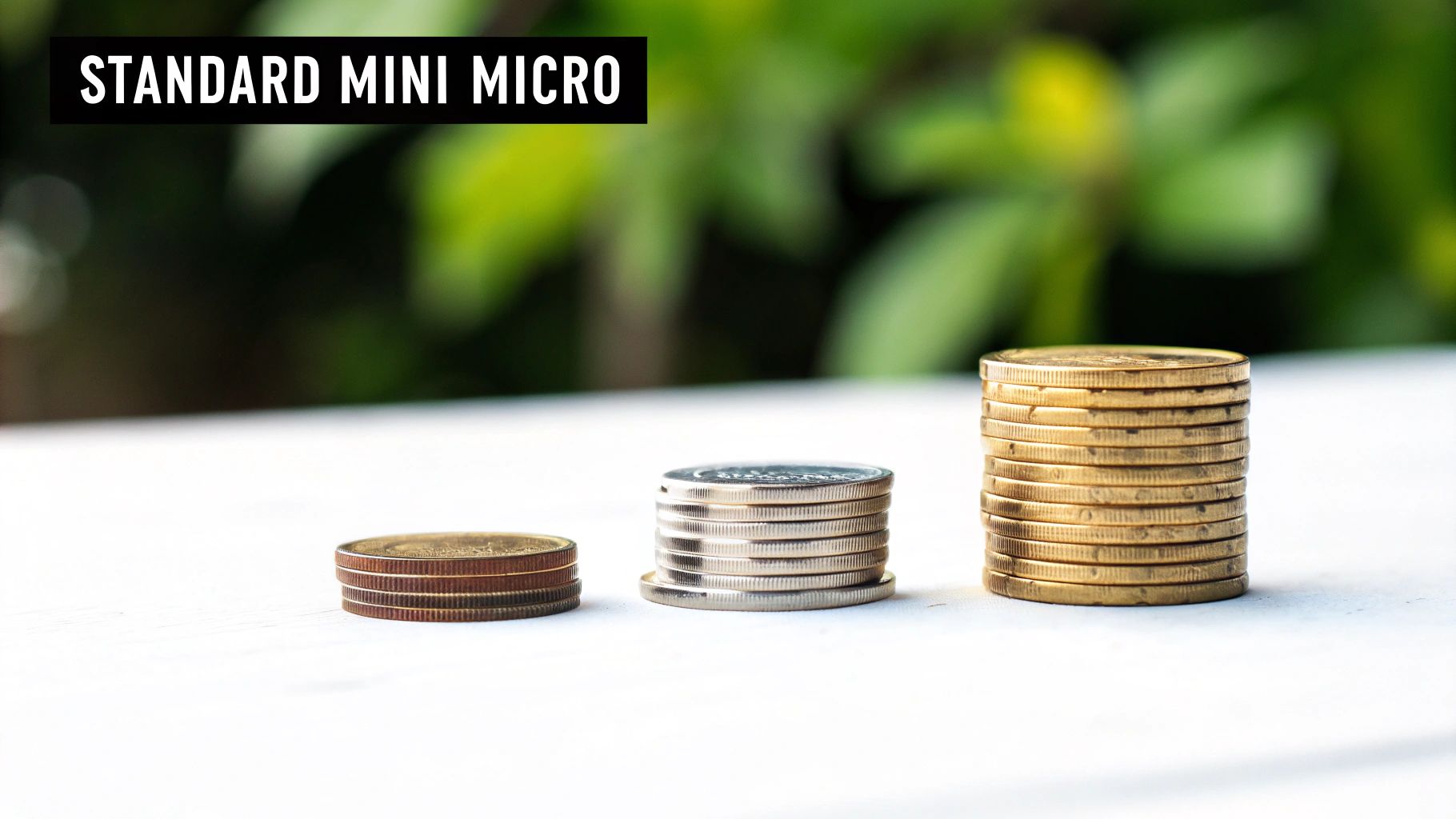
Now that you understand the concept of a “lot,” let’s look at the specific types you’ll encounter on your trading platform. Forex offers different lot sizes to accommodate various account sizes and risk tolerances. Picking the right one is a fundamental skill, especially in a prop firm environment where you must manage capital under strict risk rules.
The Standard Lot: For Institutional Scale
A standard lot is 100,000 units of the base currency. If you place a one-lot trade on EUR/USD, you’re controlling €100,000. This is the traditional unit used by banks and large financial institutions.
- Units: 100,000
- Pip Value (approx.): $10 for most USD pairs
- Best for: Institutional traders or those with very large accounts.
- Risk: High. A small price move against you can lead to rapid, significant losses.
The Mini Lot: A Balanced Approach
A mini lot is 10,000 units of the base currency, or one-tenth of a standard lot. A one-mini-lot trade on GBP/USD means you’re controlling £10,000.
- Units: 10,000
- Pip Value (approx.): $1 for most USD pairs
- Best for: Traders with intermediate experience and moderate account balances.
- Risk: Moderate. It offers solid profit potential without the extreme risk of a standard lot.
The Micro Lot: For Precise Risk Management
The micro lot is where most retail traders start. It represents 1,000 units of the base currency, or 0.01 of a standard lot.
- Units: 1,000
- Pip Value (approx.): $0.10 for most USD pairs
- Best for: Beginners, traders with small accounts, or for testing new strategies.
- Risk: Low. Micro lots are essential for precise risk management, allowing you to risk a small, fixed percentage of your account even with a small balance. They help you get used to the emotions of trading without the fear of a catastrophic loss.
The widespread availability of micro lots helped fuel the growth of retail forex. As leverage rules have tightened globally, their usage has increased, helping traders manage risk more effectively. If you want to dive deeper into how lots and leverage interact, educational resources like Babypips are a great place to start.
The Nano Lot: For Ultimate Precision
A nano lot is the smallest available size at just 100 units of the base currency (0.001 of a standard lot).
- Units: 100
- Pip Value (approx.): $0.01 for most USD pairs
- Best for: Traders with very small accounts (under $100) or those fine-tuning entries with minimal financial risk.
- Risk: Very low. Not all brokers offer nano lots, but they provide the most granular position sizing possible.
Connecting Lot Size to Real Money with Pip Value
Now let’s connect the abstract concept of “lot size” to the cash in your trading account. This is where chart movements turn into real profit or loss. The key to this is understanding pip value. A “pip” is the smallest standard move a currency pair can make, but its cash value changes based on the lot size you choose.
How to Calculate Pip Value
Calculating pip value is the only way to know exactly how much you are risking before you enter a trade. For pairs where the USD is the second currency (the quote currency, like EUR/USD), the formula is straightforward.
Pip Value = (Pip in Decimal Form × Lot Size in Units)
For most currency pairs, a pip is 0.0001. Let’s see how this works in practice.
Worked Examples: Pip Value in Action
Here’s how a single pip move in EUR/USD affects your account across different lot sizes.
- Standard Lot (100,000 units): 0.0001 × 100,000 = $10 per pip
- Mini Lot (10,000 units): 0.0001 × 10,000 = $1 per pip
- Micro Lot (1,000 units): 0.0001 × 1,000 = $0.10 per pip
If you trade one standard lot and the price moves against you by 20 pips, you lose $200 (20 pips × $10). With one micro lot, that same 20-pip move would be a $2 loss (20 pips × $0.10). The difference is massive and demonstrates how lot size is your primary risk control.
Pip Value Comparison Across Lot Sizes for USD Quote Pairs
| Lot Size | Units | Pip Value (Approx.) |
|---|---|---|
| Standard | 100,000 | $10.00 |
| Mini | 10,000 | $1.00 |
| Micro | 1,000 | $0.10 |
| Nano | 100 | $0.01 |
As you can see, each step down in lot size reduces your exposure by a factor of ten. This control is why many retail traders prefer micro lots for precise risk management. You can find more details on how brokers present lot size calculations in this guide to lots in forex from VT Markets.
What About Pairs Like USD/JPY?
When the USD is the first currency in the pair, the calculation has one extra step. The pip value is first determined in the quote currency (e.g., Japanese Yen) and then converted back to dollars.
The formula is: Pip Value = (Pip in Decimal Form × Lot Size) / Current Exchange Rate
Let’s run through an example for USD/JPY, where a pip is 0.01.
- Assume: You trade one standard lot (100,000 USD) and the current USD/JPY exchange rate is 150.00.
- Calculate Pip Value in JPY: 0.01 × 100,000 = 1,000 JPY.
- Convert to USD: 1,000 JPY / 150.00 = $6.67 per pip.
Thankfully, your trading platform calculates this automatically. However, understanding the mechanics helps you grasp how risk changes between different currency pairs. For more answers, explore our forex trading FAQs.
How to Calculate Your Position Size for Every Trade
Knowing what a lot size is and how pip value works is the foundation. Now it’s time to put it all together with the most important risk management practice: position sizing. Instead of guessing a lot size, you need a consistent method to calculate your exact trade volume based on your account size and the specific trade setup.
The Essential Position Sizing Formula
There’s a straightforward formula that you should use before every single trade. It connects your account size, your risk appetite, and your trade idea.
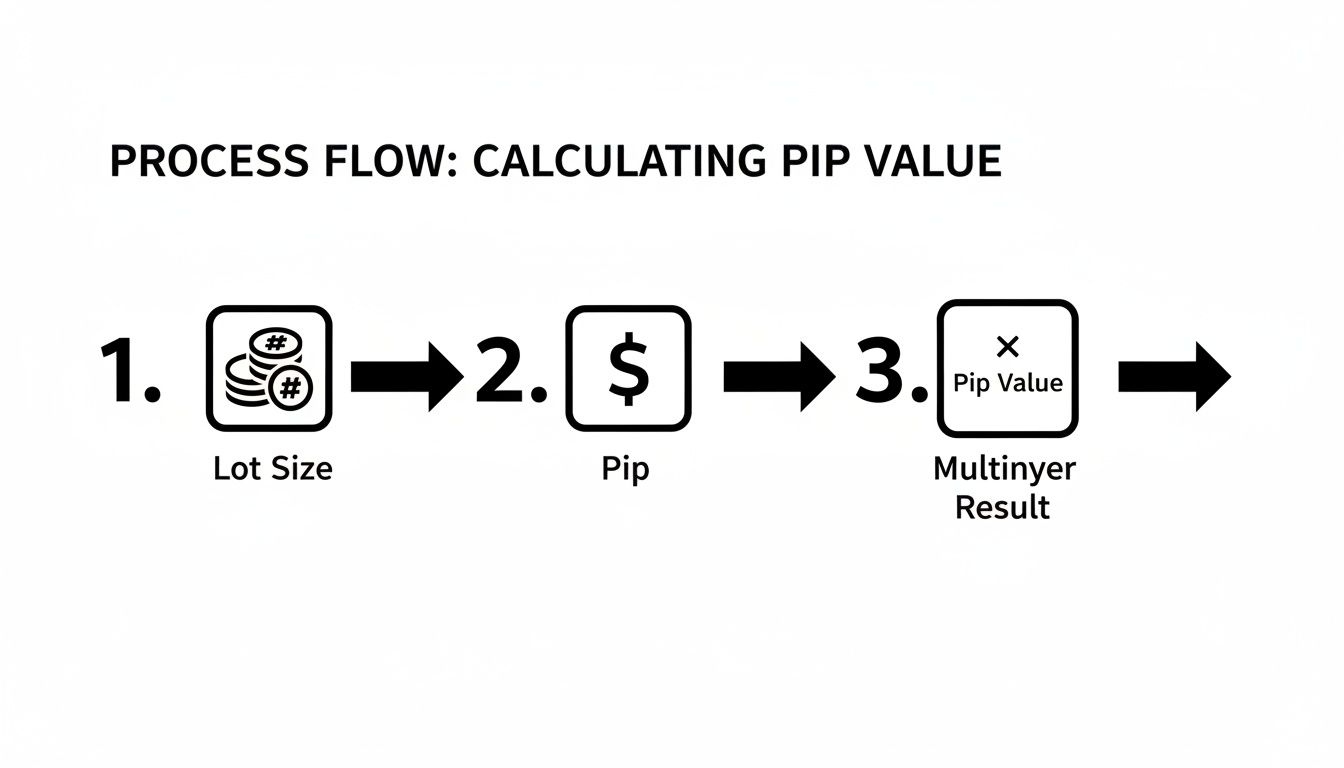
Lot Size = (Account Equity × Risk Percentage) / (Stop Loss in Pips × Pip Value)
Here’s a breakdown of each component:
- Account Equity: Your current trading account balance.
- Risk Percentage: The maximum percentage of your account you are willing to lose on this trade. Professionals typically risk between 0.5% and 2%.
- Stop Loss in Pips: The distance between your entry price and your protective stop-loss order.
- Pip Value: The cash value of a single pip for a standard lot of the pair you’re trading (e.g., $10 for EUR/USD).
This process connects your trade idea directly to your risk management rules.
Position Sizing Calculation in Action
Let’s walk through a practical example with a $10,000 trading account.
Scenario: EUR/USD Trade
- Account Equity: $10,000
- Risk Percentage: 1% (you are willing to risk a maximum of $100)
- Trade Setup: Long on EUR/USD with a 20-pip stop loss
- Pip Value (for 1 Standard Lot): $10
Calculation:
- Dollar Risk: $10,000 × 0.01 = $100
- Risk per Lot: 20 pips × $10 = $200 (This is the amount you would lose with a 1.0 lot if your stop is hit)
- Lot Size: $100 (Your Max Risk) / $200 (Risk per Lot) = 0.50 Standard Lots (or 5 mini lots)
By trading 0.50 lots, you ensure that if your 20-pip stop loss is hit, you will lose exactly $100—no more, no less. If your trade required a wider, 50-pip stop loss, the formula would adjust your position size down to 0.20 lots to keep the dollar risk at $100.
Why This Mechanical Approach Is Critical
This calculation is vital for all traders, but it’s non-negotiable when trading with a prop firm. Firms have hard limits, such as a 5% daily loss limit. Calculating your position size correctly is your first line of defense against accidentally breaking a rule. For a detailed breakdown, see our guide on how the 5% daily loss limit is calculated.
By using a formula, you remove the guesswork and emotion that destroy trading accounts. You are no longer gambling; you are managing probabilities with a defined, repeatable process.
Applying Lot Size Rules in a Prop Firm Environment
Trading with a prop firm is a game of survival where risk rules are not suggestions—they are hard limits designed to protect the firm’s capital. Your ability to calculate the correct lot size for every trade is the most critical skill for success. It prevents an oversized trade from ending your evaluation prematurely.
Navigating Drawdown Limits with Precision
Prop firm rules, especially drawdown limits, force you to operate like a professional risk manager. The daily loss limit, often set around 5%, is your most immediate boundary. A single poorly sized trade can breach that limit and disqualify your account.
Let’s use a practical example:
- Account Size: $100,000
- Daily Drawdown Limit: 5%
- Maximum Daily Loss in Dollars: $100,000 × 0.05 = $5,000
This $5,000 is your total risk budget for the day, not for one trade. If you plan to take multiple trades, you must divide this budget accordingly. Suddenly, your maximum risk per trade is much smaller.
Calculating Your Maximum Lot Size: A Step-by-Step Example
Let’s continue with the $100,000 account and its $5,000 daily loss limit. You see a setup on EUR/USD that requires a 25-pip stop loss and you decide to risk a conservative $500 (0.5% of the account) on this single trade.
Here’s how to calculate your lot size:
- Define Your Dollar Risk: You’ve set your maximum loss at $500.
- Determine Your Stop Loss: The trade requires a 25-pip stop.
- Find the Pip Value: For a standard lot (1.0) of EUR/USD, the pip value is $10.
- Calculate Risk per Standard Lot: 25 pips × $10/pip = $250.
- Calculate Maximum Lot Size: $500 (Your Max Risk) / $250 (Risk per Lot) = 2.0 Standard Lots.
The math shows that a 2.0 lot position is the absolute maximum size to keep your potential loss capped at $500. Making this calculation a mandatory part of your pre-trade routine ensures no single trade can end your challenge.
Some prop firms may have specific rules on position sizing. Always double-check their guidelines. You can see how MyFundedCapital handles this by checking if you are subject to any position limits.
The Psychological Edge of Rule-Based Sizing
This mechanical approach to position sizing provides a significant psychological advantage. When you remove the fear of a catastrophic loss, you can focus on executing your strategy effectively.
- Increased Confidence: Knowing your exact downside risk builds a calm, professional mindset.
- Stronger Discipline: Consistently calculating your lot size turns it into a powerful habit.
- Higher Evaluation Success: Traders who master risk management are far more likely to pass challenges and get funded.
In a prop firm, strict lot size rules are not a restriction; they are a framework for building a sustainable trading career.
Frequently Asked Questions About Forex Lot Sizes
What is the best lot size for a $100 account?
For a $100 account, you should exclusively use micro lots (0.01). A responsible risk management strategy, such as risking 1% per trade, means your maximum loss should be $1. If a trade requires a 20-pip stop loss, a micro lot (~$0.10 per pip) would result in a $2 loss, which is already 2% of your account. Using a standard lot would wipe out your account almost instantly.
Can I have different lot sizes open at the same time?
Yes, you can have multiple trades open with different lot sizes. For example, you could have a swing trade with a 0.05 lot and a scalp trade with a 0.10 lot open simultaneously. However, the crucial factor is your total combined risk. The potential loss from all open positions must not exceed your overall risk limit (e.g., 2% of your account equity at any one time).
How does leverage affect my lot size?
Leverage allows you to control a larger position than your account balance would normally permit, but it magnifies both profits and losses. Your lot size should always be determined by your risk management formula, not by the maximum leverage your broker offers. High leverage does not mean you should use larger lot sizes. Its primary purpose is to reduce the margin required to open a trade. Combining high leverage with oversized positions is the fastest way to blow up an account.
Why is lot size so important for risk management?
Lot size is the single most important factor in determining how much money you stand to win or lose on a trade. It directly controls the dollar value of each pip movement. By calculating your lot size based on your account equity and stop-loss distance, you can define your exact risk in dollars before entering a trade, which is the foundation of professional risk management.
Ready to apply professional risk management principles? MyFundedCapital is built for traders who understand the importance of discipline and position sizing.
Compare our funding programs and start your challenge today!
