

 AR
AR
 NL
NL
 EN
EN
 FR
FR
 DE
DE
 ES
ES
 IT
IT
 PL
PL
 SV
SV


A lot of traders hit the same wall. They can find entries, call direction, even string together good trades, then fail a funded challenge because one impulsive decision breaks the rules.
Trading the plan fixes that problem. Not because it makes you right more often, but because it keeps one bad decision from turning into a blown account. This is educational only, not financial advice, and trading always involves risk of loss.
Why a Plan Is Your Only Safety Net in Trading
If you're trying to pass a prop firm challenge, your problem usually isn't that you have zero strategy. The problem is that your strategy lives in your head, while the rules of the challenge live in hard numbers.
That gap is where traders fail.
A strategy tells you what setup you want to trade. A trading plan tells you everything else that decides whether you survive long enough to use that setup well: when you trade, what you risk, where the trade is invalid, when you stop for the day, and what you do after a mistake.
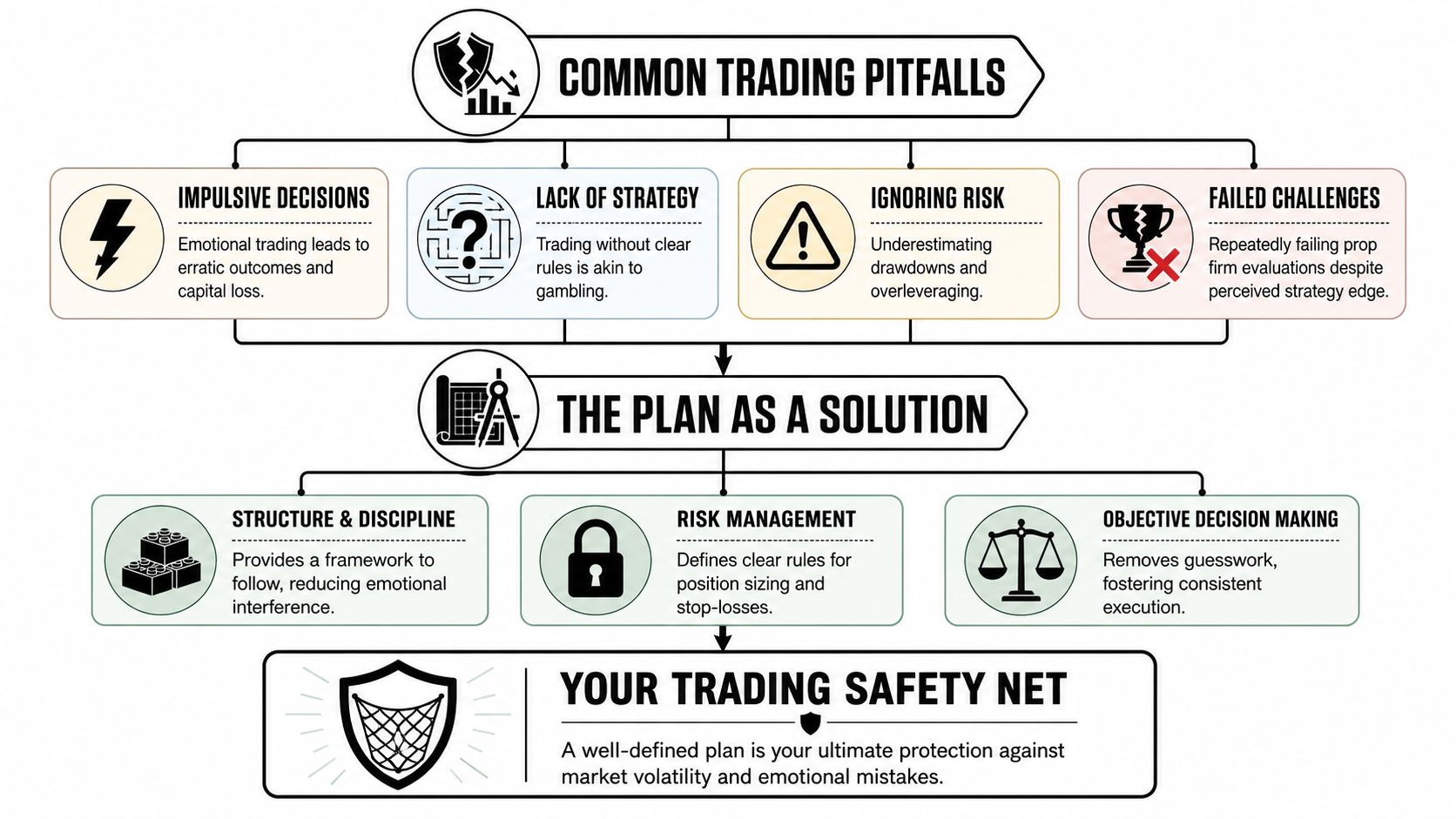
A strategy can be profitable and still fail a challenge
This is the hard truth junior traders resist. A decent setup doesn't save you if you oversize, move stops, revenge trade, or keep firing after your edge disappears.
In a prop environment, that matters even more because you aren't just fighting the market. You're also operating inside guardrails such as daily loss limits and total drawdown rules. If you don't understand how drawdown works in practice, study maximum drawdown in funded trading before you place another challenge trade.
Practical rule: If your next impulsive trade can violate a firm rule, you don't have a strategy problem. You have an operating problem.
Expectancy is what pays you, not ego
Most traders still think in terms of single-trade outcomes. That's a fast way to sabotage yourself.
Profits come from expectancy over many trades, not from winning every trade. A trading system can still work with a modest win rate if the average winner is larger than the average loser. One trading lesson shows that with a 2:1 risk-reward ratio, a trader can break even at roughly a 33% win rate according to MarketMates on trading probabilities and expectancy.
That changes how you should think about trading the plan:
- Your job isn't to be right today. Your job is to execute a model with a positive expectancy.
- A loss isn't automatically a mistake. A rule-break is.
- A winning trade can still be bad. If it violated your plan, it reinforces behavior that eventually costs you the account.
What a real safety net looks like
A usable plan covers more than entries.
It should answer:
- What markets you trade
- When you trade them
- What conditions must exist before entry
- Where the trade is invalid
- How size is calculated
- When you stop trading
- How you review execution
Most challenge failures aren't caused by one giant flaw. They come from small acts of undisciplined trading the plan, repeated until the account can't absorb them anymore.
The trader who survives isn't usually the one with the flashiest setup. It's the one who treats the plan like a seatbelt. Boring before the crash. Essential during it.
Designing Your Prop-Firm-Proof Trading Plan
A plan that works in a personal account can still fail in a challenge. The prop version has to be tighter, simpler, and built around rule protection first.
If you're writing a plan from scratch, don't begin with indicators. Begin with constraints.
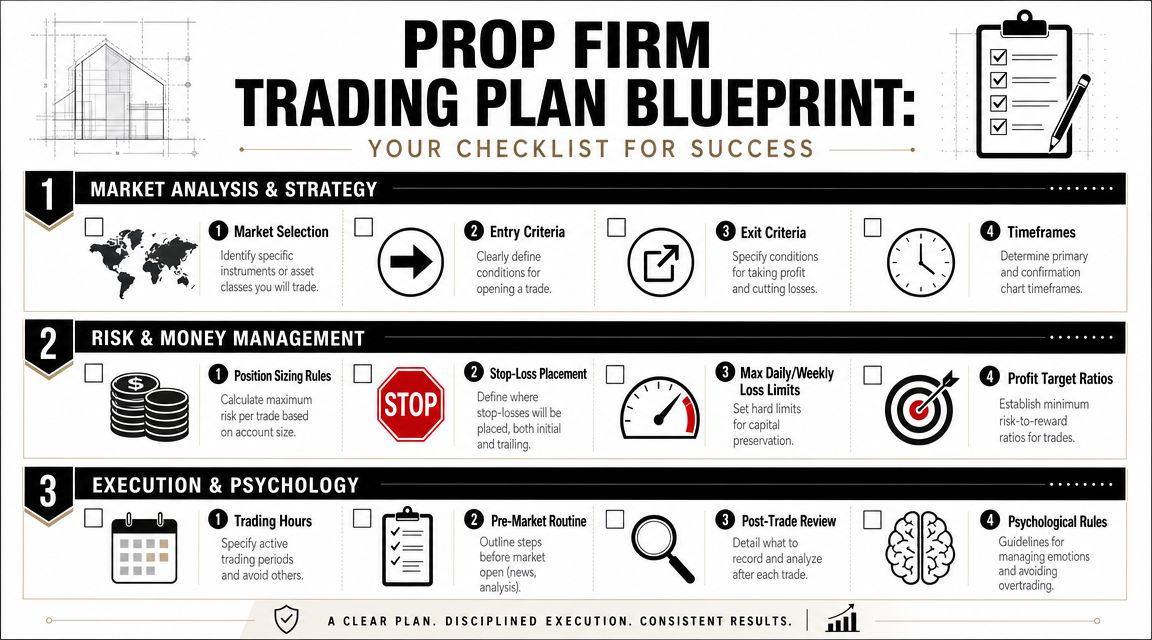
Start with the boundaries
Your plan should fit the account before it fits your personality.
That means defining:
- Products: Forex, indices, crypto, or commodities. Don't trade everything because it's available.
- Session: London open, New York open, overlap, or a specific window where you perform well.
- Setup type: Breakout, pullback, reversal, range fade, momentum continuation. Pick a small number.
- No-trade conditions: Choppy session, missed entry, emotional frustration, platform issues, unclear invalidation.
If you want a structure to work from, use a dedicated trading plan template for funded traders and customize it around the account's actual restrictions.
Risk rules come before entry rules
Most traders get sloppy by defining a setup, then guessing size. That's backwards.
A sound trade plan requires hard risk quantification. Common benchmarks are risking 1%–2% of trading capital per trade, with total portfolio exposure kept below 6%, and the method is to set the account risk budget, calculate the stop-loss point, then size the trade so the dollar loss at the stop matches the budget, as explained in Bookmap's guide to risk-based trade planning.
That gives you a practical workflow:
- Set the risk budget first. Decide what you're willing to lose on the trade before you think about profit.
- Mark the invalidation level. Your stop belongs where the trade idea is wrong, not where the loss feels comfortable.
- Calculate position size from the stop distance. Size is the output, not the input.
- Check the reward profile. If the trade doesn't offer enough room relative to risk, skip it.
- Record the plan before entry. If it's not written, you'll rewrite it emotionally mid-trade.
A stop-loss without position sizing is decoration. Position sizing is what turns a stop into actual risk control.
Build rules that are hard to misread
Ambiguity kills execution.
Bad rule: "Buy strong momentum near support."
Better rule: "Trade only during my session. Enter only when my chosen setup appears. Stop goes at the invalidation level already defined on the chart. If I can't define the stop and target before entry, I don't take the trade."
Use this checklist in your written plan:
- Market filter: What has to be true before you even look for a trade
- Entry trigger: The exact event that gets you in
- Stop placement: Where the idea fails
- Target logic: Fixed target, opposing level, or managed exit
- Kill switch: What ends your trading day after poor execution or unstable conditions
Keep challenge rules above personal opinion
In a funded evaluation, surviving the rules is part of the edge.
A trader can be directionally correct and still fail because the account management was loose. This is why firms like MyFundedCapital publish flat daily loss and maximum drawdown parameters for their simulated funding models. Those limits aren't a side note. They should shape every line of your plan.
When you're trading the plan in a challenge, good trading isn't just about finding opportunity. It's about staying inside the box while opportunity plays out.
Validating Your Plan Before You Risk Capital
A written plan isn't proof. It's a hypothesis.
Before you pay for a challenge or scale size, test whether the rules hold up and whether you can execute them under pressure.

Backtest the rules, not your memory
Backtesting only helps if the rules are specific enough to replay accurately. If your setup changes depending on mood, hindsight will lie to you.
A statistically credible trading plan is tested on historical charts across uptrend, downtrend, and sideways conditions. The benchmark metrics commonly used to judge whether the plan is working are win rate, risk-reward ratio, maximum drawdown, and profit factor, and a low win rate can still work if the payoff distribution is strong, as outlined in this guide to building and testing a complete trading plan.
Use a review sheet that captures:
- Market condition: Trend, range, or unstable price action
- Setup quality: Clean, acceptable, or forced
- Execution result: Followed rules or didn't
- Outcome pattern: Win, loss, scratch, or missed trade
If you need a primer on the process itself, read how backtesting works for traders before you trust a setup just because it looked good on a few screenshots.
Forward test in challenge-like conditions
Forward testing is where traders discover whether they can follow the plan in real time.
Paper trading isn't about fantasy fills or random clicking. It should mirror the environment you plan to trade in. Same platform style, same session, same markets, same execution rules, same daily stop behavior.
Your plan isn't validated when it looks clean in a spreadsheet. It's validated when you can follow it on an ordinary Tuesday after two frustrating losses.
What you're checking in forward testing isn't only the setup. You're checking whether the plan survives boredom, hesitation, and stress.
What invalidates the plan
A plan needs revision when one of two things happens:
| Issue | Meaning |
|---|---|
| Rules don't produce stable results across different conditions | The edge may be weak or too dependent on one market environment |
| You can't execute the rules consistently in real time | The plan may be too vague, too complex, or too discretionary |
Many traders skip this step because they want action. That's expensive impatience. Validation is where you find out whether you're holding a process or a story.
Executing Your Plan with Systems and Checklists
Most traders don't need more motivation. They need fewer decisions.
Discipline gets framed like character, but in practice it's usually system design. If your process leaves room for impulse, impulse will show up.
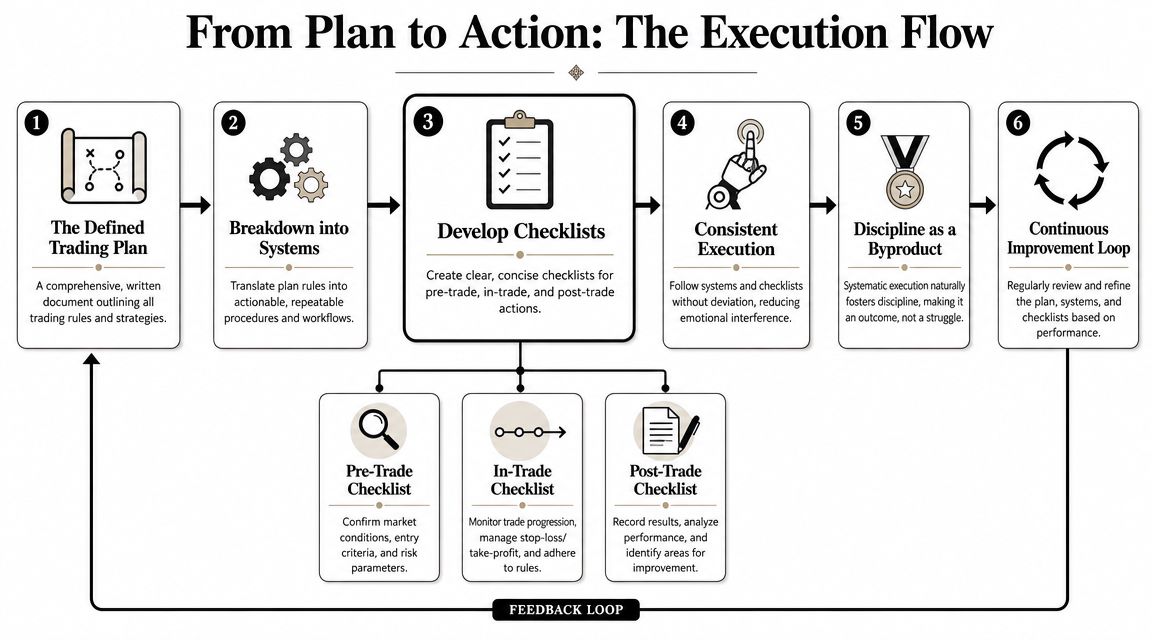
Turn the plan into operating steps
A trading plan that sits in a document won't control behavior by itself. You need an execution system that forces the plan into the moment when you're about to click.
That means breaking the plan into three checklists:
- Pre-trade checklist
- In-trade checklist
- Post-trade checklist
The pre-trade list matters most because that's where bad trades can still be prevented.
A pre-trade checklist that actually works
Keep it short enough to use every time, but strict enough to block bad behavior.
Sample checklist:
- Session check: Am I trading during my approved market hours?
- Setup check: Is this one of my planned setups, or am I improvising?
- Market condition check: Does current price action fit the environment this setup needs?
- Invalidation check: Have I defined where the idea is wrong?
- Size check: Did I calculate size from risk and stop distance?
- Exit check: Do I know how I will take profit or manage the trade?
- Rule check: Does this trade keep me comfortably within account rules?
- Mental check: Am I calm enough to execute this without forcing it?
If one answer is no, there is no trade.
Good execution should feel almost boring. If every trade feels exciting, you're probably adding discretion where the plan should be doing the work.
Friction is useful
Most traders make rule-breaking too easy. One click, one impulse, one oversized trade.
Add friction instead:
- Use written order tickets: Write entry, stop, target, and size before placing the order.
- Keep a visible checklist: On-screen note, printed card, or platform workspace reminder.
- Restrict your watchlist: Fewer symbols means fewer random temptations.
- Predefine shutdown rules: If your behavior slips, the session ends.
Trading the plan becomes much easier when the system makes bad decisions inconvenient. That's what professionals do. They don't rely on mood. They rely on process.
Mastering Discipline Through Journaling and Review
If your journal only records entry, exit, and profit or loss, you're missing the part that improves you.
The useful journal isn't just a ledger. It's an audit trail of whether you followed your own rules.
Journal execution, not just outcome
Plan adherence often breaks down because of emotion and overconfidence, not because the strategy itself is broken. A stronger approach is to treat the plan as an auditable process by using journaling, checklist compliance, and trade-tagging metrics such as rule-break frequency, as discussed in Bookmap's piece on execution quality and behavioral trading mistakes.
That means every trade should be tagged with more than result.
Track things like:
- Plan-compliant or rule-break
- Setup grade
- Emotional state before entry
- Did I move the stop
- Did I size correctly
- Did I enter early or late
- Would I take this exact trade again
Review patterns, not isolated mistakes
One bad trade doesn't tell you much. Repeated behavior does.
Use a simple review rhythm:
| Review cycle | What to inspect |
|---|---|
| Daily review | Did I follow the process, and where did execution slip? |
| Weekly review | What repeated mistakes showed up across multiple trades? |
| Targeted adjustment | Which single behavior needs a rule or checklist change? |
Traders begin to identify their true leaks. Not "my strategy doesn't work." More often it's "I break rules after a loss," "I force trades in slow conditions," or "I stop waiting for confirmation when I'm trying to make back money."
The journal should tell you whether your losses came from the market or from you.
Use outside accountability if discipline keeps slipping
Some traders can self-correct with data alone. Others keep seeing the same behavioral pattern and need another person involved.
In that case, structured support like accountability coaches can help because they create external review, follow-up, and pressure to stick to stated rules. That's useful when you know what to do but keep failing to do it consistently.
A journal becomes powerful when it stops being a diary and starts being evidence. You're not writing down feelings for the sake of it. You're collecting proof of where your execution breaks and what must change.
Contingency Protocols for Inevitable Setbacks
Every serious trading plan needs an emergency manual.
Not because you're planning to fail, but because stress changes behavior fast. If you don't decide your response in advance, you'll improvise at the worst possible time.
Write if-then rules for bad days
Contingency rules should be mechanical. Short, clear, and easy to enforce.
Examples:
- If I break an entry rule, then I close the trade if the setup isn't valid and document the mistake before taking anything else.
- If I feel the urge to revenge trade, then I step away from the platform and don't place another order until I've reviewed the last trade.
- If I hesitate on valid setups repeatedly, then I reduce screen noise, return to my checklist, and trade only the cleanest version of the setup.
- If market conditions are unclear, then I stop trying to manufacture opportunity and sit out.
Protect the account before you protect your ego
What works in setbacks is reduction, not escalation.
When execution slips, the right response usually includes one or more of these:
- Trade less
- Lower decision speed
- Narrow the watchlist
- Return to one setup
- Pause and review before re-engaging
What doesn't work is trying to "win it back," adding size, broadening markets, or rewriting rules mid-session.
Rule-breaks need consequences
A lot of traders journal mistakes with no consequence. That teaches the brain that rule-breaking is acceptable as long as it's written down later.
Build a response ladder instead:
| Trigger | Response |
|---|---|
| Minor lapse | Note it, review it, continue only if fully reset |
| Clear rule-break | Stop trading and complete a post-mortem |
| Repeated behavior | Cut activity and return to testing mode until execution stabilizes |
This is what makes trading the plan operational instead of aspirational. Good traders don't just have entry criteria. They have preplanned responses for the moments when they, or the market, stop behaving cleanly.
Frequently Asked Questions About Trading the Plan
How detailed should a trading plan be
Detailed enough that another trader could understand your decisions from the document alone. If your plan says "trade strong setups" or "cut losses quickly," it's too vague. You need specific entry conditions, invalidation rules, sizing logic, session limits, and review procedures.
What if my plan says skip the trade, but the setup wins without me
Then you did your job.
A missed winner hurts the ego, but taking trades outside the plan hurts the account. Funded traders last longer when they judge themselves by execution quality first and outcome second.
Should I change my plan after a losing streak
Not automatically. A losing streak can come from normal variance, poor market conditions, or poor execution.
Change the plan only after review shows that the rules themselves are flawed or too hard to execute consistently. If the issue is rule-breaking, changing the plan just hides the problem.
Can I still use discretion while trading the plan
Yes, but only if discretion is defined.
For example, you can allow discretion in selecting the cleanest setup among approved markets or standing aside during messy price action. What you can't do is use "discretion" as a label for emotional decision-making, random size changes, or moving exits on impulse.
Trading the plan isn't restrictive in a bad way. It removes low-quality freedom so you can keep the only freedom that matters, staying in the game long enough to let your edge play out.
If you're ready to apply this in a real evaluation environment, explore the funded programs at MyFundedCapital. Compare account types, review the challenge rules carefully, and choose the path that fits your trading process.
