

 AR
AR
 NL
NL
 EN
EN
 FR
FR
 DE
DE
 ES
ES
 IT
IT
 PL
PL
 SV
SV

Becoming a funded trader lets you trade a prop firm's capital, but it's a serious career path, not a get-rich-quick scheme. This guide provides a direct, actionable roadmap for traders ready to prove their skills, covering everything from building a trusted strategy to passing the evaluation and succeeding long-term. You'll learn the practical steps needed to turn your trading talent into a professional career.
What It Really Means to Be a Funded Trader
Being a funded trader is a partnership: you provide the trading skill, and a proprietary trading firm provides the capital. You trade the firm's account and keep a significant share of the profits—often up to 100%. This model allows skilled traders to access significant buying power without risking their personal savings. For a detailed breakdown, learn how proprietary trading firms operate in our complete guide.
The arrangement benefits both parties. The firm profits by backing disciplined traders, and you can focus entirely on executing your strategy without the financial stress of risking your own money on every trade.
The Tradeoff: Skill for Capital
The deal is simple: prove you can trade consistently and manage risk, and the firm will fund you. This proof comes from passing an evaluation, often called a "challenge."
Think of the challenge as a professional tryout. You trade in a simulated environment with specific rules and objectives. The goal is to hit a profit target without violating key risk parameters, such as a maximum daily loss or total drawdown limit.
This process ensures only traders with a consistent, risk-managed approach get funded. It is a merit-based system where performance is the only metric that matters. To pass, you must demonstrate you can:
- Follow strict rules, proving you can protect capital.
- Generate consistent profits without taking excessive risks.
- Maintain a professional mindset, treating the evaluation account as if it were real capital.
Disclaimer: The path to becoming a funded trader is challenging. Industry data shows that evaluation pass rates are typically between 5% and 10%. This statistic is not meant to discourage you but to emphasize the importance of thorough preparation and strict discipline. Success is built on solid risk management, not a "perfect" strategy.
Beyond the Challenge: The Start of Your Career
Passing the evaluation isn't the finish line; it's the starting point. As a funded trader, you manage a live account where the objective shifts from hitting a short-term target to generating sustainable, long-term growth.
This is where you build a career. You learn to handle the psychology of trading larger capital, process your first payouts, and work toward scaling your account to higher levels. It’s a career built on repeatable skill, not a lucky streak.
Developing a Strategy That Prop Firms Trust

Before attempting a funding challenge, you must have a trading strategy that is not just profitable but also disciplined and repeatable. Prop firms look for partners who manage risk meticulously, not gamblers seeking a single big win. A consistent, rule-based trading plan is non-negotiable.
Your trading plan is your professional blueprint. It guides every decision, removes emotion from the process, and transforms trading from a speculative activity into a structured business.
Defining Your Trading Identity
First, you must define precisely how you will approach the markets. A vague plan leads to inconsistent results. Get specific about your trading style, market selection, and daily routine.
- Trading Style: Are you a scalper, day trader, or swing trader? Your choice determines your time commitment and the types of setups you will look for.
- Market Selection: Will you focus on major FX pairs like EUR/USD, indices like the NASDAQ 100, or commodities like gold? Specializing in a few markets you understand deeply is more effective than trying to trade everything.
- Trading Times: Identify when you are most focused and when your chosen markets are most active. Sticking to a specific session, like London or New York, helps build consistency and prevents overtrading.
A detailed trading plan is your most critical asset. It proves to yourself—and a prop firm—that you have a measurable edge and the discipline to execute it under pressure.
Building Your Rulebook Around Prop Firm Requirements
Risk management is the core of your strategy. Prop firms prioritize capital protection above all else. Your plan must include strict, non-negotiable rules that align with their evaluation criteria.
Define your risk parameters before entering any trade. These rules act as guardrails to prevent a single bad day from ending your challenge. For a detailed guide on building a plan, see our article on how to create a Forex strategy based on technical analysis.
Key Trading Plan Components for Prop Firm Success
| Component | Description | Example for a $100k Account |
|---|---|---|
| Trading Style | The primary method used to identify and execute trades. | Day trading based on price action and key support/resistance levels during the New York session. |
| Market(s) | The specific financial instruments you will trade. | Major Forex Pairs (EUR/USD, GBP/USD) and US30 Index. No exotic pairs or other commodities. |
| Risk Per Trade (%) | The maximum percentage of the account balance risked on a single trade. | 0.5% of the account balance per trade. |
| Max Risk ($) | The maximum dollar amount risked on a single trade. | $500 per trade (0.5% of $100,000). |
| Entry Criteria | The specific set of conditions that must be met before entering a trade. | Price must break and retest a 4-hour support level, with a bullish engulfing candle on the 15-minute chart. |
| Exit Criteria (Stop-Loss) | The pre-defined price level where a losing trade will be closed. | Stop-loss placed 10 pips below the entry candle's low. |
| Exit Criteria (Take-Profit) | The pre-defined price level where a winning trade will be closed. | Target set at a 1:3 Risk/Reward Ratio, targeting the next major resistance level. |
| Max Daily Loss | The maximum cumulative loss allowed in a single trading day before stopping. | 2% of the account ($2,000). If hit, trading stops for the day. |
This table illustrates the level of detail required for a professional trading plan.
Validate Your Strategy with Data, Not Hope
A trading plan is only a theory until it is tested. The most critical step in your preparation is to validate your strategy in a demo environment.
Your goal is to collect data over a significant sample size—at least 100 trades—to confirm your strategy has a positive expectancy. A few big wins are luck; consistency is skill. A prop firm needs to see that you can execute your plan repeatedly through various market conditions.
Track these metrics during your demo trading:
- Win Rate: The percentage of trades that reach their profit target.
- Average Risk-to-Reward Ratio: How much larger your average win is compared to your average loss.
- Maximum Drawdown: The largest peak-to-trough decline in your account equity. This reveals how your strategy performs under stress.
Only after your demo account shows consistent profitability while strictly following your rules should you consider a funding challenge. This data-driven validation separates professionals from amateurs.
Finding the Right Prop Firm: Your Partner in Trading
Choosing a prop firm is like selecting a long-term business partner. The decision impacts the rules you trade by, the technology you use, and your overall chance of success. While high profit splits are attractive, the details are what truly matter.
The prop trading industry has grown significantly, now valued at around $20 billion with over 2,000 firms. Global search interest has increased by over 600% in the last four years. To learn more, check out the latest prop trading industry statistics. This growth provides more options but requires careful vetting.
The First Big Choice: Evaluation Challenge vs. Instant Funding
Your first decision is whether to prove your skills through an evaluation challenge or start immediately with instant funding. The best choice depends on your confidence, trading style, and risk tolerance.
Evaluation Challenges (1-Step or 2-Step)
This is the most common path. You pay a one-time fee to take a challenge, and if you pass, you receive a funded account.
Pros:
- Access to Large Capital: A small, often refundable fee can give you access to a $100,000 account or more.
- High Payouts: Profit splits are typically 80% or higher on funded accounts.
- Skill Validation: Passing a tough challenge confirms your strategy works under pressure.
Cons:
- Strict Rules: Profit targets and drawdown limits are designed to be difficult. Many traders fail.
- Psychological Pressure: Deadlines and targets can lead to emotional mistakes like over-trading.
Instant Funding
This model allows confident traders to skip the evaluation and trade a live account from day one.
Pros:
- Immediate Earnings: You can earn profits from your first trade.
- No Time Pressure: Without a profit target, you can trade patiently according to your plan.
Cons:
- Stricter Drawdown Rules: Risk parameters are often tighter, leaving less room for error.
- Slower Scaling: You typically start with a smaller account and must prove consistency to scale up.
Digging Deeper: What Really Matters in a Prop Firm
Beyond the funding model, several key factors distinguish great firms from the rest.
Reputation and Payouts: Look for firms with a strong track record and positive reviews on sites like Trustpilot. Transparency is key; a reputable firm will share payout proof on its social media channels.
Trading Rules: Ensure the rules align with your trading style. Can you hold trades over the weekend? Is news trading permitted? Some firms, like MyFundedCapital, offer add-ons for greater flexibility.
Profit Splits and Scaling Plan: An 80% profit split is standard, but the scaling plan is equally important. A good firm offers a clear and achievable path to managing more capital as you demonstrate consistent profitability.
Trading Platforms: You must be comfortable with your trading tools. Ensure the firm offers a platform you know and trust, such as DXtrade, cTrader, or Match-Trader.
Choose a firm whose rules, technology, and community support your professional goals, not just one with the most attractive headline offer.
Navigating and Passing Your Funding Challenge
You've prepared your strategy; now it's time to execute. Passing a prop firm challenge is primarily a test of discipline. This is where you prove you can follow your plan under pressure.
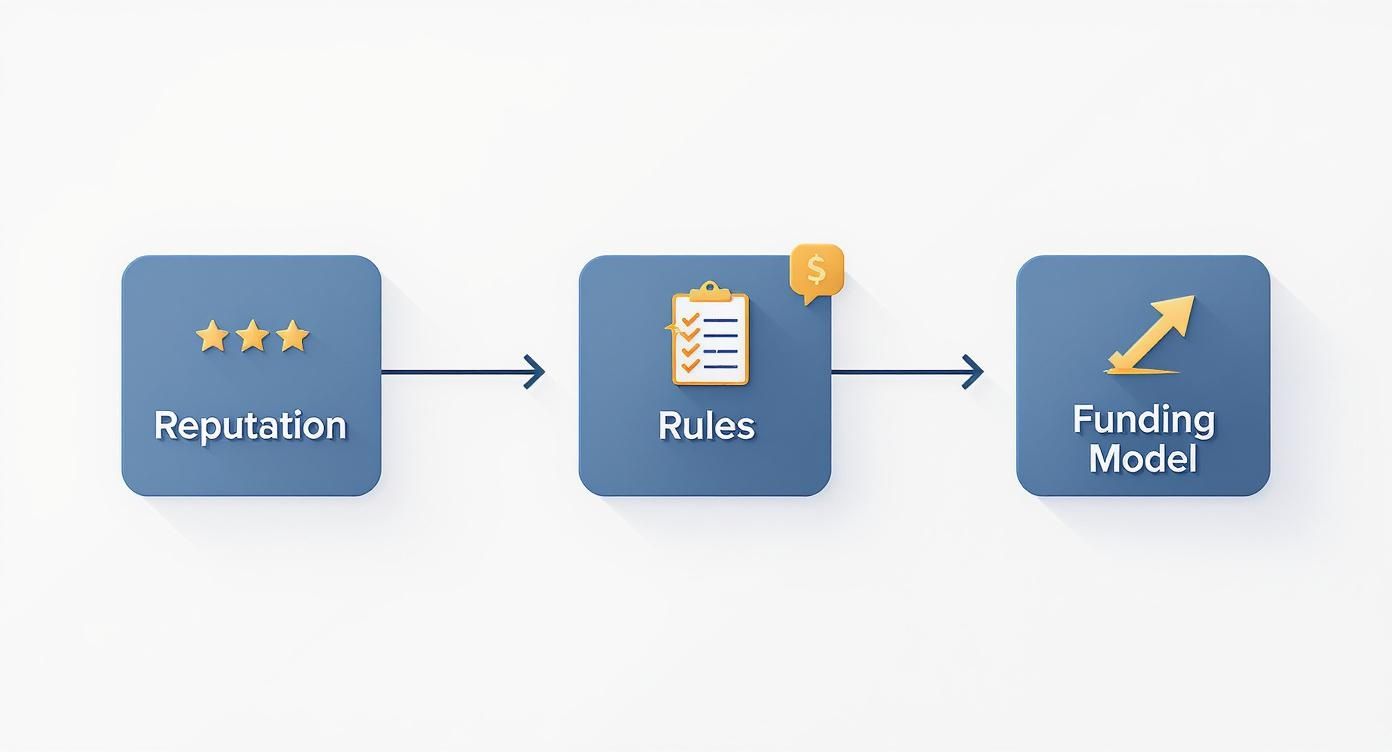
From the start, treat the evaluation account like it's your own real money. The rules are not suggestions; they are hard boundaries. Adhering to them demonstrates the professional mindset that firms want to fund. The flowchart below illustrates the ideal decision-making process when choosing a firm.
The First Few Days: Adopt a Marathon Mindset
Many traders fail their challenges within the first few days by trying to pass too quickly. The urge to hit a big winning trade is strong, but you must resist it.
Your only goal in the first few days is to protect your starting capital. Trade small, stick to your plan, and focus on executing well. This is a marathon, not a sprint.
- Reduce Your Risk: If your plan calls for 0.5% risk per trade, consider cutting it to 0.25% for the first week. This keeps you in the game and helps avoid an early, significant drawdown.
- Be Selective: Only take your highest-probability A+ setups. Patience is your greatest advantage.
- Aim for a Modest Start: Ending the first week at breakeven or slightly profitable is a psychological victory. It proves you can control your impulses and sets a professional tone.
Breaking Down the Profit Target
A 10% profit target can seem daunting, often pushing traders to take on too much risk. A smarter approach is to break the large goal into smaller, manageable weekly or daily objectives.
For a $100,000 account with a $10,000 profit target (10%):
- Weekly Goal: Aim for a 2.5% gain ($2,500).
- Daily Objective: This breaks down to about $500 per day, or just 0.5% of the account.
This reframing helps you focus on your daily process rather than a distant outcome, preventing the kind of impulsive trading that leads to failure.
Prop firms are not looking for traders who get lucky. They are evaluating your ability to follow a process, manage risk, and produce consistent results.
Mastering the Rules and Avoiding Common Pitfalls
Every firm has a non-negotiable rulebook. Violating a core rule results in immediate failure. The two most important rules are the maximum daily loss and the maximum total drawdown. You must know these limits and build them into your trading plan.
To avoid violations, set hard stops in your trading platform. If the daily loss limit is 5% on a $100k account ($5,000), you must stop trading for the day once you hit that limit. No exceptions.
Be aware of other common rules, such as restrictions on holding trades over the weekend or trading during major news events. For a deeper look, read our guide on understanding the prop firm challenges.
Common pitfalls to avoid:
- Revenge Trading: Immediately re-entering the market after a loss to win money back. This is an emotional response that almost always leads to bigger losses.
- Over-Leveraging: Increasing your position size to chase the profit target. This multiplies your risk and brings you closer to the drawdown limit.
- Strategy Hopping: Abandoning your validated plan after a few losses. Trust the system you worked to develop.
Passing a funding challenge is a reflection of your professionalism. Approach it with patience, discipline, and respect for the rules.
Succeeding as a Funded Trader After You Pass
Receiving the email that you've passed your challenge is a major accomplishment, but it's the beginning of your career, not the end. The focus now shifts from hitting a short-term target to generating consistent, long-term profits.
This transition requires a mindset adjustment. The sprint mentality of the evaluation must be replaced with a patient, marathon approach. Your job is to protect the firm's capital and grow the account methodically.
From Evaluation to Payouts: The New Reality
As a funded trader, your performance is measured by your ability to generate real, withdrawable profits. You need to understand the firm's payout process.
At MyFundedCapital, our challenge programs typically allow for your first payout after 14 or 21 days, with subsequent withdrawals available bi-weekly. The key is to trade your plan consistently and let profits accumulate naturally without forcing trades to meet a payout date.
What's the Real Earning Potential?
A common question is, "How much can a funded trader make?" The answer depends on your performance, account size, and profit split. While nothing is guaranteed, the potential is significant for disciplined traders.
According to industry reports, the average annual income for a funded trader in the U.S. is around $96,774, or about $400 per trading day. For example, a 5% monthly return on a $100,000 account ($5,000) with an 80% profit split would yield a $4,000 payout. These numbers show that funded trading can be a viable career. You can learn more by reading about the earning potential of funded traders from industry reports.
The goal is to build a consistent income stream, not chase a single large payout. A trader who makes a steady 2-3% per month while following the rules is far more valuable than one who makes 15% one month and blows the account the next.
How to Scale Your Funded Account
Scaling is how prop firms reward consistent, profitable traders. By increasing your account size, they effectively give you a raise for good performance.
Firms typically look for the following criteria before approving a scaling request:
- Consistent Profitability: A common benchmark is achieving a certain profit percentage (e.g., 10%) over a set period, such as three consecutive months.
- Solid Risk Management: The firm will review your trading history to ensure you have followed all rules and avoided excessive risk.
- Sufficient Track Record: You generally need to trade the live account for a minimum of two to three months to provide enough data for analysis.
Meeting these conditions proves you are a reliable partner. The firm may then increase your account size by 25% or more, boosting your earning potential without increasing your personal risk.
Frequently Asked Questions About Funded Trading
Here are answers to some of the most common questions from aspiring funded traders.
How much personal capital do I need to start?
You do not need a large amount of personal capital. That is the primary benefit of funded trading—you use the firm's capital. Your only upfront cost is the one-time fee for the evaluation challenge, which is a small fraction of the account size you can manage if you pass. For example, a fee of a few hundred dollars could give you access to a $100,000 trading account.
What happens if I lose money in a funded account?
The prop firm assumes the financial risk of trading losses. If you have a losing trade, the loss is covered by the firm's capital, not your personal funds. However, you are responsible for adhering to the risk rules. If you violate a rule, such as the maximum daily loss or total drawdown limit, your funded account will be closed. Your personal money is safe, but you will lose access to the account if you fail to manage risk properly.
What is the realistic income I can expect?
Your income is directly tied to your performance and is not guaranteed. A realistic goal for a disciplined trader is to aim for a consistent 2-5% monthly return. On a $100,000 account with an 80% profit split, this would translate to a monthly income of $1,600 to $4,000. Top-tier traders can earn significantly more, but consistency is the key to building a sustainable income.
How quickly can I get paid?
Payout schedules vary by firm. After passing a challenge and trading your funded account, there is typically a set period before you can request your first withdrawal. At MyFundedCapital, traders on our challenge programs are eligible for their first payout on a bi-weekly basis. We also offer 7-day payout cycles as an add-on. For our Instant Funding models, you can request your first payout just 14 days after your first trade.
Disclaimer: Trading involves substantial risk of loss and is not suitable for all investors. This content is for educational purposes only and should not be considered financial advice. Past performance is not indicative of future results.
Ready to Become a Funded Trader?
You now have a practical roadmap to becoming a funded trader, from developing a robust strategy to managing a live account. The path requires discipline, patience, and a professional mindset, but for traders who are prepared, it offers a unique opportunity to build a career.
If you have done the preparation and are ready to prove your skills, your journey starts now.
Explore the funding programs at MyFundedCapital to find the one that best suits your trading style.
Find the right challenge for you and start your evaluation today.
