

 AR
AR
 NL
NL
 EN
EN
 FR
FR
 DE
DE
 ES
ES
 IT
IT
 PL
PL
 SV
SV

A lot of traders hit the same wall. They can make money for a few weeks, sometimes a few months, but they never turn that into a structured compound trading account that grows cleanly under real prop firm rules.
The difference usually isn’t the strategy. It’s position sizing, withdrawals, drawdown control, and the discipline to keep reinvesting without drifting into revenge trades or oversized risk. Here’s how compounding works in trading, and how to apply it without breaking the rules that funded traders live under.
What Exactly Is a Compound Trading Account
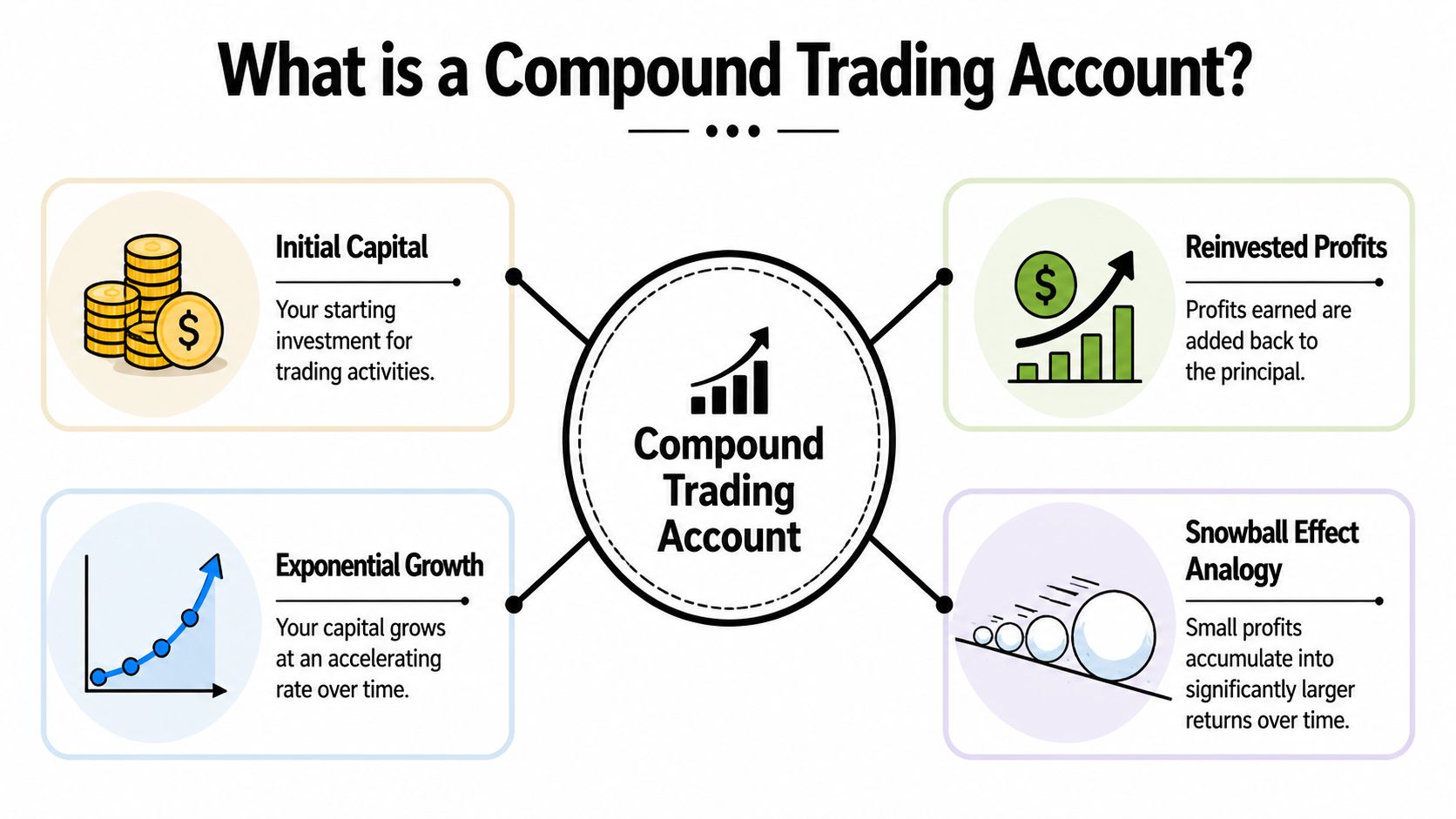
A compound trading account is an account where you reinvest profits back into your trading balance so future gains are calculated on a larger base. That’s the whole idea. Instead of treating each profitable month as a separate paycheck, you let each gain increase the capital you deploy next.
The easiest way to think about it is the snowball effect. A small snowball rolling downhill doesn’t stay small for long if it keeps picking up snow. Trading works the same way when profits stay in the account and your risk model scales off current balance rather than original balance.
What changes when you compound
With fixed withdrawals, your account tends to grow slowly or not at all. With compounding, three things change:
- Your trade size can scale naturally: If your system risks a fixed percentage of current balance, position size increases only when the account earns that increase.
- Profits start working twice: First as realized gains, then as new capital for future setups.
- Growth stops being linear: Returns begin stacking on previous returns instead of resetting every month.
That last point matters most. A linear approach can still be profitable, but it doesn’t use time nearly as well.
A straightforward example shows why. Starting with $10,000 and compounding at 5% monthly produces $17,958.56 by year-end, for a 79.59% total return, while a simple non-compounded 60% return would leave the account at $16,000 instead, according to this compound trading account example.
Why traders misunderstand it
Many traders hear “compound trading account” and think it means chasing bigger and bigger wins. It doesn’t. Good compounding usually comes from repeating the same process with controlled risk, not from increasing aggression.
Practical rule: Compounding is a sizing method, not a prediction method. It doesn’t fix a weak strategy. It amplifies a disciplined one.
That distinction matters even more if you trade funded accounts, crypto CFDs, or short-term systems where slippage, execution speed, and platform reliability affect repeatability. If you’re building products or infrastructure around crypto execution, it’s worth reviewing how a DEX development company approaches trading platform design, because compounding only works when the underlying execution environment supports consistent rules.
The real implication
A compound trading account rewards patience. It also punishes inconsistency. If you keep changing risk after wins, reducing size after normal losses, or withdrawing too early, you interrupt the curve before it has time to do its job.
That’s why compounding sounds simple in theory and feels hard in practice. The math is easy. The behavior isn’t.
The Mathematics of Compounding Growth in Trading
Traders often overcomplicate compounding by obsessing over formulas and ignoring what the numbers are saying. The useful part is simple: if your account grows by a fixed percentage and you recalculate size from the new balance, the base gets larger every cycle.
The standard compounding framework is built around future value. You don’t need to memorize it to use it, but you do need to understand what changes the outcome: return rate, time, and whether gains stay in the account.
A practical table for a $10,000 account
Using the compound growth formula, the performance of a $10,000 account can be observed at different monthly return rates over time.
| Monthly Return | End of Year 1 | End of Year 3 | End of Year 5 |
|---|---|---|---|
| 3% | $14,257.61 | $28,980.22 | $58,916.79 |
| 5% | $17,958.56 | $57,920.05 | $186,791.62 |
| 8% | $25,181.70 | $159,251.98 | $1,011,996.27 |
The table is useful for planning, but it can also be misleading if you read it emotionally. Traders see the longer-term numbers and start forcing setups to “hit the curve.” That’s where compounding usually breaks.
Risk profiles matter more than ambition
Monthly performance targets have to match the way you trade. A useful framework from Saxo breaks this down into broad profiles: conservative targets at 5% to 8% monthly with 60% to 65% win rate and 1:1.5 reward-to-risk, moderate at 10% to 15% monthly with 55% to 60% win rate and 1:2, and aggressive at 15% to 25% monthly with 50% to 55% win rate and 1:2.5. The same guide notes that $1,000 compounded at a conservative 5% monthly grows to $1,796 in 12 months and $3,225 in 24 months, as shown in Saxo’s guide to compounding returns.
Those figures give you two important truths:
- Small monthly gains matter: You don’t need extreme returns to create meaningful growth.
- Higher targets usually require looser tolerance for pain: As targets rise, win rate often drops or drawdown pressure increases.
A quick mental shortcut
A lot of traders like the Rule of 72 as a rough estimate for doubling time. It’s a shortcut, not a planning tool. Divide 72 by the annual return rate and you get an approximate number of years to double.
Use it only as a sanity check. It helps frame expectations, but it won’t replace proper projections based on your actual monthly system returns, payout timing, and drawdown constraints.
Your model should come from your trade log, not your optimism.
What this means for live trading
The point of compounding math isn’t to impress yourself with future balance screenshots. It’s to choose a growth target you can execute repeatedly.
A realistic workflow looks like this:
- Pull actual results: Use your backtest and recent forward data.
- Cluster your months: Separate stable performance from outlier months.
- Build projections from the lower end: If your average month is strong but erratic, plan from the steadier range.
- Stress-test the model: Ask whether the same return target still works during a losing streak.
A good compound trading account model should survive boring months. If it only works on your best month, it isn’t a model. It’s a fantasy.
Compounding Growth vs Fixed Withdrawal Strategies
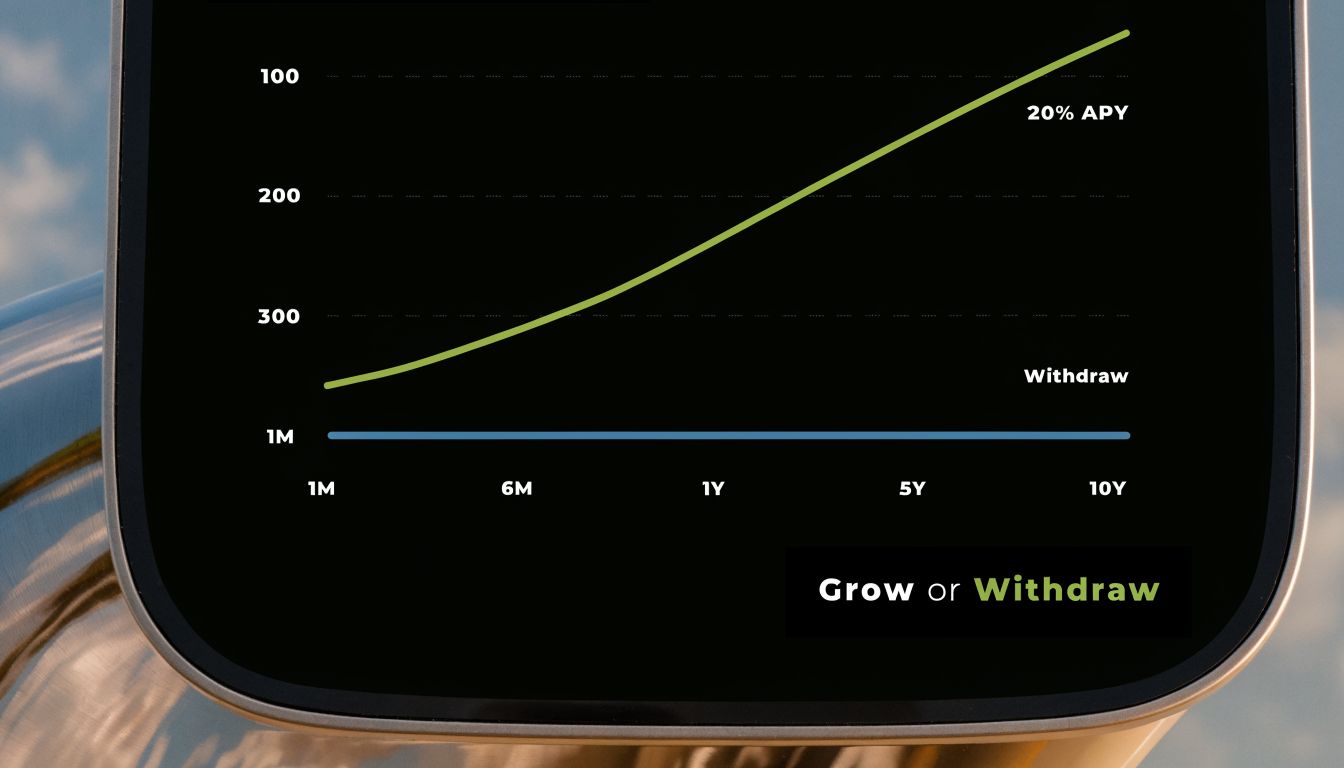
Every profitable trader eventually faces the same decision. Do you leave profits in the account and build a larger base, or do you pull income regularly and keep the account size steady?
Neither choice is automatically better. They solve different problems.
Path one keeps the growth engine running
A trader who compounds treats profits as working capital. The account balance rises, position size rises with it, and the strategy has more room to produce bigger absolute returns without changing the edge itself.
This path usually suits traders who:
- Want account growth first: They’re trying to reach larger size before prioritizing income.
- Trade best without income pressure: They don’t need every payout to cover living costs.
- Can tolerate delayed gratification: They care more about scale later than cash flow now.
The biggest advantage is obvious. A larger base makes the same setup worth more over time. The downside is psychological. Watching profits stay in the account can tempt traders to protect open equity too aggressively or to break rules after a drawdown.
Path two pays you now but slows the curve
A trader who withdraws on a fixed rhythm turns trading into income. That’s often the right move if the account already supports useful payouts or if personal cash flow matters more than maximizing balance growth.
This path usually fits traders who:
- Need consistent cash flow: Rent, bills, and real life don’t wait for compound curves.
- Want lower emotional attachment to account swings: Pulling profits can reduce the urge to overprotect unrealized gains.
- Prefer operational stability: The account stays in a familiar sizing range.
The trade-off is simple. If profits leave the account, they stop contributing to future growth inside the account.
A trader doesn’t fail by choosing withdrawals. A trader fails by choosing withdrawals while still expecting compounding results.
What works in practice
Most skilled traders eventually use a hybrid approach. They compound during specific periods, then switch to scheduled withdrawals once the account reaches a target size or once they hit a milestone in a funded program.
A practical decision checklist:
- Compound more aggressively when your edge is stable, your personal expenses are covered, and you’re still trying to scale.
- Withdraw more consistently when trading income has become part of your monthly budget.
- Use a split approach when you want growth without feeling trapped by unrealized account progress.
The mistake isn’t choosing one path over the other. The mistake is drifting between both without rules. If you compound some months, withdraw heavily after a few wins, then oversize to make back what you pulled, your process becomes random.
A compound trading account only works if the money management policy is as consistent as the entries.
Compounding Within Prop Firm Rules and Scaling Plans
Compounding gets more interesting once you trade under prop firm rules. In a personal account, you can decide how much pain you’re willing to tolerate. In a funded environment, the rules decide for you.
That changes how a compound trading account should be built. You aren’t only compounding profit. You’re compounding inside hard risk boundaries, payout schedules, and scaling milestones.
Drawdown rules come first
In prop trading, the first job isn’t maximizing growth. It’s staying inside the daily and overall loss rules. If the firm uses a 5% daily loss limit and 10% maximum drawdown, your compounding model has to respect those limits before you think about scaling, as discussed in this compound trading strategy reference.
That means your sizing process should start with current allowed loss, not with desired profit.
Here’s a simple explanation:
- Account rules define the outer boundary: You never risk in a way that can break the daily or total cap.
- Your strategy defines the inner operating range: You choose a smaller percentage risk that leaves room for normal variance.
- Compounding only happens inside that range: If growth in size pushes you too close to the rule limit, the model is too aggressive.
Expectancy matters more than excitement
A lot of traders approach funded accounts with challenge mentality. They think in terms of passing quickly instead of compounding properly. That mindset usually creates unstable sizing.
The better lens is expectancy. The growth model cited by FXOpen uses E = P * ((1 + %win) * (1 − %loss))^(N * WR), and gives an example of a trader risking 3% to gain 6% with a 60% win rate to project account growth. The same source connects that framework directly to prop environments with 5% daily and 10% max drawdown limits, and to scaling paths such as moving from a $100K to a $500K account through disciplined execution.
You don’t need to trade that exact profile. The point is that a funded account should be judged by whether the edge survives the rule set.
If your strategy only works when you size aggressively, it probably doesn’t fit a prop environment.
Scaling plans are structured compounding
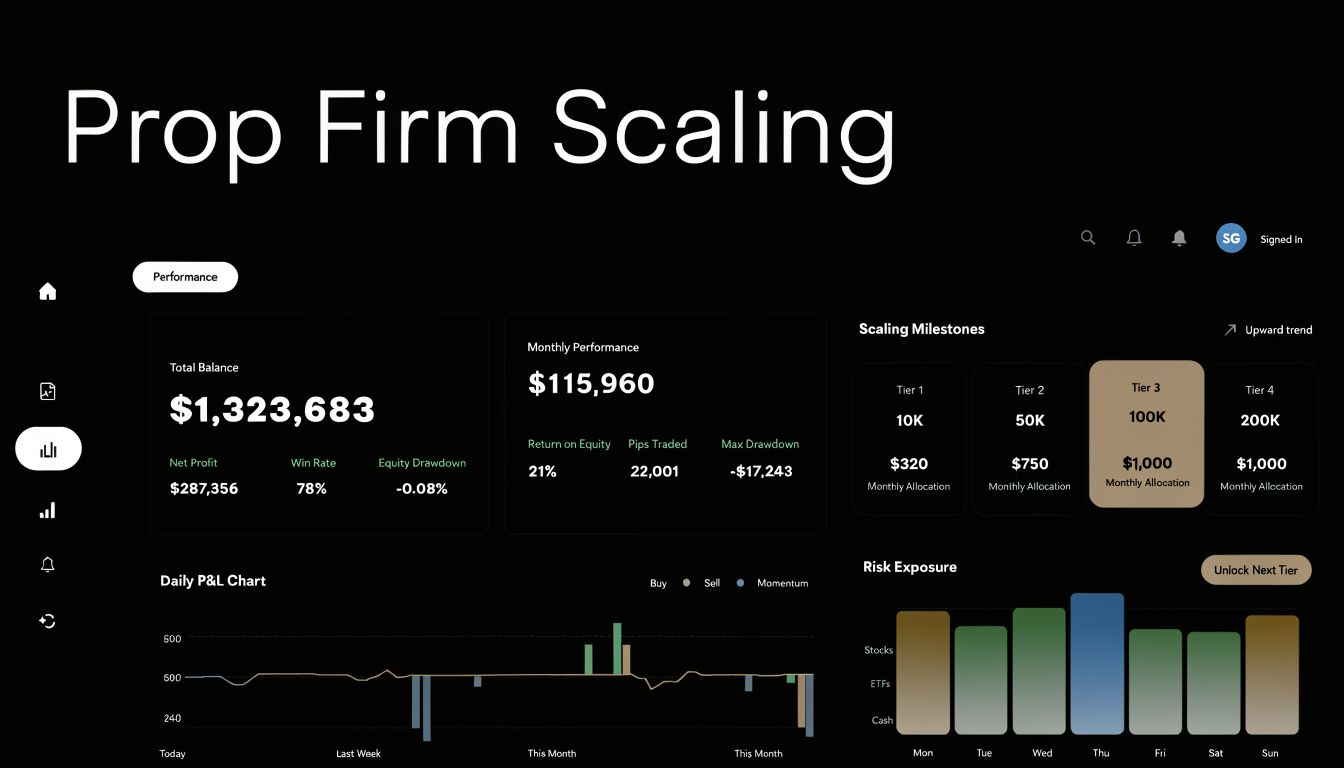
A scaling plan is basically compounding with an external accelerator. Instead of only relying on profits retained inside the same account, the firm increases your capital allocation after sustained performance.
That’s why scaling milestones matter so much. They compress years of self-funded account building into a more structured path, but only if the trader treats the process with restraint.
A practical funded-account workflow looks like this:
- Risk from current usable balance, not from ego: Position size should adjust to live balance conditions and rule headroom.
- Preserve consistency near milestones: Traders often sabotage a scale-up by pressing too hard when they’re close.
- Use payouts strategically: If payouts are frequent, decide in advance what portion supports income and what portion stays allocated to growth.
- Audit breach scenarios: One oversized trade can erase weeks of clean compounding.
For traders evaluating how funded structures work, this guide to funded trading accounts gives useful context on the operating model, account pathways, and why rule clarity matters.
What actually works under firm rules
The funded traders who scale well usually do a few unglamorous things better than everyone else:
- They recalculate size mechanically: No guessing lot size after a winning week.
- They keep drawdown buffers: They don’t use the full rule allowance as if it’s their target.
- They value survival over speed: A slower curve that stays funded beats a fast curve that ends in breach.
- They think in review cycles: Payout to payout, milestone to milestone, not trade to trade.
A prop firm can provide the capital ladder, but it can’t supply discipline. That’s still the trader’s job.
Practical Steps to Build Your Compound Trading Plan
A working compounding plan shouldn’t live in your head. It needs written rules, a sizing method, and a payout policy. Otherwise you’ll improvise under pressure, which usually means you’ll compound inconsistently or stop compounding the moment emotions show up.
Start with your risk unit
Pick one risk model and keep it stable. Most traders do best when they risk a fixed percentage of current balance rather than a fixed dollar amount, because it scales up after wins and scales down after losses automatically.
Write down:
- What balance you use for sizing: Current balance, current equity, or post-payout balance.
- When you recalculate: Every trade, every day, or after each closed session.
- What invalidates a setup: If the stop is too wide and forces oversized exposure, skip the trade.
The key isn’t perfection. It’s repeatability.
Set a target from evidence, not hope
Your monthly goal should come from tested performance. Use your journal, forward results, and platform exports. If your strategy has both hot and flat periods, build the plan around the steadier range, not your best run.
A simple checklist helps:
- Review past trades
- Identify a realistic monthly expectation
- Choose a compounding interval
- Decide what gets reinvested after payouts
- Record the rule in writing
If you don’t already use a structured worksheet, this trading plan template is a practical starting point for turning loose ideas into written rules.
Account for splits, fees, and tax drag
Many traders become sloppy by modeling compounding on gross gains, then discover later that the actual amount available to reinvest is smaller after profit splits, withdrawal costs, spreads, commissions, and tax obligations.
One overlooked point matters a lot: a prop firm’s 80/20 versus 90/10 split can change whether compounding accelerates or stalls, and one source notes that a 90/10 split with weekly payouts can outperform an 80/20 account by 15–25% annually through compounding alone, as discussed in this breakdown of compounding trading returns.
Use that insight correctly. Don’t just chase the highest split headline. Look at the full chain:
- Profit split quality: What portion do you keep?
- Payout timing: Faster access can support more frequent reinvestment.
- Trading costs: Fees reduce the capital base you can compound.
- Tax planning: Money owed later isn’t available capital, even if it’s still sitting in the account today.
Build the plan around behavior
A compounding plan only works if it remains easy to follow when you’re up, flat, or frustrated.
Keep your process simple:
- Use one position size calculator
- Journal every payout and reinvestment decision
- Review whether you followed the plan, not just whether you made money
- Reduce complexity before you increase size
The best compound trading account plans aren’t clever. They’re durable.
Common Pitfalls That Will Derail Your Compounding
Most traders don’t fail at compounding because they can’t do the math. They fail because they stop following their own process as soon as the account starts growing or a drawdown hits.
The emotional shift is subtle. A small account feels easy to manage because mistakes look cheap. A larger account creates pressure, and that pressure exposes every weak habit in your execution.
Manual control becomes a trap
One of the most common mistakes is manual position adjustment. Traders say it gives them flexibility. What it usually gives them is inconsistency.
Research highlighted by HowToTrade points out that traders often manage growth manually because it “feels controllable”, but that approach breaks down as accounts scale because manual adjustments fragment the rules, emotional exits creep in, and execution friction eats into the compound path. That’s a sharp summary of why many profitable traders still fail to scale, as noted in this discussion of compound trading behavior.
The mistakes that show up most often
Some errors are technical. Most are behavioral.
- After a winning streak, traders force growth: They raise size outside the plan because normal compounding feels too slow.
- After a losing streak, traders abandon valid setups: Fear shrinks execution quality before risk controls even need to.
- They treat drawdown recovery like a sprint: That usually leads to revenge trading, not recovery.
- They keep changing sizing rules: No compounding model survives constant rule edits.
The market usually isn’t what breaks a compounding plan. The trader breaks it first.
What disciplined traders do differently
They remove as many decisions as possible from the live moment. They use fixed rules for risk, fixed criteria for valid setups, and fixed review intervals.
That’s also why risk management deserves its own system, not just good intentions. If you need a stronger framework, this risk management in forex trading guide is useful for tightening the parts of your process that usually fail under pressure.
A durable anti-sabotage routine includes:
- Predefined risk per setup
- A maximum number of trades per session
- A rule for stepping down after poor execution
- A written payout and reinvestment policy
- Post-trade reviews focused on rule adherence
Impatience ruins more accounts than bad strategy
A lot of traders want compounding to feel dramatic. In practice, the strongest phases often feel repetitive and uneventful. That’s a good sign.
If your account growth requires adrenaline, it probably also requires too much risk. A real compound trading account grows through boring precision. That’s not exciting, but it scales.
Frequently Asked Questions About Compound Trading
Is a compound trading account better than withdrawing profits regularly
It depends on your objective. If you’re trying to grow capital and can leave profits in the account, compounding gives your strategy a larger base to work from over time. If you need cash flow now, regular withdrawals may be the better choice.
A lot of traders do best with a hybrid model. They reinvest during growth phases, then switch to a more income-focused payout routine once they reach a balance or milestone they care about.
Can beginners use compounding or is it only for advanced traders
Beginners can use compounding, but they should keep it simple. The core requirement isn’t advanced strategy design. It’s consistent risk control.
The mistake beginners make is trying to compound before they have stable execution. If your entries, exits, and risk per trade change every week, compounding won’t fix that. It will just magnify the inconsistency.
How often should I recalculate position size in a compound trading account
Use one schedule and stick to it. Some traders recalculate after every trade. Others do it daily or after a payout cycle. The best option is the one that keeps your process accurate without making you overmanage every fluctuation.
If frequent recalculation makes you emotional, step back and use a calmer schedule. The goal is disciplined sizing, not constant tinkering.
Does compounding work well in prop firm accounts
It can work very well, but only when it respects the firm’s loss limits, payout structure, and scaling rules. In a funded environment, survival matters as much as growth because one breach can reset the whole process.
That’s why traders need to think beyond raw returns. A compounding approach inside a prop account has to fit the rule set cleanly, especially around daily loss control, maximum drawdown, and how profits are split and paid out.
Trading always involves risk of loss. This content is educational only and isn’t financial advice.
If you want to apply these ideas in a funded environment, explore the account options, scaling paths, and payout structures at MyFundedCapital. Compare the programs, choose the format that fits your trading style, and start with rules you can follow.
