

 AR
AR
 NL
NL
 EN
EN
 FR
FR
 DE
DE
 ES
ES
 IT
IT
 PL
PL
 SV
SV


Most advice about trading for profits starts in the wrong place. It tells you to find a better indicator, a cleaner setup, or a faster entry, when the bigger problem is that most traders never build a complete operating system for risk, execution, and review.
The hard truth is that trading is statistically difficult. The good news is that the traders who last usually aren't doing anything magical. They're doing basic things with unusual consistency.
Building Your Foundation Choosing a Verifiable Trading Edge
The fastest way to stay stuck is to obsess over entries.
A lot of prop content still revolves around indicators and signal hunting. That misses the point. Research summarized by Goat Funded Trader notes that most prop trading content emphasizes technical indicators and entry signals, with over 70% of traders using technical analysis, yet traders who achieve consistency separate signal construction from position sizing and validate that through structured backtesting over 60 to 120 days in a prop-style framework built around drawdown limits (analysis of profitable trading strategy gaps).
That distinction matters. A decent setup with correct sizing can survive. A good setup with reckless sizing still fails.

Stop looking for a magic signal
A trading edge isn't one indicator. It's a repeatable behavior that produces acceptable outcomes over a meaningful sample.
That means your edge must answer practical questions:
- What market do you trade: forex, indices, commodities, or crypto.
- What conditions qualify: trend, range, breakout, pullback, news reaction, session timing.
- What invalidates the trade: price level, time-based exit, or structural shift.
- What makes it executable: spread, volatility, your schedule, and your ability to follow the plan.
If you can't define those in plain language, you don't have an edge yet. You have a bias or a preference.
A setup becomes tradable only when another trader could follow your rules and produce roughly the same trades.
Choose the strategy type that fits your actual behavior
Most traders fail because they pick a style that conflicts with their temperament. The strategy isn't always bad. The match is.
Manual trading
Manual trading works for people who can read context and make decisions without improvising every five minutes.
It fits traders who enjoy market structure, session timing, and discretionary judgment. It fails when the trader keeps changing rules after a loss or chases movement that wasn't in the plan.
Manual trading usually suits you if:
- You can sit out patiently: you don't need constant action.
- You can document context: why this setup is valid today, not just in theory.
- You can execute the same way repeatedly: same session, same trigger, same invalidation.
Algorithmic trading
Algo trading works when the logic is clear enough to code and simple enough to test.
The benefit is consistency. The drawback is that many traders automate a weak idea faster instead of improving the idea itself. If you trade with EAs or rule-based systems, your edge lives or dies on clean rules, rigorous testing, and whether the strategy survives changing conditions.
Use algo trading if:
- You trust process over intuition
- You can review logs and performance data
- You won't interfere with the system mid-trade unless rules require it
Copy trading
Copy trading can work, but only if you treat it like manager selection, not passive hope.
The mistake is copying returns without understanding risk behavior. If you don't know how the strategy handles drawdown, concentration, or news exposure, you aren't investing in a process. You're outsourcing decisions blindly.
Use copy trading only when you can verify:
- How trades are sized
- How losses are cut
- Whether the style matches your risk tolerance
- Whether performance came from one hot streak or a repeatable method
Verify the edge before you size it
A lot of traders reverse the order. They choose a challenge, pick an account, then try to force a strategy into the rules.
Do it the other way around. First verify the method. Then adapt sizing to the environment.
A simple review framework helps:
- Write one setup in exact terms
- Test it over 60 to 120 days
- Record market condition, entry, stop, exit, and management
- Tag mistakes separately from valid losses
- Decide whether the edge is present or whether the results came from luck
If you need help narrowing down your approach, this guide to a practical trading strategy framework is a useful reference point.
The goal isn't to find a perfect strategy. It doesn't exist. The goal is to find a strategy you can execute cleanly enough that the data means something.
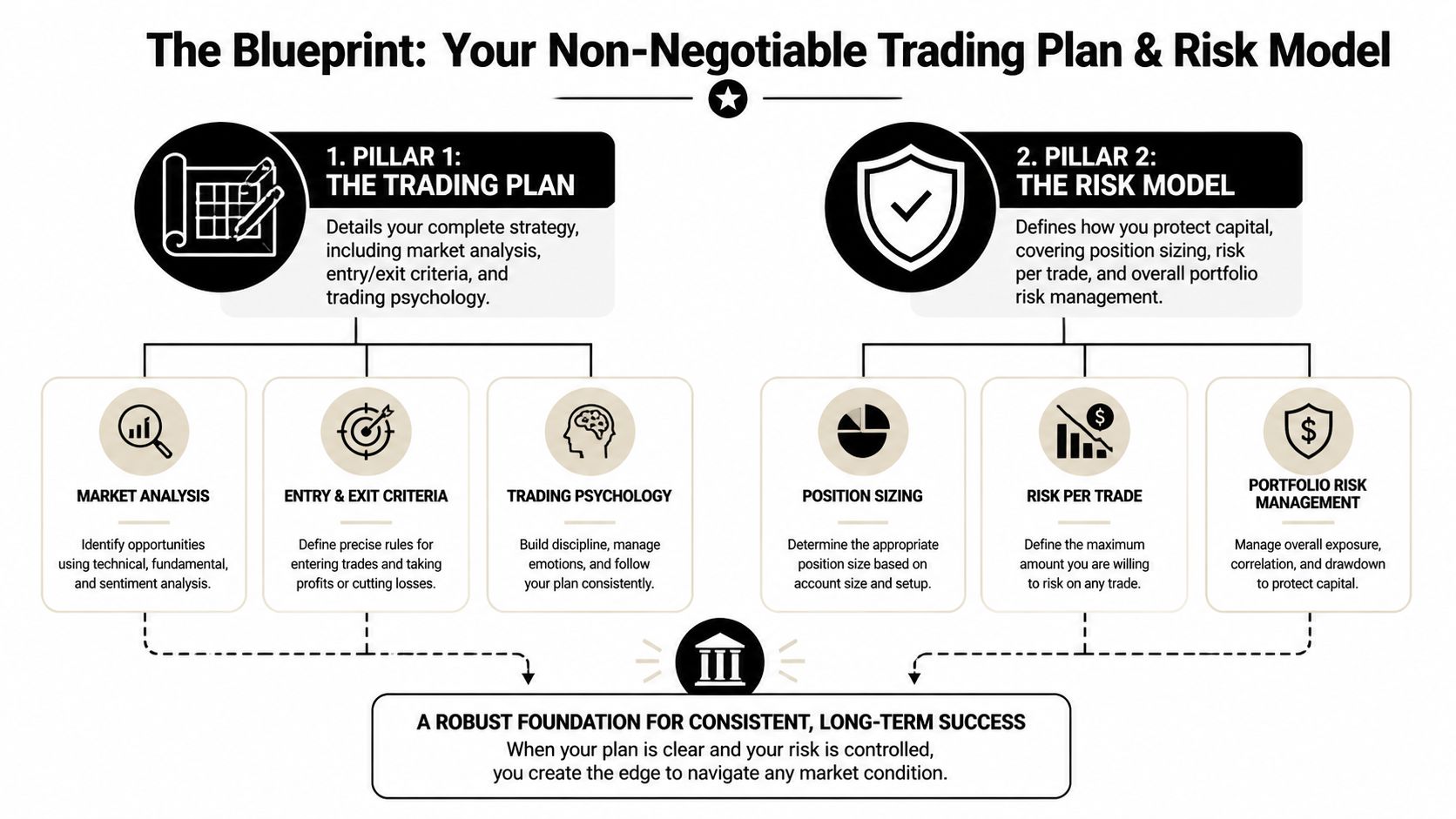
The Blueprint Your Non-Negotiable Trading Plan and Risk Model
A strategy without a risk model is just a nice idea with a short lifespan.
Most traders can explain why they entered a position. Far fewer can explain exactly how much they were allowed to lose, why that size made sense, and how that trade fit inside the day's total risk budget. That's where trading for profits stops being a hobby and starts looking like a business.
Build the plan before the session starts
Your trading plan should be boring to read. That's a good sign.
It needs to define what you trade, when you trade, what a valid setup looks like, where the stop goes, how profits are taken, and when you stop trading for the day. If any of that is vague, you'll end up negotiating with yourself in real time.
A functional plan includes:
- Market focus: the exact instruments you trade and which ones you ignore
- Session rules: London open, New York open, overlap, or specific times you avoid
- Setup criteria: structure, confirmation, and invalidation
- Execution method: market order, limit order, or confirmation candle
- Management rules: fixed target, scale-out, trail, or time stop
- Kill switch: when you're done for the day after mistakes, drawdown, or poor conditions
For a working template, use this trading plan template for funded traders.
Position sizing is where discipline becomes measurable
The cleanest rule in active trading is still one of the most important. Traders who last tend to risk no more than 1 to 2% per trade, and that approach can still be profitable with a 50% win rate if the risk-reward profile is at least 1:2, based on the risk management benchmarks summarized by Navia (risk management and trader performance benchmarks).
That doesn't make 1 to 2% a magic number. It makes it a practical ceiling.
Example using a prop-style account framework
Take a $100K account with a 5% daily loss limit and 10% maximum drawdown. Those parameters mean:
- Daily loss limit: $5,000
- Maximum drawdown: $10,000
Now apply the 1% rule.
- Risk at 1%: $1,000 on one trade
- Risk at 2%: $2,000 on one trade
On paper, both fit inside the account rules. In practice, they create very different pressure.
If you risk $2,000 per trade, a small string of losses can damage your flexibility fast. If you risk $1,000, you give yourself more room to stay objective, make corrections, and survive a rough session without forcing recovery trades.
A practical way to consider:
| Account parameter | Amount |
|---|---|
| Account size | $100,000 |
| Daily loss limit | $5,000 |
| Maximum drawdown | $10,000 |
| 1% risk per trade | $1,000 |
| 2% risk per trade | $2,000 |
The question isn't "What's the maximum I can risk?" It's "What size lets me trade well under pressure?"
Practical rule: Your trade size should protect decision quality, not just account rules.
Convert dollar risk into actual size
This is the mechanical step many traders skip.
Start with the amount you're willing to lose on the trade. Then divide that by the distance from entry to stop. That gives you the size you can take.
The formula is simple:
Position size = dollar risk / stop distance
Example:
- You choose $1,000 as your risk.
- Your stop is 50 units away in the instrument's pricing structure.
- Your size must be small enough that a full stop equals $1,000, not more.
The exact lot or contract calculation depends on the instrument and platform. The principle doesn't change. Wider stop, smaller size. Tighter stop, larger size, but only if the tighter stop is structurally valid and not just chosen to gain greater exposure.
If your stop placement is arbitrary, your sizing calculation is fake precision.
Protect the downside before you think about upside
Most bad weeks don't start with a terrible setup. They start with one lapse in discipline, then another, then a refusal to stop.
A few essential elements help:
- Set the stop before entry: not after price moves against you
- Define the daily stop: once hit, you're done
- Separate valid losses from rule breaks: one is business cost, the other is operator error
- Reduce size in unstable conditions: especially when volatility expands and your normal stop no longer fits
If you want a plain-English refresher on stop placement and why it's central to risk control, this piece on Zaro investment risk management is worth reviewing.
Your risk model should survive a losing streak
Every plan looks good after a clean week. The test is whether it still works when the market chops, your best setup fails twice, and you're tempted to push size.
Write these rules into your plan:
- Maximum trades per day
- Maximum losses before stopping
- When to cut size after drawdown
- When to return to baseline size
- Which mistakes force a reset day
That's what makes the plan unchangeable. Not the PDF. The enforcement.
The Ledger How to Journal and Track KPIs Like a Pro
A lot of traders treat journaling like admin work. That mistake costs money.
In a prop environment, the journal is part of the risk system. It shows whether profits came from repeatable execution or from a few trades that happened to work. If you plan to scale, request larger allocations, or use a next level funding path built for measured account growth, you need records that prove your edge survives rules, pressure, and changing conditions.
What a useful journal records
Every trade should leave evidence.
Record the setup name, the exact reason it qualified, the planned risk, screenshots at entry and exit, and a short note on execution quality. Emotional notes only help if they are specific. "Entered before confirmation because I was chasing the move" can be reviewed and corrected. "Felt good" cannot.
Use a simple table like this:
| Date | Asset | Setup/Strategy | Risk (in $) | P/L (in $) | R-Multiple | Notes/Review |
|---|---|---|---|---|---|---|
That format does two jobs. It creates accountability on every trade, and it makes review fast enough to maintain.
The journal should also separate process from outcome. A rule-followed loss and a rule-broken win do not belong in the same mental category. One is business cost. The other is a hidden problem.
The KPIs that matter
Raw P/L is too noisy to guide decisions. Good review comes from a short list of metrics tied to execution and account survival.
For practical review, four KPIs carry most of the weight.
Profit Factor
Profit Factor measures gross profits against gross losses.
This helps expose systems that look fine on a green week but fall apart over a larger sample. If the number is weak, a decent win rate can hide bad trade management, poor location, or oversized losses.
Expectancy in R
Expectancy tells you what the strategy earns, on average, per unit of risk.
This is one of the cleanest metrics for prop traders because it standardizes performance across account sizes and payout stages. Two traders can make the same dollar amount with very different quality. The one with better expectancy usually has cleaner execution and a model that scales more safely.
Average winner versus average loser
This shows whether exits support the plan.
Many traders say they target strong asymmetric returns, then their journal shows repeated early profit-taking and full-stop losses. That is not a signal problem. It is a management problem.
Drawdown
Drawdown determines whether a strategy is tradable by a real operator under real constraints.
A model can be profitable on paper and still fail in practice if the normal losing stretch is too hard to sit through. In prop trading, drawdown also affects how aggressively you can size, how quickly you can recover, and whether you stay inside firm limits long enough to get paid.
A good journal explains why the equity curve moved, not just where it ended.
What review should uncover
The point of tracking KPIs is not to admire a spreadsheet. It is to find the leaks.
Once trades are tagged correctly, useful patterns show up fast. One setup may produce clean returns only during a specific session. One market may suit your pace while another keeps pulling you into low-quality entries. You may find that your first trade is consistently rule-based and your later trades are impulse-driven.
Those findings matter because they lead to operating changes, not motivational notes.
A monthly review should answer questions like:
- Which setup generated the highest expectancy
- Which time window produced the worst execution
- Which rule break showed up more than once
- Where slippage or hesitation changed the trade outcome
- Whether smaller size improved decision quality
- Whether a setup still deserves capital
A review rhythm that holds up
Keep the process simple enough to repeat.
- After each trade: log the facts while context is fresh
- End of day: mark rule-followed, rule-broken, or unclear
- End of week: review by setup, session, and mistake type
- End of month: update KPIs, cut weak patterns, and keep only changes supported by sample size
This is how traders stop guessing. The journal becomes a business ledger for decision quality, risk use, and edge durability. In prop trading, that record matters as much as the entries themselves.
The Accelerator Scaling Your Profits with MyFundedCapital
A funded account doesn't fix poor process. It magnifies it.
That's why a lot of traders pass a good week in simulation or demo, then struggle once evaluation pressure becomes real. Industry data compiled by QuantVPS shows that only 5 to 10% of traders pass initial prop evaluations, and only 7% of funded accounts receive payouts (prop firm pass rates and payout bottlenecks). The issue usually isn't market knowledge alone. It's process durability under rules.

Match the account path to your documented evidence
Traders often choose an evaluation path based on impatience. That's expensive.
Choose based on your records.
When a challenge account makes sense
A challenge suits traders who already have a written plan, stable execution, and enough journal data to know how their system behaves across different market conditions.
That includes traders who can answer questions like:
- What setup generates most of my returns
- What my normal losing streak feels like
- How I reduce size after mistakes
- Whether my strategy performs better with fixed targets or active management
If you don't know those answers, the challenge becomes tuition.
When instant funding may fit better
Instant funding may appeal to traders with a documented process who want to skip the profit-target behavior that sometimes pushes people into overtrading during an evaluation.
It can also suit traders whose strategy is naturally steady rather than explosive. If your method tends to compound through clean singles instead of big bursts, immediate live-style constraints may align better than target chasing.
When to wait
Waiting is a valid decision.
If your journal still shows inconsistent rule-following, unstable sizing, or frequent emotional overrides, adding firm rules won't solve the underlying problem. It will expose it faster.
Use firm rules as part of the system design
A prop environment works best when your method is calibrated to its limits instead of merely tolerated by them.
The practical considerations are straightforward:
- Daily loss rules: these determine how much room you have for normal variance
- Maximum drawdown: this affects whether your setup cluster can survive a rough patch
- News trading permission: essential if your edge depends on event volatility
- Weekend holding: important for swing traders and crypto traders
- Platform support: execution quality matters if your process relies on specific workflow features
One option in this category is MyFundedCapital’s next-level funding path, which offers Instant Funding as well as 1-Step and 2-Step challenge models, supports manual, algorithmic, and copy trading, and operates with a flat 5% daily loss limit and up to 10% maximum drawdown across supported accounts, based on the firm's published framework.
Treat platform choice as an execution issue
A lot of traders underestimate platform friction.
If you use DXtrade or cTrader, the question isn't which one looks cleaner. The question is which one lets you execute your checklist with less hesitation. Fast order entry, clean stop placement, chart layout, and trade history visibility all affect whether your process holds up under pressure.
The right funded account is the one that fits your actual data, not the identity you want to have as a trader.
How to scale without forcing it
Scaling should follow evidence, not confidence.
Good signs that you're ready to scale inside a prop environment include:
- Your journal shows consistent rule adherence
- Your drawdown behavior is understood, not surprising
- Your primary setup has repeatable performance
- You can handle flat periods without changing the system
Bad signs include increasing size to recover losses, changing style to meet a target faster, and treating add-ons or looser permissions as excuses to become less selective.
In a prop setting, structure is an advantage if you use it properly. It becomes a trap only when you try to outrun your own process.
The Payout Plan Managing Withdrawals and Long-Term Growth
A trader who reaches payout stage but has no withdrawal plan is still trading emotionally. The emotion just moved from entries to money management.
This part matters more than most traders expect. Once payouts become possible, your job changes. You're no longer only trying to execute trades well. You're managing a cash-flow stream with uneven monthly output, rule constraints, and your own tendency to overestimate what one good period means.
Profit split headlines don't tell the full story
A lot of firms market the split first because it's easy to understand. An 80/20, 90/10, or 100% split sounds decisive. It isn't.
The impact depends on how your trading behaves over time. Atlas Funded's industry summary makes the important point that profit splits can look similar on the surface while producing very different outcomes once you account for volatility, payout timing, and your own performance pattern (how profit-sharing structures affect trader outcomes).
A trader with smooth, frequent gains may value one payout structure. A trader with lumpy returns and recovery periods may benefit from another. The headline number doesn't answer that for you.
Build a withdrawal policy before you need one
The best payout plan is pre-committed.
That means deciding in advance:
- What portion you withdraw regularly
- What portion you leave available as business capital
- When you pause withdrawals after a rough patch
- How you handle a strong month without suddenly increasing lifestyle spending
If you don't decide this early, every payout becomes a fresh emotional debate.
A clean approach is to think in buckets:
| Bucket | Purpose |
|---|---|
| Operating bucket | Covers normal trading-related needs and business continuity |
| Reserve bucket | Absorbs variance, recovery periods, and lower-output months |
| Personal income bucket | Pays you without forcing pressure onto the next trading cycle |
No exact split works for everyone. The point is to separate functions so every dollar has a role.
Don't confuse payout access with trading freedom
Faster payouts can be useful. So can flexible withdrawal windows.
But access to profits can also create a bad habit. Some traders start trading their next withdrawal instead of trading their process. That changes decision-making fast. They hold too long to hit a bigger number, or they force mediocre setups because a payout date feels close.
A funded account becomes more stable when you think like an operator protecting cash flow, not a gambler extracting winnings.
Long-term growth comes from stability, not excitement
The traders who build durable income usually do a few things well:
- They keep their personal spending separate from short-term trading results
- They review net retained earnings, not just gross payouts
- They compare payout structures against their actual performance history
- They avoid increasing risk just because prior withdrawals felt easy
The biggest mental shift is this. Your objective isn't to win more dramatic trades. It's to maintain a process that can keep producing over time.
That's what turns trading for profits into a business instead of a streak-based activity.
Frequently Asked Questions About Trading for Profits
How realistic is trading for profits?
More difficult than new traders expect.
A small minority produce consistent net returns over time, and research summarized by Quantified Strategies points to loss as the common outcome for active retail traders, especially after fees and execution costs (research summary on day trading profitability). The practical takeaway is simple. Treat trading like a performance business, not a signal hunt. Edge verification, position sizing, daily loss limits, and KPI review decide whether a trader survives long enough to improve.
How can I verify I have a trading edge?
Use rules, samples, and records.
A real edge is specific enough to write down before the trade and strict enough to grade after the trade. Entry condition. Invalidation level. Target logic. Session filter. Maximum risk per trade. If those pieces keep changing, you are testing ideas, not trading an edge.
The proof comes from a meaningful sample of executed trades under one ruleset. Review expectancy, drawdown, win rate, average win versus average loss, and whether your results hold up inside prop firm constraints. That last part matters. A setup that looks good on a retail chart but fails under firm rules is not a usable business model.
What should I do during a losing streak?
Slow the operation down.
Start with diagnosis, not reaction. Separate market-driven losses from execution errors. If the trades followed plan and market conditions shifted, reduce size and wait for cleaner conditions. If the losses came from revenge trading, missed filters, oversized positions, or breaking daily limits, stop and fix the behavior before putting more capital at risk.
One question helps here. Would I take the next trade at full size if a risk manager were reviewing every click? If the answer is no, size is too big or discipline is slipping.
Should I choose instant funding or a challenge?
The right route depends on what your records show.
Instant funding suits traders who already know their average drawdown, can keep risk tight from day one, and have enough journal data to trade within firm limits without improvising. A challenge can make more sense if you need lower upfront cost or want a structured test of consistency before managing a larger allocation.
With MyFundedCapital, compare the account type against your own numbers, not your excitement. Match the rules to your average holding time, setup frequency, max adverse excursion, and payout habits. Traders usually get into trouble when they choose an account model first and try to force their strategy into it later.
If you're ready to apply this framework inside a prop environment, explore MyFundedCapital and compare its Instant Funding, 1-Step, and 2-Step account options against your own trading plan, risk model, and journal data. Trading involves risk of loss. This content is educational only and not financial advice.
