

 AR
AR
 NL
NL
 EN
EN
 FR
FR
 DE
DE
 ES
ES
 IT
IT
 PL
PL
 SV
SV


Most traders hear “funded account” and think access to capital. The better way to think about it is access to a rule set. If you can’t perform inside that rule set with discipline, you won’t last long enough to matter.
The numbers are a hard reset on expectations. In late 2022, data from one major prop firm showed that only 0.2% of new accounts in one month and 0.07% in another reached their first profit split, which tells you how rare funded success is in practice, not in marketing copy (MyForexFunds challenge outcomes discussed here). That’s the frame for this guide. If you want to become an elite funded trader, you need a process that survives rules, pressure, and repetition.
Becoming a Funded Trader
An elite funded trader isn’t someone who passed a challenge once. It’s someone who can keep risk tight, produce repeatable results, and stay inside the firm’s framework without constant rule friction.
Most traders come in with the wrong target. They focus on passing. Professionals focus on surviving long enough to build a payout record.
Why the label matters
“Elite” gets used loosely in prop trading. In reality, the bar is high because the environment is harsh.
At one major prop firm, thousands of accounts were opened in late 2022, but only a tiny fraction made it all the way to a first profit split. One month came in at 0.2%, another at 0.07%, based on data discussed in the prop trading community (details here). Those numbers line up with what experienced traders already know. Many traders don’t lose because they lack chart knowledge. They lose because they can’t control risk or behavior.
What usually goes wrong
A funded evaluation exposes weaknesses fast:
- Oversizing early: Traders press to hit the target fast, then breach on one bad sequence.
- Changing systems mid-run: Two losses in a row, then suddenly the trader becomes a breakout trader, reversal trader, and news trader in the same week.
- Ignoring rule mechanics: A good strategy can still fail under the wrong drawdown or payout structure.
- Treating the challenge like a lottery ticket: That mindset kills accounts.
The traders who last usually look boring from the outside. Their equity curve is built on restraint, not drama.
If you want the shortest honest definition of an elite funded trader, it’s this: someone who can trade well enough, long enough, under enough constraint, that a prop firm keeps trusting them with more room.
What Defines an Elite Funded Trader
The cleanest way to define an elite funded trader is not by one payout screenshot or one huge day. It’s by process quality. Good traders can have good days. Elite traders can repeat a controlled process under stress.

Elite traders think in distributions, not single trades
A weak trader asks, “Can this setup make money today?”
A strong trader asks:
- What’s my edge over a sample of trades
- What conditions weaken that edge
- How much drawdown can this method produce
- Can I execute it without improvising
That shift matters. A prop firm doesn’t care whether your best trade was brilliant. It cares whether your behavior is stable.
Core principle: Elite status comes from repeatable execution with controlled downside. Not from one home run day.
The metrics that matter
You’ll hear traders talk about win rate because it feels intuitive. Win rate matters less than often considered when viewed alone. A trader can win often and still fail if losses are too large or discipline breaks under pressure.
The metrics worth tracking are the ones that answer practical questions:
Drawdown control
This is the first gate. If your strategy regularly puts you near your loss limits, you don’t have a prop-friendly approach yet.
Track:
- Peak-to-trough drawdown
- Average losing day
- Losses after your first loss of the session
- How often you violate your own stop
A lot of traders don’t have a strategy problem. They have a drawdown expansion problem.
Profit factor and expectancy
These help you judge whether the system has a real edge. You don’t need to talk like a quant to use them. You just need to know whether your average outcome across many trades is strong enough to survive fees, mistakes, and normal variance.
If you can’t explain why your setup makes money over time, you’re guessing.
Risk-adjusted consistency
Here, the elite funded trader separates from the crowd. Smoothness matters. A firm can tolerate a moderate pace of gains. It won’t tolerate erratic behavior that keeps flirting with a breach.
Look for:
- Similar trade sizing across similar setups
- Fewer emotional spikes in P&L
- No dependence on one outsized day
- Stable execution in both good and flat conditions
The business-owner mindset
Retail traders often chase excitement. Professionals build operating rules.
That means:
- Trading one or two proven setups instead of ten mediocre ones
- Defining when not to trade
- Accepting that flat is a valid result
- Reviewing execution quality, not just profit and loss
I’d trust a trader with modest but clean results over a trader with flashy results and messy risk every time. Firms usually do too.
A simple self-test
If you want to know whether you’re moving toward elite funded trader territory, ask yourself these questions:
- Can I describe my edge in one paragraph?
- Do I know the exact conditions that invalidate my setup?
- Do I stop trading when my plan says stop?
- Can I produce similar execution quality next week, not just today?
If the answer is no, the goal isn’t to buy another challenge. The goal is to tighten the process until the answer becomes yes.
Decoding Prop Firm Models and Risk Parameters
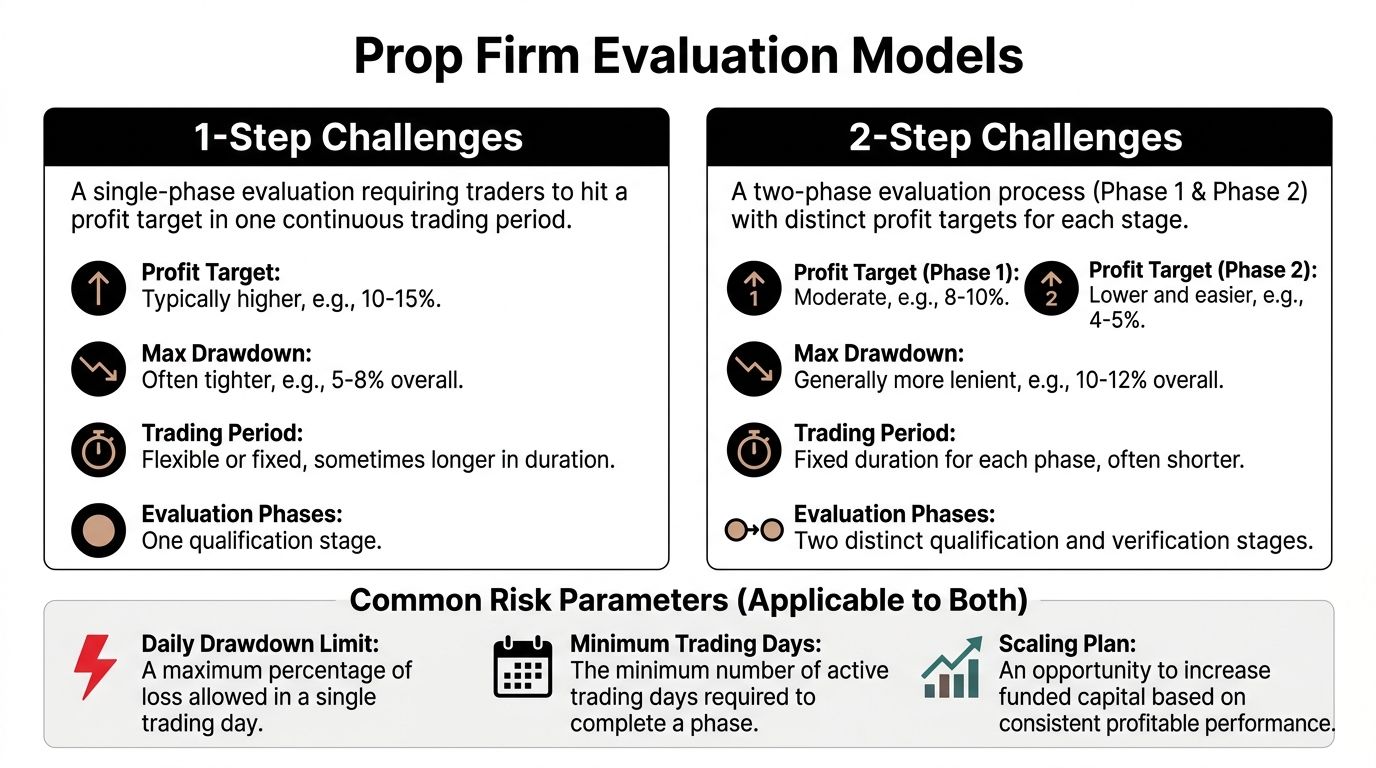
Most challenge failures don’t come from technical analysis mistakes alone. They come from a mismatch between the trader and the model. A good system under the wrong funding structure can still fail.
The three models you’ll run into
1-step challenges
These are direct. One evaluation phase, one push to the target, then funded status if you stay inside the rules.
They usually appeal to traders who already have a stable process and don’t want a long qualification path. The trade-off is obvious. One-step models often put more pressure on precision because there’s less room for a sloppy start.
Good fit for:
- Traders with a clean, well-tested system
- Traders comfortable with pressure
- Traders who don’t need a long runway to prove themselves
Bad fit for:
- Anyone still changing strategies
- Traders who tilt after a few losses
- Traders who rely on occasional outsized wins
2-step challenges
These add a verification layer. That can feel annoying, but it also filters out lucky streaks.
For many traders, a two-step model is more realistic because it forces them to show they can repeat performance under a second set of conditions. If your edge is real, this structure can help by slowing you down.
Good fit for:
- Traders building consistency
- Traders who perform better with a measured pace
- Traders who want a validation checkpoint before funding
Instant funding
This model removes the evaluation phase and shifts the burden to immediate rule compliance. It sounds easier. It often isn’t.
Without the evaluation runway, traders can expose weak habits fast. Instant funding tends to work best for traders who already know their execution profile and don’t need the challenge process to reveal flaws.
Prop firm models compared
| Model | Structure | Pros | Cons | Best For |
|---|---|---|---|---|
| 1-Step | Single evaluation phase | Faster route, simpler path, less administrative drag | Higher pressure from day one, less room for sloppy execution | Experienced traders with a stable edge |
| 2-Step | Qualification plus verification | Encourages consistency, catches lucky streaks, often easier mentally | Takes longer, can frustrate impatient traders | Developing traders with discipline |
| Instant Funding | Immediate access under firm rules | No evaluation delay, direct live-style accountability | Exposes bad habits quickly, little margin for adjustment | Traders who already trade like professionals |
The rules that matter more than the model
A trader can work around a demanding target. Hidden rule complexity is harder to work around.
One well-known example is Elite Trader Funding’s historical use of the 23% Rule and 40% Consistency Rule. Under those rules, each active day had to contribute at least 23% of the best day’s profit, and no single day could account for more than 40% of total profits for payout eligibility (rule summary here). Those rules are designed to reward steady performance, but they also punish traders whose P&L comes in bursts.
That matters because many otherwise capable traders don’t fail on direction. They fail on rule geometry.
If a firm’s rules force you to trade differently from your proven edge, the account may be a bad fit even if the headline offer looks attractive.
What to inspect before you buy
Use this checklist before paying for any challenge:
- Drawdown type: Static drawdown is easier to model. Trailing drawdown requires tighter awareness because the line can move against you as equity changes. If you need a refresher, review what trailing drawdown means in prop trading.
- Daily loss logic: Some firms calculate from balance, some from equity, some reset daily in ways traders misunderstand.
- Minimum day requirements: These can force suboptimal trading.
- Consistency clauses: Rules like active-day thresholds can block payouts even after profitable performance.
- Instrument restrictions: News, overnight holding, and correlated positions can all change how usable the account really is.
If your risk framework is shaky, spend time improving your trading risk management before you spend more money on evaluations. Most challenge losses start there.
What works and what doesn’t
What works:
- Matching the account model to your trading style
- Reading payout rules before challenge rules
- Stress-testing your method against the loss limits
- Favoring transparent rule sets over clever marketing
What doesn’t:
- Choosing based on the cheapest fee
- Assuming “funded” means flexible
- Ignoring consistency math
- Buying multiple accounts before proving one process
The elite funded trader reads the rulebook like it’s part of the chart. Because it is.
The Four Core Skills of a Top-Tier Trader
Passing a challenge is one skill. Keeping a funded account is another. The second one is harder.
Industry discussion around funded trader retention points to a brutal pattern. Many traders fail after they get funded, with analysis and forum commentary suggesting that over 80% can fail within the first 3 months, mainly because of drawdown breaches (discussion here). That tells you something important. Critical work begins after access to capital.

Skill one builds the edge
You need a trading plan that can be tested, repeated, and rejected if the data turns against it.
A plan includes:
- Market selection: One or two markets you understand well
- Setup definition: Exact entry conditions
- Invalidation point: Where the trade idea is wrong
- Session logic: When you trade and when you stand down
Most underperforming traders don’t have a plan. They have preferences.
A strong plan should be simple enough that another trader could follow it from your notes. If it only works when you “feel aligned with the market,” it isn’t ready.
Skill two controls position size
Many good analysts become bad prop traders at this stage.
You can read the market well and still fail if your size is unstable. Prop firms don’t care how accurate your bias was if one oversized trade takes you out.
Do this instead:
- Cut size after unusual volatility
- Trade smaller after a rule-adjacent day
- Keep risk per trade consistent within the same setup family
- Reduce exposure when concentration risk builds across correlated instruments
Small size preserves decision quality. Oversizing creates urgency, and urgency wrecks execution.
The fastest way to look unprofessional is to let position size change with your emotions.
Skill three handles pressure
Psychology gets discussed badly in trading. It’s not about confidence mantras. It’s about behavior under constraint.
Pressure shows up in a few predictable places:
After a strong day
Many traders get reckless after gains. They loosen criteria because they feel invincible.
After two losses
Revenge trading often hides here, masked by the language of “making it back.”
Near a target or payout
That’s when traders stop following process and start negotiating with the market.
The fix isn’t motivational content. It’s operating rules. Hard stops. Session caps. Predefined shut-down points. A written routine helps too, and if you need a practical framework for that, this guide on developing a trading mindset for consistent execution is worth reviewing.
Skill four uses the journal as an audit tool
Most journals are too emotional and not analytical enough.
A useful journal should answer:
- What setup did I trade?
- Did I follow my rules?
- Was the size correct?
- Did market conditions match the plan?
- What mistake repeats most often?
What to record every session
- Screenshots: Before and after if possible
- Execution notes: Why you entered, why you exited
- Rule violations: Even minor ones
- Behavior flags: Hesitation, impulsive entry, missed stop, premature take profit
What to review weekly
Don’t just review winners and losers. Review clusters.
Look for:
- Repeated mistakes by time of day
- Setup drift
- Whether your best trades come from one condition set
- Whether your worst days come from forcing action
A journal should make bad habits impossible to hide.
What separates top-tier traders
Not intelligence. Not screen time. Not social media presence.
The traders who stay funded tend to share a few traits:
- They can tolerate boredom.
- They don’t need constant action.
- They can stop for the day without drama.
- They respect rules they don’t like.
That last one matters. Any trader can follow rules they agree with. Professionals follow rules because that’s the business they chose.
Your Roadmap to Achieving Elite Funded Status
There’s a clean path to becoming an elite funded trader, but it isn’t glamorous. You don’t start with the challenge. You start with proof.
Phase one build a prop-ready process
Before paying for evaluation, run your method in a demo or simulator under the same style of constraints you expect from a prop account.
Treat it seriously:
- Trade the same hours you’ll trade in the challenge
- Use the same instruments
- Respect the same stop logic
- End the day when your planned limit says stop
This phase has one purpose. Find out whether your edge survives rules.
A lot of traders skip this because demo trading feels less exciting. That’s a mistake. Simulation is where you discover whether your strategy and your temperament fit the environment.
Phase two choose the model that fits your behavior
Pick the challenge structure based on how you trade, not how you wish you traded.
If your style is measured and incremental, a multi-step path may suit you better. If your process is already highly standardized, a shorter route may fit. If you’ve never proven consistency, avoid choosing based only on speed.
Use these decision questions:
- Do I tend to start slowly and improve through repetition?
- Does my edge rely on frequent small gains or fewer larger moves?
- Am I vulnerable to trailing drawdown pressure?
- Do payout conditions interfere with how I naturally generate profits?
The best account is the one that lets your strengths show up cleanly.
Phase three execute the challenge like an audit
At this point, most traders sabotage themselves. They stop trading their plan and start trading the target.
Don’t do that.
Approach the challenge with a fixed routine:
Before the session
- Check major market conditions
- Mark your levels
- Define invalidation
- Write down what qualifies as an A-grade setup
During the session
- Take only planned setups
- Keep size aligned with the plan
- Stop after rule-defined limits or behavioral slippage
- Avoid “just one more” trades late in the day
After the session
- Log screenshots
- Note whether you followed the process
- Grade the day on execution, not only P&L
A challenge should feel almost uneventful when you’re doing it right. Calm is usually a good sign.
Phase four shift from passing to preserving
A funded account changes the emotional load. Traders often become either too aggressive or too cautious.
Neither works.
Once funded, your job is to preserve the account while building a payout record. That means:
- Respecting the same trade criteria that got you there
- Lowering emotional attachment to individual days
- Avoiding the urge to “prove” yourself with larger size
- Thinking in monthly process quality, not daily excitement
Many traders give back progress at this stage. They treat funding as graduation when it’s really probation.
Phase five build a payout profile
The practical marker of an elite funded trader is not a pass certificate. It’s a reliable history of compliant performance and withdrawals.
That’s why payout structure matters. By 2026, one major futures prop firm reported paying over $13 million to its traders, with a split that starts at 100% of the first $12,500 in profits, according to a public video cited for the firm’s payout terms (reference here). The upside exists. But only traders who can adhere to rules and perform consistently get access to it.
Focus on building:
- A clean compliance record
- Repeated, rule-friendly profit generation
- The ability to reset mentally after withdrawals
- An execution style that scales without becoming reckless
Phase six scale carefully
Scaling isn’t about multiplying risk. It’s about extending a stable process across more buying power.
Before scaling, ask:
- Does my system still behave well under more size?
- Do I have enough data to know my weak conditions?
- Can I manage larger swings without changing my decision quality?
If the answer is uncertain, wait. Traders often destroy stable performance by scaling before their routines are sufficiently developed.
A working weekly structure
Here’s a simple rhythm that helps:
| Day range | Focus |
|---|---|
| Early week | Trade best setups only. Don’t force volume. |
| Midweek | Review execution quality and market conditions. |
| Late week | Protect gains. Don’t invent trades to improve the week. |
| Weekend | Journal, screenshot review, and plan adjustments only if data supports them. |
The roadmap is simple to say and hard to do. Build the process. Match the model. Execute with restraint. Protect the funded account. Scale only when the evidence says you’re ready.
How MyFundedCapital Supports Aspiring Elite Traders
Many prop firms make traders solve two problems at once. Trade well, and decode a maze of rules. That second problem creates unnecessary friction.
MyFundedCapital takes a cleaner approach. The appeal isn’t just funding access. It’s the clarity of the framework.
Simpler risk limits reduce avoidable mistakes
The biggest operational advantage is straightforward risk structure. A flat 5% daily loss limit and 10% maximum drawdown are easier for traders to model and respect than heavily layered rule systems with unusual consistency math.
That matters in practice.
When rules are simple, traders can focus on:
- Execution quality
- Position sizing
- Market selection
- Daily discipline
They don’t have to spend mental energy reverse-engineering payout eligibility from edge-case conditions.
Different models fit different traders
There isn’t one correct path for every trader. Some need immediate access to a live-style environment. Others perform better with a structured evaluation path.
MyFundedCapital supports that with:
- Instant Funding for traders who want immediate accountability
- 1-Step Challenges for traders who prefer a direct route
- 2-Step Challenges for traders who want a more measured qualification process
That flexibility matters if you trade differently from the average short-term scalper.
It supports how modern traders operate
A lot of firms still behave as if every trader is discretionary and intraday only. That’s out of step with how many profitable traders work now.
MyFundedCapital supports:
- Manual trading
- Algorithmic trading
- EA-based execution
- Copy trading
It also gives access to a broad instrument list across forex, indices, crypto, and commodities on DXtrade and cTrader, with MT5 noted as coming soon in the publisher brief.
For traders who hold over weekends or need more flexibility around market events, optional add-ons can matter more than flashy marketing language.
The scaling path aligns with long-term thinking
The serious appeal for an aspiring elite funded trader is what happens after competence is proven. MyFundedCapital offers scaling paths up to $500K, and profit splits begin at 80/20 with upgrade paths to 90/10 or 100%, according to the publisher brief.
That structure fits traders who think beyond one challenge cycle.
If you want the mechanics in one place, review how MyFundedCapital works and compare the path that matches your style.
Good prop conditions don’t make a weak trader profitable. They do make it easier for a disciplined trader to express an edge without rule confusion getting in the way.
Why this matters
A trader trying to become elite doesn’t need gimmicks. They need:
- Clear limits
- Reliable payout logic
- Platform flexibility
- Room to scale if performance holds
That’s the standard serious traders should use when choosing a firm.
Trading still involves risk of loss. A better rule set doesn’t remove that risk. It just makes the playing field easier to understand.
Your Final Checklist for Success
Becoming an elite funded trader comes down to a short list of behaviors repeated well. Not perfectly. Consistently.
Run through this checklist before you spend money on your next challenge or funded program:
- My strategy is defined clearly: I know my setups, invalidation, and no-trade conditions.
- My risk is stable: Position size doesn’t expand because I’m emotional, impatient, or close to a target.
- I understand the rulebook: I know the drawdown model, payout conditions, trading day requirements, and restrictions.
- My process works in simulation: I’ve already tested my method under prop-style constraints.
- I journal: I record mistakes, screenshots, and repeated behavioral errors.
- I can stop trading: I don’t need to force action after losses or after a good day.
- I’m choosing fit over hype: The account model matches how I trade.
- I respect the long game: I’m aiming to keep and grow the account, not just pass once.
If you can’t check most of those boxes yet, that’s not failure. It’s feedback.
The funded account is not the starting point of a trading career. It’s the result of doing a lot of unglamorous work well. Trading involves risk of loss, and this article is educational only, not financial advice.
Frequently Asked Questions
How long does it take to become an elite funded trader
There’s no universal timeline because traders start from very different levels. Some already have a tested process and mainly need rule adaptation. Others still need to define a real edge and fix position sizing.
The better question is whether you can show repeatable, rule-compliant execution over time. If you can’t do that in simulation, paying for more challenges usually just speeds up failure.
Is passing a prop challenge enough to call yourself an elite funded trader
No.
Passing proves you met a requirement once. Elite status is better judged by what happens after funding. Can you keep the account, follow rules, avoid drawdown breaches, and produce a record of disciplined performance? That’s a much stronger standard.
What kind of trader usually struggles most in prop firms
The trader with skill but no restraint.
That includes people who can read price action well but:
- Increase size impulsively
- Trade too many instruments
- Break stops after losses
- Ignore payout and consistency rules
- Treat every session like it has to be productive
Those traders often look promising early, then disappear fast.
Can algorithmic and copy traders become elite funded traders too
Yes, if the system is well-developed and the trader understands the firm’s restrictions.
Algo traders often do well when their execution is systematic and their strategy fits the rule set. Copy traders can also perform well if they control correlation, slippage, and account-level risk. The key is the same as it is for discretionary traders. The method has to survive the firm’s limits without requiring constant exceptions.
If you want a prop environment built around clear rules instead of hidden friction, explore MyFundedCapital. Compare the Instant, 1-Step, and 2-Step programs, review the risk parameters, and choose the path that fits your trading style. Trading involves risk of loss, and funded programs are best approached as a professional skill test, not a shortcut.
