

 AR
AR
 NL
NL
 EN
EN
 FR
FR
 DE
DE
 ES
ES
 IT
IT
 PL
PL
 SV
SV


Most advice on how can i make money trading starts in the wrong place. It tells you to open a tiny account, chase big returns, and hope skill appears under pressure.
That path blows up more traders than it builds. A practical path is simpler and less exciting: build an edge, protect capital, track performance, then get access to more buying power in a controlled way.
Beyond the Hype A Practical Path to Trading Profits
If you're asking how can i make money trading, the first answer is uncomfortable. Many who try don't last.
Only 13% of day traders remain active after three years, and just 1% achieve consistent profitability over five years. The washout starts fast: 40% quit within the first month, and 97% lose money within a year according to Quantified Strategies' day trading statistics.
That doesn't mean trading is impossible. It means the popular story is false.
The market doesn't pay you for wanting freedom. It pays you for doing a few boring things better than the average participant:
- Having a real edge: not a favorite indicator, but a setup you can define and test.
- Following rules under pressure: because a decent strategy collapses when execution falls apart.
- Using enough capital: because even a skilled trader can't build much income by swinging wildly in a tiny account.
A lot of beginners think profits come from prediction. In practice, they come from process. Traders who last learn to think in terms of repeatable opportunities, risk limits, and market behavior. If you want a useful primer on how professionals think about exploiting inefficiencies in the market, that framework helps more than another list of indicators.
The other myth is that day trading income starts with a tiny account and compounds neatly. Sometimes it does. More often, undercapitalized traders force size, overtrade, and break their own rules. That's one reason the transition to funded trading matters so much. If you want a grounded overview of the odds, this piece on whether day traders can make money is worth reading before you risk more capital.
Trading isn't a shortcut to income. It's a skill business with strict failure penalties.
The traders who eventually earn don't ask, "How fast can I make money?" They ask, "What process can I run for years?"
The Trader's Foundation Skill Strategy and Edge
Skill in trading isn't general intelligence. It's narrower than that. You need one approach that fits your schedule, your temperament, and the market you trade.

Pick one market and one style first
Most struggling traders spread themselves too thin. They watch forex, indices, crypto, gold, and equities, then switch between scalping, intraday trading, and swing trading depending on mood.
That isn't flexibility. It's confusion.
Start by narrowing your field:
- Choose one market family: forex, indices, commodities, or crypto.
- Choose one holding style: intraday or swing. Don't mix both in the same learning phase.
- Choose one execution framework: breakout, pullback, trend continuation, mean reversion, or event-driven trading.
A trader with one clean playbook usually outperforms the trader with six half-built systems.
Define what your edge is
"Edge" gets used loosely. In practice, it means a pattern or behavior that gives you positive expectancy when traded consistently.
A usable strategy needs clear rules:
| Element | What must be defined |
|---|---|
| Market | What instrument you trade |
| Context | Trend, range, session, volatility condition |
| Entry | Exact trigger |
| Stop | Where the trade is wrong |
| Target or exit | How profits are taken |
| Invalidation | What cancels the setup |
| Risk rule | How much you risk per trade |
If you can't write those rules in plain language, you don't have a strategy yet.
High win rate means nothing without payoff control
Many traders fool themselves here. They focus on being right, not on making money.
A 2023 study of 25,000 retail traders found that 65% had a win rate above 50%, yet 82% still lost money overall. The reason was poor payoff structure. Average winners were +1.2% while average losers were -2.8%, based on the analysis at Investing.com.
That single point wipes out most beginner thinking.
You can be right often and still lose if you:
- take profits too early
- widen stops after entry
- hold losers hoping they'll come back
- enter late and accept bad trade location
Practical rule: A setup with ordinary accuracy can work if the loss is controlled and the winner has room to pay for the misses.
Build a strategy like a working model
A strategy should survive contact with data before it touches your account.
Use this sequence:
Write the setup rules
Include market, timeframe, trigger, stop placement, and exit logic.Review historical charts
Mark examples by hand first. This helps you see whether the setup is real or whether you're forcing patterns.Backtest across many occurrences
The goal isn't perfection. The goal is to see how the setup behaves through trends, ranges, and bad periods.Track core metrics
Focus on:- Win rate
- Average winner versus average loser
- Expectancy
- Profit factor
- Maximum drawdown
Forward test in demo or very small size
This catches a common problem: a strategy that looks clean in hindsight but feels hard to execute in real time.Refine only one variable at a time
If you change entry, stop, timeframe, and target together, you won't know what improved or damaged the system.
A lot of traders need fewer strategies, not more. If you're searching for more structured examples, this guide to a best trading strategy is useful as a reference point for comparing approaches.
What usually doesn't work
After seeing enough blown accounts, the same patterns repeat.
- Indicator stacking: adding more tools when the first setup isn't clear.
- Style hopping: trying scalping on Monday and swing trading on Thursday.
- Trading all sessions: taking low-quality setups because the screen is on.
- Learning only from winners: reviewing good trades and ignoring bad execution.
- Mistaking excitement for edge: if a strategy feels thrilling, that's usually not a trading advantage.
The strongest traders often look boring from the outside. Same market, same hours, same setup family, same risk.
That's the point.
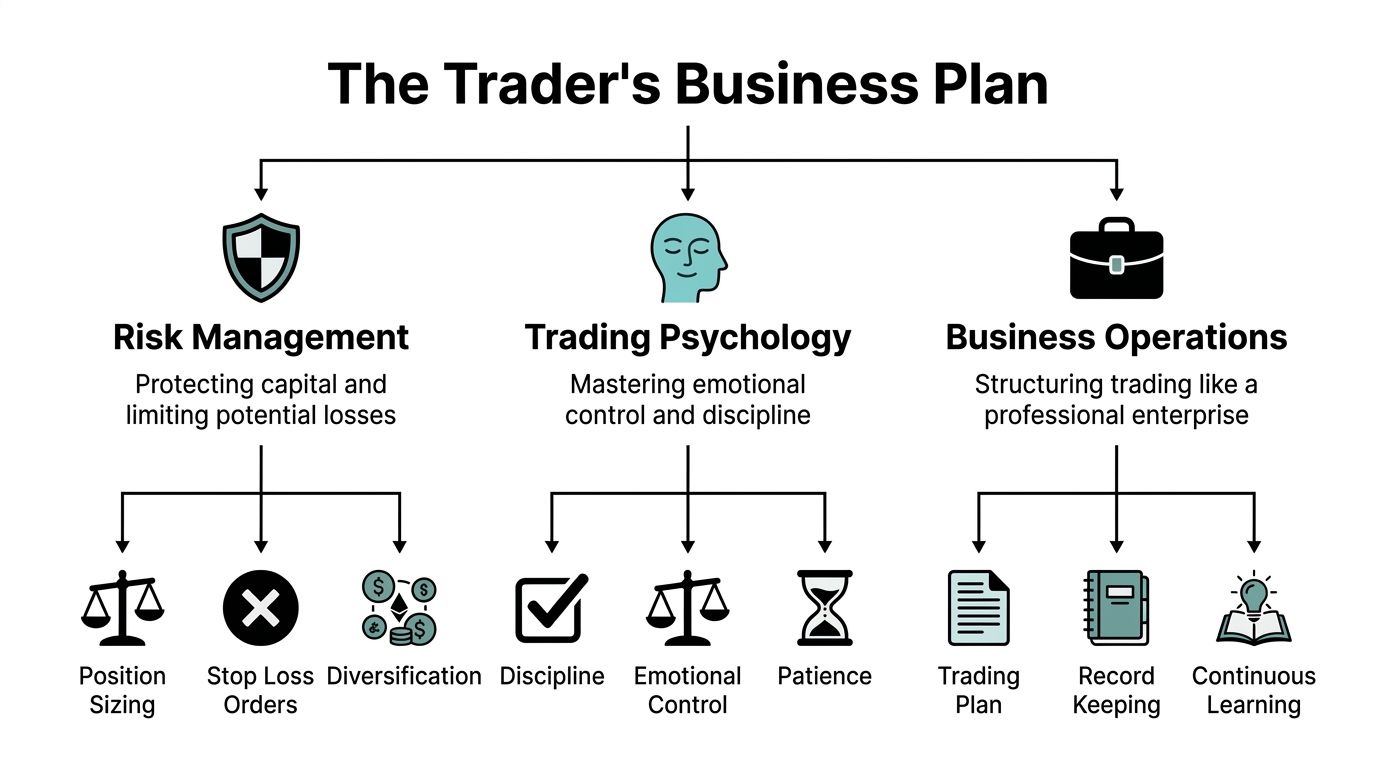
Your Business Plan Risk Management and Psychology
Professionals spend more time preventing damage.
A trading business survives because losses are controlled before profits are chased.
Your first job is staying in the game
Funded-account traders learn this fast because the rules are blunt. Break the drawdown limit and you're done.
According to For Traders, over 90% of traders fail funded challenges because of poor risk management and emotional decisions, not because the strategy itself is bad. The same source notes that risking 0.5% per trade allows a trader to endure up to 10 consecutive losses before hitting a 5% daily drawdown limit, while risking 2% leads to failure in just 3 trades.
That example matters far beyond prop challenges. It shows how position sizing controls your future.
A weak system with strict risk can stay alive long enough to improve. A decent system with reckless size dies quickly.
The Essential Parts of a Trading Plan
Your plan should answer operational questions before the session starts.
Use a document that includes these points:
- Market focus: what you'll trade and what you'll ignore
- Trading hours: specific sessions and no-trade times
- Setup list: the exact patterns you are allowed to take
- Risk per trade: fixed and small
- Daily stop rule: when trading ends for the day
- Execution rules: order types, stop placement, target rules
- News and event filter: whether you trade around major releases
- Review process: how you log and grade each trade
Shorter is better if you'll follow it.
Psychology is visible in behavior, not in quotes
Traders often talk about mindset as if it's abstract. It isn't. You can see poor psychology directly in the order history.
Common forms of self-sabotage look like this:
| Behavior | What it usually means |
|---|---|
| Moving a stop farther away | Refusal to accept being wrong |
| Taking profits too early | Fear of giving back unrealized gains |
| Doubling size after a loss | Revenge trading |
| Entering outside the plan | Boredom or FOMO |
| Trading after the cutoff rule | Ego trying to recover the day |
You don't fix this with motivation. You fix it with friction.
Rules that reduce emotional mistakes
Here are practical controls that work:
- Use a fixed risk amount: decide your per-trade risk before the session. Don't adjust it because a setup "looks amazing."
- Set a daily shutoff: if you hit your loss threshold or break your rules repeatedly, stop trading.
- Limit consecutive mistakes: a simple three-strikes rule works well. Three execution errors in one day means you're done.
- Pre-write your invalidation: know where the trade is wrong before entering.
- Screenshot and tag every trade: this exposes patterns your memory hides.
The market doesn't care that you're down on the day. The next trade still has to meet the same standard as the last one.
Treat capital as inventory
Retail traders often act as if each trade is a chance to change their lives. That mindset creates oversized risk and bad decisions.
Professionals treat capital like business inventory. Its job is to stay available for the next valid opportunity.
That changes how you respond to loss:
- A stopped-out trade isn't a personal failure.
- A missed trade isn't a reason to chase.
- A green day doesn't justify rule-breaking.
- A red streak doesn't permit emotional size increases.
If you want long-term income from trading, think like an operator, not a gambler. The operator asks whether today's actions preserved tomorrow's opportunity set.
That question keeps more accounts alive than any indicator ever will.
Performance Tracking for Consistent Profitability
Most traders review results by looking at the balance curve and asking one question: up or down?
That isn't enough. A green month can hide bad habits, and a red month can contain useful improvement.

Track more than profit and loss
Your journal should tell you whether the process is improving.
The most useful performance markers are:
- Expectancy: what you make or lose on average per trade
- Profit factor: gross profits divided by gross losses
- Maximum drawdown: how deep the account falls from a peak
- Rule adherence: whether the trade followed your plan
- Setup breakdown: which pattern makes money and which one drains you
A lot of traders discover that one setup carries the account while two others create noise and churn.
What a proper journal review looks like
Don't just log entries and exits. Review them weekly with direct questions.
Use a checklist like this:
- Which trades followed the plan exactly
- Which trades broke rules
- What conditions were present in the best trades
- What conditions were present in the worst trades
- Did I cut winners early or hold losers too long
- Was position size consistent
- Did I trade because the setup was there, or because I wanted action
Write short answers. You don't need essays. You need patterns.
A journal becomes useful when it shows why money was made or lost, not just when it records that it happened.
Grade execution separately from outcome
This is one of the biggest upgrades a trader can make.
A losing trade can be an A-grade execution. A winning trade can be sloppy and dangerous.
Try a simple grading model:
| Grade | Meaning |
|---|---|
| A | Followed the plan cleanly |
| B | Minor execution issue, still acceptable |
| C | Forced or late trade |
| D | Clear rule break |
| F | Emotional trade with no business being taken |
This keeps you from learning the wrong lesson from random short-term outcomes.
Review in cycles, not after every emotional swing
Daily review helps, but broader patterns matter more. One week might show that a setup works only in clean directional conditions. A monthly review might show that your first trade of the day is solid and the later ones are noise.
You should come out of each review with one action, not ten.
Examples:
- remove one low-quality setup
- stop trading after a rule break
- reduce session length
- tighten entry criteria
- stop trading one instrument that consistently causes problems
That is how consistency is built. Not from inspiration, but from repeated correction.
Scaling Your Trading Income From Self-Funded to Prop Firm
Many articles give weak advice here. They tell undercapitalized traders to start with a very small account and compound forever.
That sounds responsible. In practice, it often creates the exact behavior that ruins traders.
A small personal account pushes people toward bad decisions:
- forcing oversized returns
- taking low-quality trades
- taking on excessive risk because normal gains feel too slow
- treating every setup like a rescue mission
A more realistic path is to separate skill-building from capital access.
Why the capital problem matters
A major gap in trading education is the transition from self-funded retail trading to funded accounts. As noted in Share Talk's guide to trading with little investment, retail brokers report that 70% to 90% of clients lose money, while far fewer resources explain how a trader can pass a challenge on a demo with real market quotes and gain access to accounts up to $500K instead of repeatedly blowing up small personal balances.
That's the practical shift many traders need.
The question stops being, "How can I turn a tiny account into income fast?" It becomes, "Can I prove disciplined execution under rules and access more capital without putting my own savings at constant risk?"
Self-funding and prop funding are different business models
Here is the cleanest way to compare them.
| Factor | Self-Funding ($5,000 Account) | Prop Firm Funding ($100,000 Account) |
|---|---|---|
| Capital at risk | Your own money absorbs losses directly | You pay for evaluation or funding access, not the full trading capital |
| Psychological pressure | High if the account is money you can't easily replace | Still demanding, but the structure separates personal savings from position exposure |
| Room to scale | Slow unless you add more personal capital | Faster if you can trade rules consistently |
| Typical mistake | Overtrading to make the account "worth it" | Breaking drawdown rules through impatience |
| Main requirement | Capital plus skill | Skill plus rule discipline |
| Best fit | Traders who want full independence and can fund themselves comfortably | Traders with an edge but limited personal capital |
Neither route is magic. Both punish poor execution.
What prop firm trading is really for
Prop funding makes sense for one type of trader in particular: the trader who can execute but is stuck undercapitalized.
That includes people who:
- trade well in demo or small size but can't scale safely with personal funds
- already have a defined system and journal
- understand daily loss limits and can follow them
- want structure rather than unlimited discretion
Many traders skip this route because they misunderstand the goal. The goal isn't to gamble through a challenge. The goal is to trade your normal system under stricter operating rules.
What to check before using a prop firm
Not all firms fit all styles. Before signing up, review these points carefully:
- Platform support: make sure it supports your workflow, whether that's manual trading, algo trading, or copy trading
- Risk rules: understand daily loss limits, maximum drawdown, consistency rules, and restricted behavior
- Instrument list: confirm your market is available
- Payout structure: know how and when payouts are processed
- Trading restrictions: check rules around news, weekend holding, and strategy type
- Scaling model: see whether larger capital access is available after strong performance
One option in this space is MyFundedCapital funded trading accounts, which provide simulated capital access through instant funding and challenge-based models across DXtrade and cTrader. That's relevant if you trade forex, indices, crypto, or commodities and need a route from personal-size trading to larger rule-based capital.
The trade-off many miss
Self-funded trading gives you freedom. Prop trading gives you structure and capital access. Some traders need freedom. Others need rules imposed from outside because those rules stop them from doing dumb things.
If you've spent months trying to force income out of a small account, the better move may not be "trade harder." It may be:
- simplify your system
- tighten your risk
- prove consistency
- use external capital once the process is stable
That is a business decision, not a motivational one.
Advanced Scaling and Automation Options
Once you have a working edge, the next question changes. It isn't how to find more setups. It's how to apply the same edge with less friction and more consistency.
Automation can help if the logic is already solid
A lot of traders try to automate too early. They code a weak idea, then blame the software.
Automation works best when:
- your setup rules are objective
- your entry and exit logic are precise
- your market and session filters are clear
- you've already seen the strategy behave acceptably in manual review
For traders using EAs or algorithmic models, the biggest advantage isn't just speed. It's consistency. Code doesn't get bored, chase losses, or widen stops because of hope.
The danger is obvious too. Bad logic runs faster when it's automated.
Scaling isn't only about being right on direction
One overlooked shift in mature trading is moving from pure directional prediction to structures that can earn even if entry timing isn't perfect.
According to the discussion referenced in this YouTube video on profiting even when initially wrong, professional desk data indicates that up to 80% of profits for top traders come from income setups, such as options theta decay, rather than pure directional bets. The broader lesson applies even if you don't trade options directly: build trade structures and management rules that don't require perfect prediction.
That mindset improves scaling because it reduces dependence on calling every move exactly right.
The more your process depends on perfect entries, the harder it is to scale calmly.
Copy trading and multi-account execution
Copy trading can fit two types of traders:
- traders who already execute a stable process and want to mirror it across accounts
- traders who want operational efficiency without manually repeating every order
This only works when the base strategy is already controlled. Copying inconsistency just multiplies inconsistency.
What mature scaling looks like
A more developed trading business usually has these traits:
| Area | What changes as you mature |
|---|---|
| Strategy | Fewer setups, clearer filters |
| Execution | More standardized, less impulsive |
| Technology | More use of alerts, partial automation, or full automation |
| Capital use | More attention to drawdown and capacity |
| Review | More data-driven, less emotional |
That's how trading income becomes more durable. Not by adding chaos, but by reducing it.
Frequently Asked Questions and Your Next Step
Can I make money trading with a small account?
You can, but small accounts create pressure to force results. That's why many traders take on excessive risk, overtrade, and break rules. A small account is fine for learning execution. It is usually a poor vehicle for trying to create meaningful income quickly.
Do I need a high win rate to be profitable?
No. A lot of losing traders win often and still lose because their losses are larger than their gains. The quality of your risk-reward structure and your discipline matters more than bragging about accuracy.
Is it realistic to make a living from trading?
It's possible, but it isn't common and it doesn't happen fast for many. Traders who last treat it like a profession, not a side game. They build skill, manage risk tightly, and track performance with honesty.
Is prop firm trading better than self-funded trading?
Not automatically. It's better for traders who have process but lack capital. It's worse for traders who still break rules constantly, because the structure will expose that quickly.
Trading always involves risk of loss. No setup, platform, or funding model removes that. This article is for educational purposes only and isn't financial advice.
If you're ready to move from small-account guesswork to a more structured path, explore MyFundedCapital. Compare the account types, review the risk parameters, and choose a challenge or funding model that fits the way you trade.
